


Physical AI System Design for Weld and Assembly Quality in a Vehicle Plant in Pakistan
Discrete Manufacturing & Automotive Watch: One Living Picture of the Operation
For the leaders accountable for discrete manufacturing & automotive operations, their supervisors, and the data and platform engineers who would build and run it.
Vertical-Driven Architectures is a CodeNinja series of system designs. Every design in the series is driven by a real-world problem and scenario in a single industry, and every one is designed on Praxis, CodeNinja's platform for designing physical AI systems. Operations are described by class, never by name.
Physical AI System Design for Weld and Assembly Quality in a Vehicle Plant in Pakistan
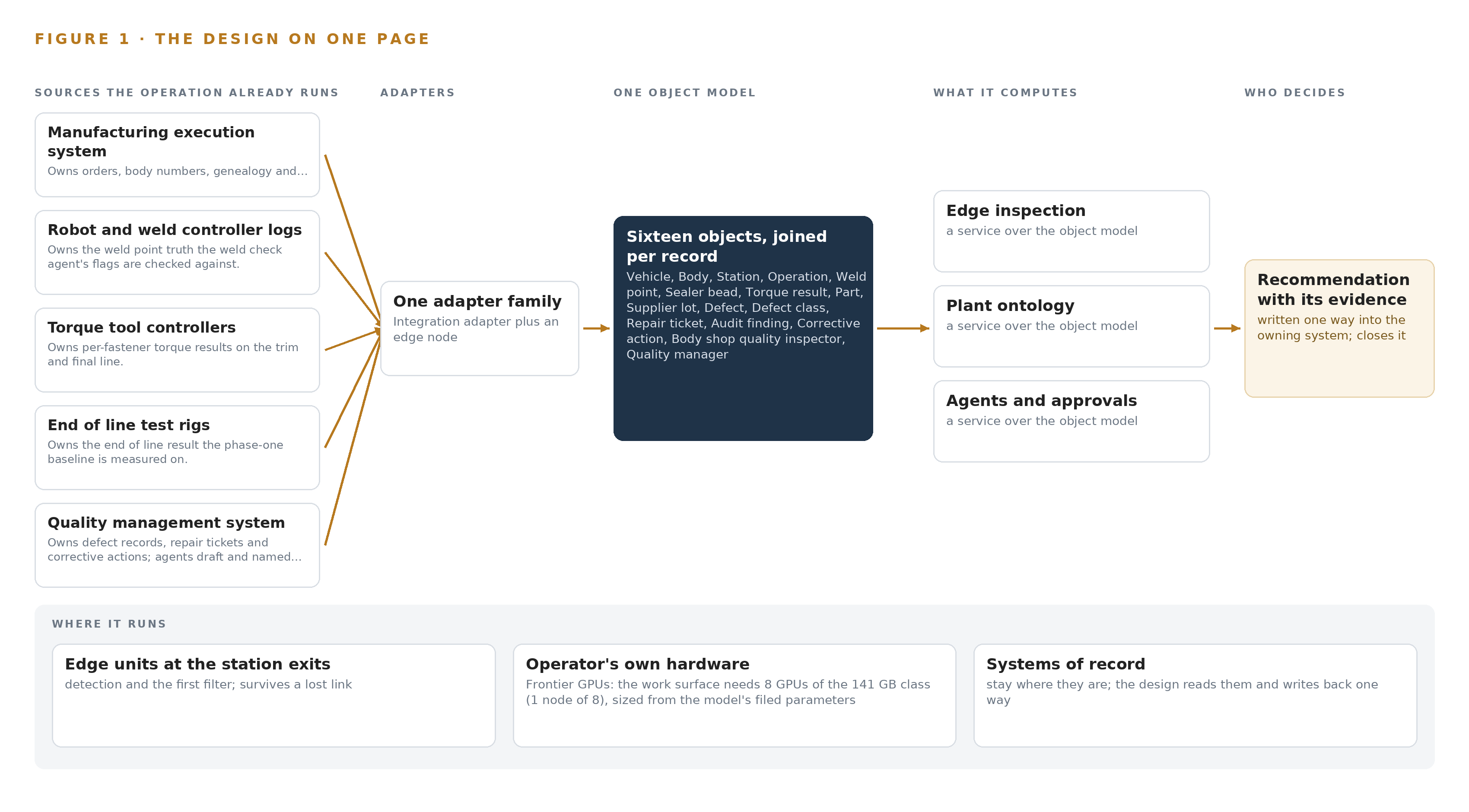
What this is. An open reference architecture for physical AI system design, built for a vehicle assembly company in Pakistan that is starting production of new energy vehicles at a new plant sized for about 25,000 vehicles a year on one shift, where owning the inference node that runs the work surface costs about 572,000 US dollars over three years. When a batch of locally made door hinges arrives slightly out of tolerance, the design catches it first as sealer gaps at the body shop station exit and then as door fit faults on the trim line, joins the weld point flags, body numbers, operations, supplier lots and confirmed defects into one argument, and traces the pattern to the supplier lot before the next delivery. Every frame, model and inference stays inside the plant network on hardware the operator owns, under the parent company's global quality standards, the national data protection rules for cameras on workers and the national automotive policy's localisation conditions. It is written for the leaders accountable for discrete manufacturing and automotive operations, their supervisors, and the data and platform engineers who would build and run it. The operator is described by class, never by name.
The answer in numbers.
| Part | The design |
|---|---|
| Sources | Six read only systems of record, entering through one integration adapter family (Debezium change data capture from the MES and QMS databases, collectors for controller and rig logs, one way transfer out of a network zone) that owns a contract per source, resolves identity once with lineage and stamps every event from the PTP grandmaster: the manufacturing execution system, the robot and weld controller logs, the torque tool controllers, the end of line test rigs, the quality management system and the supplier parts receiving records; the single write path back is the approved record into the quality management system |
| Object model | 16 typed objects with 13 typed links, from the vehicle, body, station and operation through the weld point, sealer bead, torque result, part and supplier lot to the defect, defect class, repair ticket, audit finding and corrective action, with the body shop quality inspector and the quality manager; identity from the body number and MES genealogy rather than tracking, published as JSON for reuse |
| Models | GLM 5.3 (GLM-5.3 bespoke licence, 753B at FP8) as the agentic work surface and the ontology's maintainer, drafting weld checks, supplier lot traces and cited conversational answers; D-FINE (Apache-2.0) at INT8 on the edge NPU for weld spot, part, clip, connector and fastener presence; Anomalib 2.7.0 (Apache-2.0) for sealer bead anomalies fitted on the plant's own good beads; BGE-M3 (MIT) at FP16 for retrieval and citations; no third party model service, nothing trained into weights |
| Compute | Three tiers in the plant: fanless industrial edge units on an octa core 6 TOPS NPU SoC rated minus 40 to 85 C beside 5 MP global shutter GigE Vision cameras at five station exits; one air cooled 48 GB PCIe inference server in the plant server room; one node of eight 141 GB HBM GPUs (1,128 GB) holding 753 GB of FP8 weights with the 1.2 planning factor, 904 GB. Pakistan sits in Country Groups D:2, D:3 and D:4, so the US export licence determination for the accelerator classes is a phase one checkpoint before anything is quoted |
| Rollout | One phase carrying 15 items across six workstreams and covering the 18 requirements, closed by a gate, never a date: trim and underbody presence checking running on every body and vehicle that passes; every check in shadow mode beside the manual inspection it supports; baseline frozen from the end of line test rigs; false flag budget under 10 per inspector per shift; paint shop and end of line cameras held for the phase after, gated on phase one evidence |
| Three-year cost | About 572,000 US dollars to own the node for three years (a range of 542,000 to 610,000: server, support and power at the national industrial tariff), against about 751,000 to rent the same eight cards on the deepest three year commitment in AWS Asia Pacific (Mumbai), so ownership costs about three quarters of it, and about 2.00 million on demand, against which ownership costs a little over a quarter. Renting is a price reference only, because AWS lists no region in Pakistan and every rented option would carry images, process data and the parent's standards out of the plant (Appendix A) |
| Human control | Agents check and draft, people decide, by name: the body shop quality inspector confirms or dismisses every flagged weld point or missing clip at the station terminal, the quality manager approves every repair ticket draft and opens every corrective action; no agent stops a line or rejects a supplier lot, and every confirmation and dismissal is kept as memory the next check reads |
Reuse it. The object model, the model register and the figures are free to reuse under CC BY 4.0. Cite as https://codeatoms.ai/weld-assembly-quality-vehicle-plant-pakistan/.
Made with. Reasoned on [CodeNinja Praxis](https://codeatoms.ai/praxis/), the CodeNinja Atoms platform for designing physical AI systems. The object model imports into [Hyper Ontology](https://codeatoms.ai/hyper-ontology/), which turns it into a living system. Load it with the [hyper-ontology loader](../hyper-ontology-py/): `hyper-ontology show weld-assembly-quality-vehicle-plant-pakistan`. Both are in beta; access by request.
The Answer Already Exists in the Systems the Operation Runs
A physical AI system design for weld and assembly quality in a vehicle plant in Pakistan starts from the auditor's question: when the parent's auditors ask why a body shop defect rate rose on a given day, the plant rebuilds the answer by hand across the robot logs, the torque records and the inspection sheets.
The design reads 6 source systems through 1 adapter family into one object model of 16 objects, runs 6 services over it and opens 5 surfaces to the people who decide, with 4 models placed where the data is. This design puts triggered cameras and edge units on the CodeNinja on device AI stack at the body shop, trim and underbody station exits, checks every body against the weld point list and the sealer bead with Apache-2.0 detectors the operator owns, and lands every result in a governed plant ontology built from the MES, controller logs, torque tools, end of line rigs, QMS and receiving records. Agents draft, people decide, memory improves the next check without training, and the whole thing, including GLM 5.3 on one 141 GB-class node in the plant's own server room, stays inside the plant network in Pakistan.
The paper covers the operation and the problem its systems cannot answer, the constraints, the stack, the object model, ingestion, inference placement, the models and their licenses, the rollout and its proof, ownership, and finally how Praxis contextualized and reasoned the design.
Contents
Each chapter is tagged for the reader it serves most directly: Executive, Team Lead, FDE, Reference.
| Abstract · The Answer Already Exists in the Systems the Operation Runs | Executive | |
| PART I · THE PROBLEM | ||
| 1 | A Daily Question Goes Unanswered in the Systems That Hold the Data | Executive |
| 2 | Every System Sees One Slice of the Operation | ExecutiveTeam Lead |
| PART II · THE DESIGN | ||
| 3 | Four Constraints Shape Everything Downstream | Team Lead |
| 4 | One Stack Runs From the Systems of Record to the Surfaces | Team LeadFDE |
| 5 | Sixteen Objects Turn Operational Data Into One Argument | FDE |
| 6 | Every Source Enters Through an Adapter, Never Directly | FDE |
| 7 | Inference Belongs Where the Data Is | FDE |
| 8 | The License Decides What the Operator Can Own | FDEExecutive |
| PART III · THE ROLLOUT | ||
| 9 | Shadow Mode Comes Before Any Flag Is Trusted | Team LeadExecutive |
| 10 | The Intelligence Should Stay with the Operation That Produced It | Executive |
| PART IV · HOW IT WAS DESIGNED | ||
| Conclusion · The Pattern Repeats Wherever Systems of Record Do Not Meet | Executive | |
| 11 | How Praxis Contextualized and Reasoned This Design | Team LeadFDE |
| Sources | Reference | |
A Daily Question Goes Unanswered in the Systems That Hold the Data
The operation holds every fact the question needs and no system answers it.
The abstract promised a physical AI system design that checks every body as it passes the station exits and keeps every byte of the reasoning inside the plant. This chapter starts where the operator's requirement starts, with physical AI at the station named as the ask: the question the plant needs answered every day, the data that question requires, the regimes that govern it, and the operation as it actually runs.
1.1 The Question and the Data It Requires
The question is stated in the operator's own framing: why did the body shop defect rate rise on a given day, and which supplier lot sits behind a defect pattern, answered while the shift is still running rather than weeks later in warranty. Answering it needs six kinds of fact at once: the weld point list and weld currents from the robot and weld controllers, the sealer bead outcome, the per-fastener torque readings, the presence of clips, connectors and fasteners on the trim line, the genealogy that ties a body number to a vehicle and a kit lot, and the lot identity that ties a defect cluster to a supplier. The answer must satisfy three regimes together: the parent company's global quality standards, which the plant passes through equipment validation, production trials and quality audits before commercial production; national data protection rules that govern cameras in a workplace; and a localisation policy that obliges the plant to track each part's localisation status and local value addition, the end to end supplier traceability the International Automotive Federation frames as a requirement for its members' supply bases (IAF n.d.).
1.2 Defects Found Late Cost More Than Defects Caught at the Station
When a defect escapes the station, the cost jumps from a repair bay to a campaign. A US regulator's recall chronology for incomplete software remedies shows a concern group reconstructing an event history months after vehicles left the plant, the same hand-assembly of evidence across records that this plant performs by hand today whenever auditors ask a question (NHTSA 2024). Supplier-side blindness compounds the escape: a nonprofit study reports that many supplier factories of automobile brands misrepresent facts about work accidents, calling it a lost opportunity for improvement, and a plant that cannot trace a defect cluster to a lot cannot correct what it cannot see (Safeinindia 2024). The join itself is becoming a regulatory subject, because meeting the first Digital Product Passport deadlines depends not only on connecting data across systems but on proving how products were actually made (Qualitymag 2026).
1.3 The Operation as a Scenario
The operator is a vehicle assembly company in Pakistan starting production of new energy vehicles at a new plant, sized for about 25,000 vehicles a year on one shift, assembling kits shipped from the parent company with a rising share of locally made parts. Bodies pass through a body shop with robot and manual spot welding and sealer application, then paint, then a trim and final line where harnesses, interiors, battery packs and underbody parts are fitted and torqued, then end of line test and a final inspection booth: four physical zones in all, of which the body shop, with weld fume, spatter and summer heat, is the hardest environment for electronics. Six named systems of record hold the facts: the manufacturing execution system, the robot and weld controller logs, the torque tool controllers, the end of line test rigs, the quality management system and the supplier parts receiving records. Two named decision roles sit in the loop, the body shop quality inspector who confirms or dismisses flags at the station terminal and the quality manager who approves corrective actions, alongside plant engineers, the parent's auditors and a supplier base whose parts arrive through receiving records. The team is new to the parent's standards, and the experienced engineers who set up the line leave at handover, so the system must carry their knowledge rather than depend on their presence.
Every System Sees One Slice of the Operation
Each system of record sees its own part of the answer and none sees the whole.
Chapter 1 stated the question, the regimes and the operation. This chapter shows why none of the six systems of record can answer that question alone, by walking through what each one sees.
2.1 Each System Sees One Slice
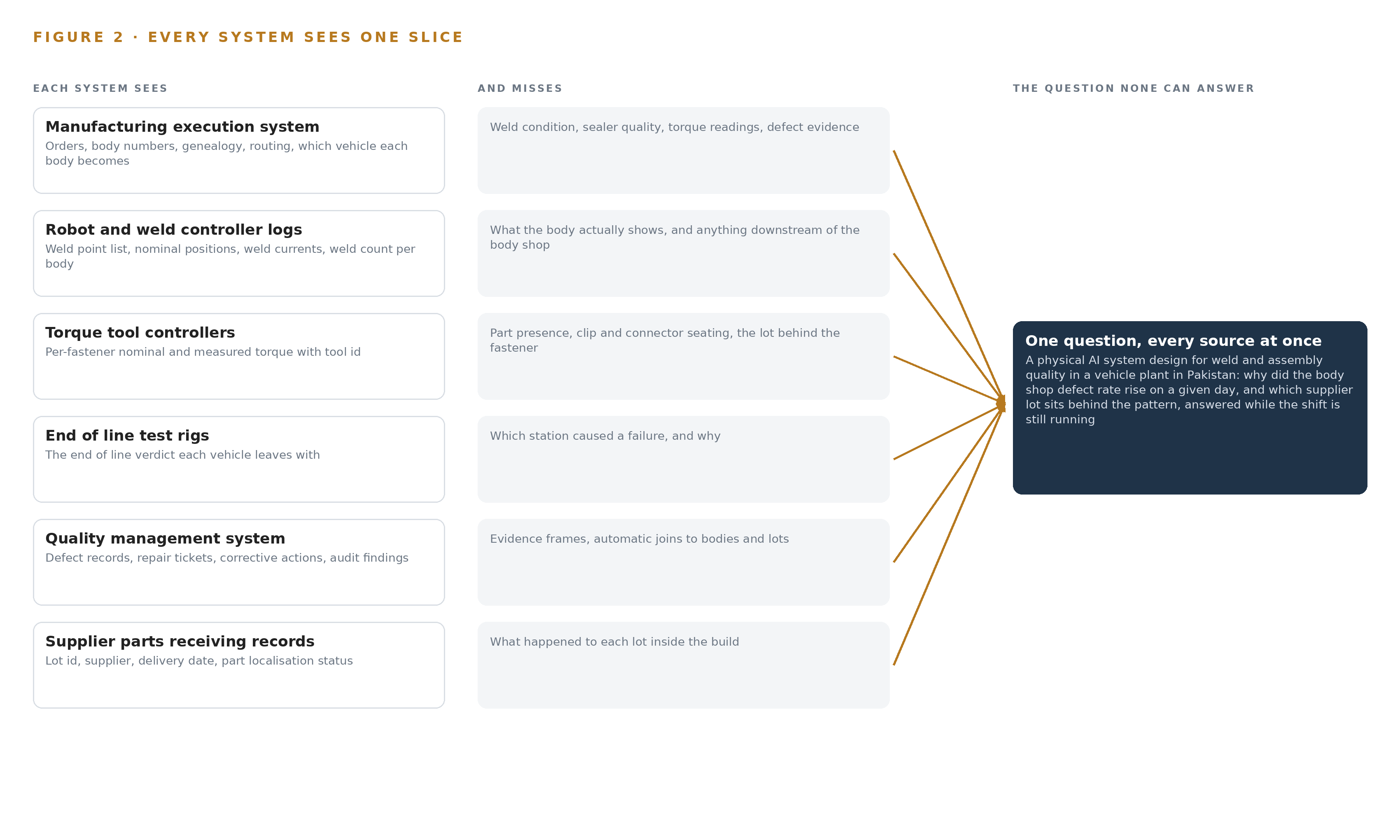
The manufacturing execution system owns orders, body numbers, genealogy and routing, so it knows which body is where and which vehicle it becomes, but it records nothing about the metal: no weld condition, no bead, no torque. The robot and weld controller logs own the weld point truth, the nominal positions and the weld currents, yet a controller reports what it commanded, not what the body shows, and nothing downstream of the body shop. The torque tool controllers own per-fastener torque readings with tool identity on the trim and final line, but not whether the clip or connector around that fastener is seated. The end of line test rigs own the verdict each vehicle leaves with, but not which station caused a failure. The quality management system owns defect records, repair tickets, corrective actions and audit findings, but they are written by hand, without evidence frames and without joins to lots. The supplier parts receiving records own lot identity, supplier and delivery date, but nothing about what happened to each lot inside the build. Figure 2 sets the six systems side by side, each with its sees and its misses, converging on the question none of them can answer alone.
2.2 What None of Them See Together
The auditor's question, why the body shop defect rate rose on a given day, requires joining weld point flags to body numbers to operations to supplier lots to confirmed defects in one argument, and today that argument is rebuilt by hand across the robot logs, the torque records and the inspection sheets. The same join failure delays the supplier trace: a defect pattern that points at one local lot surfaces weeks later in warranty, because no system holds the path from a missing clip back to a delivery date. The US national standards body's recommendations on manufacturing data note that trustworthiness depends on traceable provenance across the data lifecycle, which is exactly the property that hand-built joins lack, since each rebuild depends on whoever happens to be on shift (NIST n.d.). The cost in practice is paid three times over: in repair bay minutes for defects found at end of line, in warranty exposure for defects found by the vehicle's owner, and in engineering hours spent reconstructing answers the data already holds.
Four Constraints Shape Everything Downstream
The goals, the scoping decisions and the exclusions were fixed before any component was chosen.
Chapter 2 showed the join failure that no single system of record can repair. This chapter fixes the four goals that shape every component choice downstream, then the scoping decisions the design bought and the alternatives it set aside.
3.1 Every Body Is Checked, Not Sampled
The first goal replaces sample inspection with a check on every body, triggered once at each station exit, so a missing weld or an unseated clip is caught at the station rather than at end of line or in the field. It is hard in this industry because the body shop is hostile to electronics: weld fume, spatter and summer heat exceed the ambient ratings of the packaged smart camera class, and nuisance signatures such as dust, oil and lighting change produce false flags that make inspectors switch a system off. The design answers by hardening industrial-grade fanless edge units against the environment and by collecting and labelling nuisance images before any threshold is set, holding false flags under 10 per inspector per shift.
3.2 Nothing Leaves the Plant Network
The second goal keeps every frame, every model and every inference inside the plant network in Pakistan, on the operator's own hardware, with no third-party model service in the path. It is hard because the conversational work surface the requirement names runs on a frontier class model of 753 billion parameters at FP8 precision, where one byte per parameter means 753 GB of weights; the 1.2 planning factor for KV cache and activations raises what the GPUs must hold to about 904 GB, which one node of eight GPUs of the 141 GB class, 1,128 GB in total, carries in the plant's own server room. The same constraint forces an export license determination for the accelerator class before it is quoted.
3.3 A Named Person Decides
The third goal holds every decision with a named person: agents draft defect records, repair tickets and corrective actions, and only approved records are written to the quality management system, while no agent ever stops a line or rejects a supplier lot. It is hard because the value of the system is drafting speed, and the parent's audits demand named accountability at the same point, so the approval queue and the confirmation surface at the station terminal must be fast enough that approval is cheaper than working around it.
3.4 Improvement Never Touches the Weights
The fourth goal improves the next check through memory over confirmed outcomes, with no on the fly training or fine tuning anywhere in the design. It is hard because defects are rare and varied, so the temptation is always to retrain, yet changing weights under audit would invalidate the validation evidence the parent's standards rest on; confirmed and dismissed flags become the record each later check reads.
3.5 Scoping Decisions and Their Costs
The scoping decisions in Table 1 were fixed before any component was chosen, and each buys something at a stated cost. The object model is grown from the plant's own six systems of record rather than adapted from published industrial ontology examples, because the join keys are the plant's own body numbers and lot ids, and a borrowed model would have to be re-proven against them anyway.
| Decision | What it buys | What it costs |
|---|---|---|
| Check every body at triggered station exits | Missing welds, bead gaps and missing clips caught on every body, not a sample, with evidence frames attached | Cameras, strobed lighting and edge units at every station exit, and a false-flag budget held under 10 per inspector per shift |
| A read-only projection over the six systems of record | No system of record is replaced or re-hosted, keeping validation risk and integration risk low | The design must prove every join itself, reconciling entity resolution against actual production before any agent runs on it |
| Evidence frames only, kept on site | Worker acceptance under national data protection rules, and a bounded retention cost | No continuous video, so events between station exits stay unseen by design |
3.6 What the Design Chose Against
Table 2 records the rejected alternatives and the reasons, and closes with the scope boundary itself. Beyond that boundary, hardware and infrastructure, third-party license fees levied by the operator's own vendors, historic data migration, estate-wide end user training, round the clock support and regulatory sign-off remain the operator's, with the design supplying evidence rather than authority.
| Where | What was picked | Instead of, and why |
|---|---|---|
| Station detection | Apache-2.0 D-FINE detectors and Anomalib anomaly models on edge units of the CodeNinja on device AI stack | Packaged smart cameras of the industrial vision vendor class, rated to 40 C ambient, below a body shop summer, with weights the operator would not own |
| Vehicle identity | One triggered capture per body, joined by body number and MES genealogy | Multi-object tracking, unneeded when each body is captured once at a station exit and identity comes from the record |
| Improvement | Memory over confirmed outcomes, never weights | On-the-fly fine tuning, which would change the model under audit and invalidate the validation evidence |
| Authority | Agents draft, named people approve | Agent line stop and lot rejection authority, which the operator's own constraint withholds |
| Scope boundary | Paint shop and end of line cameras held for the phase after the first quarter, gated on phase-one evidence | A single phase covering every zone, which would spend the budget before the first gate proves the body shop and trim checks |
One Stack Runs From the Systems of Record to the Surfaces
Systems of record below, one object model in the middle, services and surfaces above.
Chapter 3 fixed the constraints that shape everything downstream: data stays inside the plant network in Pakistan, the systems of record remain authoritative and unreplaced, no agent stops a line or blocks a supplier lot without a named approval, and improvement happens through memory over confirmed outcomes rather than changes to weights. This chapter turns those constraints into a stack, the layered shape a physical AI system design takes when checks must run at station speed and the argument must assemble itself across six systems of record.
4.1 Three Tiers and One Join
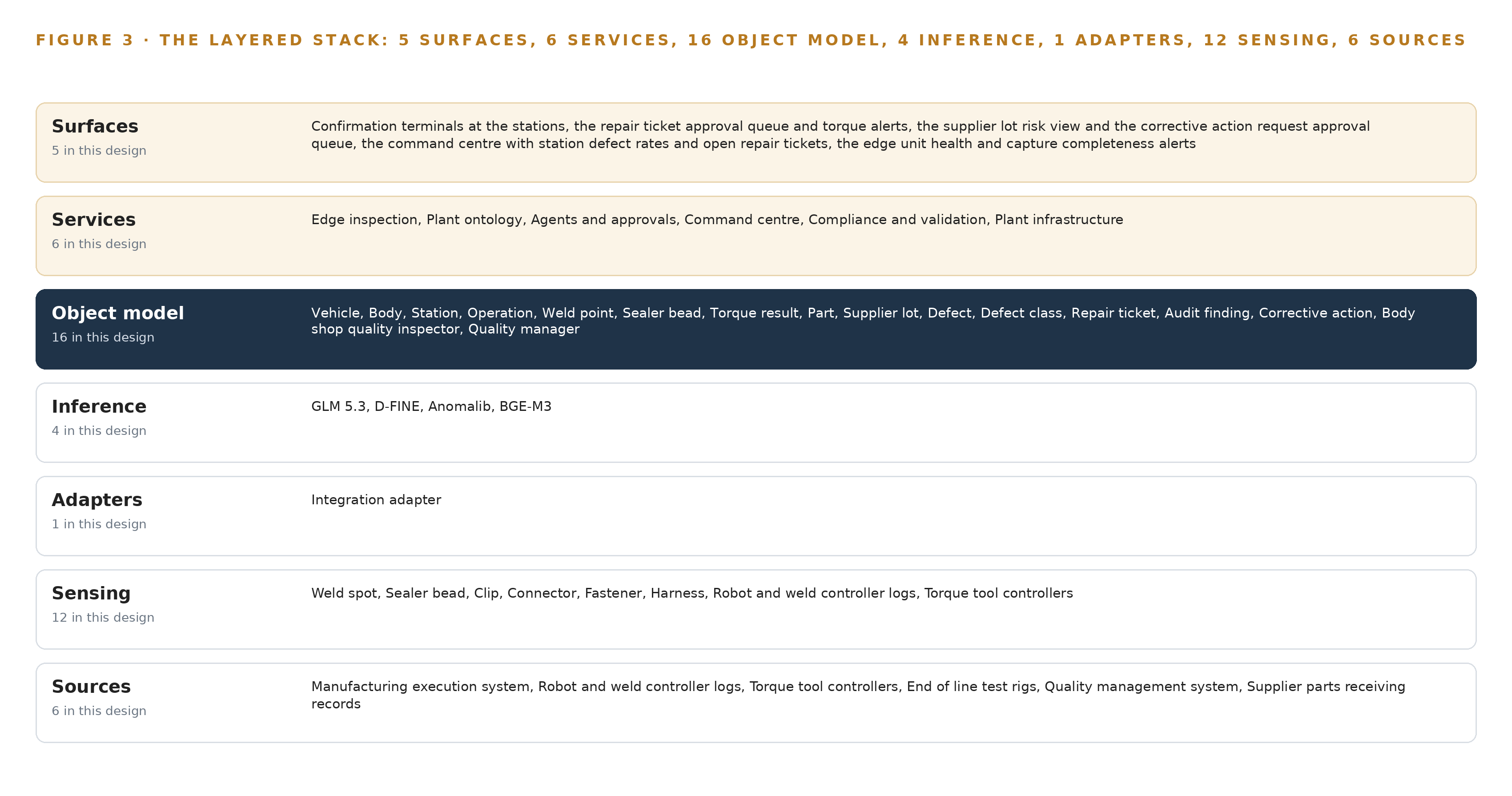
The stack has three tiers. Below sit the six systems of record: the manufacturing execution system, the robot and weld controller logs, the torque tool controllers, the end of line test rigs, the quality management system and the supplier parts receiving records, each owning its domain and keeping it. In the middle sits one object model, sixteen objects with typed links, that projects those records into a single argument a person can query. Above it run six services and five surfaces, where agents draft findings and named people confirm, approve and decide. Figure 3 shows the layered stack with the count at each layer.
The pattern fits because the plant's failure is a join failure, not a sensing failure. A camera at a trim station can see a missing clip, but the question the quality manager actually asks crosses every system of record at once: which supplier lot, which body numbers, which weld points, which corrective action. The design therefore puts the join in one place, the object model, and refuses to let any application build its own private copy. The ontology is a projection over the manufacturing execution system, never a replacement for it, which is what keeps the parent's audits answerable from the records of record.
4.2 The Stack Stage by Stage
Table 3 walks the stack from sources to surfaces, naming what each stage is responsible for and the components that carry it, in the order the data flows: Sources, Sensing, Adapters, Object model, Inference, Services, Surfaces.
| Stage | What it is responsible for | How |
|---|---|---|
| Sources | Own the record of what happened, read-only | Six operator systems: the manufacturing execution system, robot and weld controller logs, torque tool controllers, end of line test rigs, quality management system and supplier parts receiving records |
| Sensing | Capture one frame per body at the station exits | 5 MP global shutter GigE Vision cameras at five positions with strobed lighting, a body-present trigger from the station PLC, an OCP Time Card grandmaster with linuxptp |
| Adapters | Own the contract for every source | One integration adapter family: Debezium change data capture from the MES and QMS databases, collectors for controller and rig logs, one-way transfer out of a zone |
| Object model | Hold the join with lineage | the object model with sixteen objects, TimescaleDB for telemetry, Apache Kafka 4.4 as the event backbone |
| Inference | Run the checks and the reasoning | D-FINE and Anomalib at INT8 through ONNX Runtime on the edge NPU units; BGE-M3 embeddings on the site server; GLM 5.3 under vLLM on one 141 GB-class node |
| Services | Compose checks into decisions people own | Edge inspection, plant ontology, agents and approvals, command center, compliance and validation, plant infrastructure |
| Surfaces | Put the decision in a named person's hands | Confirmation terminals at the stations, the repair ticket and torque alert queue, the supplier lot risk view, the command center views, the edge health and capture completeness alerts |
4.3 A Reusable Pattern
The reusable shape is this: triggered one capture per body checks at station exits, identity from the body number rather than tracking, an adapter-only ingestion tier, one object model that holds the join, agents that draft and named people who decide, and memory that improves the next check without touching weights. A team carrying a similar brief would swap the detections for their own domain, weld spot and sealer bead becoming whatever their stations must verify, swap the six sources for their own systems of record, and re-size the three inference tiers for their own evidence volumes. What they should keep is the invariant set: no source is read directly, no agent holds stop or rejection authority, and every improvement lands as a recorded, citable decision rather than a silent change to a model.
| Layer | Component | Choice | Why |
|---|---|---|---|
| Event streaming and messaging | by class, no product named | Product | Apache Kafka 4.4 |
| The ontology or graph store | by class, no product named | Product | Hyper Ontology, the governed object model the whole argument runs through |
| Time series and telemetry storage | by class, no product named | Product | TimescaleDB (PostgreSQL extension) |
| Video ingest, recording and management | MediaMTX (for any RTSP overview camera) | Class | Station cameras are triggered GigE Vision machine vision cameras, so acquisition is by class with evidence frame only retention; the shelf holds RTSP ingest for IP cameras only. |
| Edge model serving | by class, no product named | Product | ONNX Runtime |
| On site language model serving | by class, no product named | Product | VLLM |
| Object tracking and trajectory forecasting | by class, no product named | Not needed | Each body is captured once at a triggered station exit; identity comes from the body number and MES genealogy, so no tracker is committed. |
| Edge orchestration of containers | by class, no product named | Product | K3s |
| An air gapped artifact and model registry | by class, no product named | Product | Harbor |
| Labelling and retraining | by class, no product named | Product | CVAT |
| Time synchronisation across sensors and systems | by class, no product named | Product | Linuxptp (ptp4l, phc2sys) |
| Observability of the running system | by class, no product named | Product | Prometheus, Grafana and Loki |
Sixteen Objects Turn Operational Data Into One Argument
The object model is the join the systems never made.
Chapter 4 described the stack that runs from the systems of record to the surfaces. This chapter describes what the middle layer holds: sixteen objects and the typed links between them, the join the plant's systems never made.
5.1 Sixteen Objects and Their Links
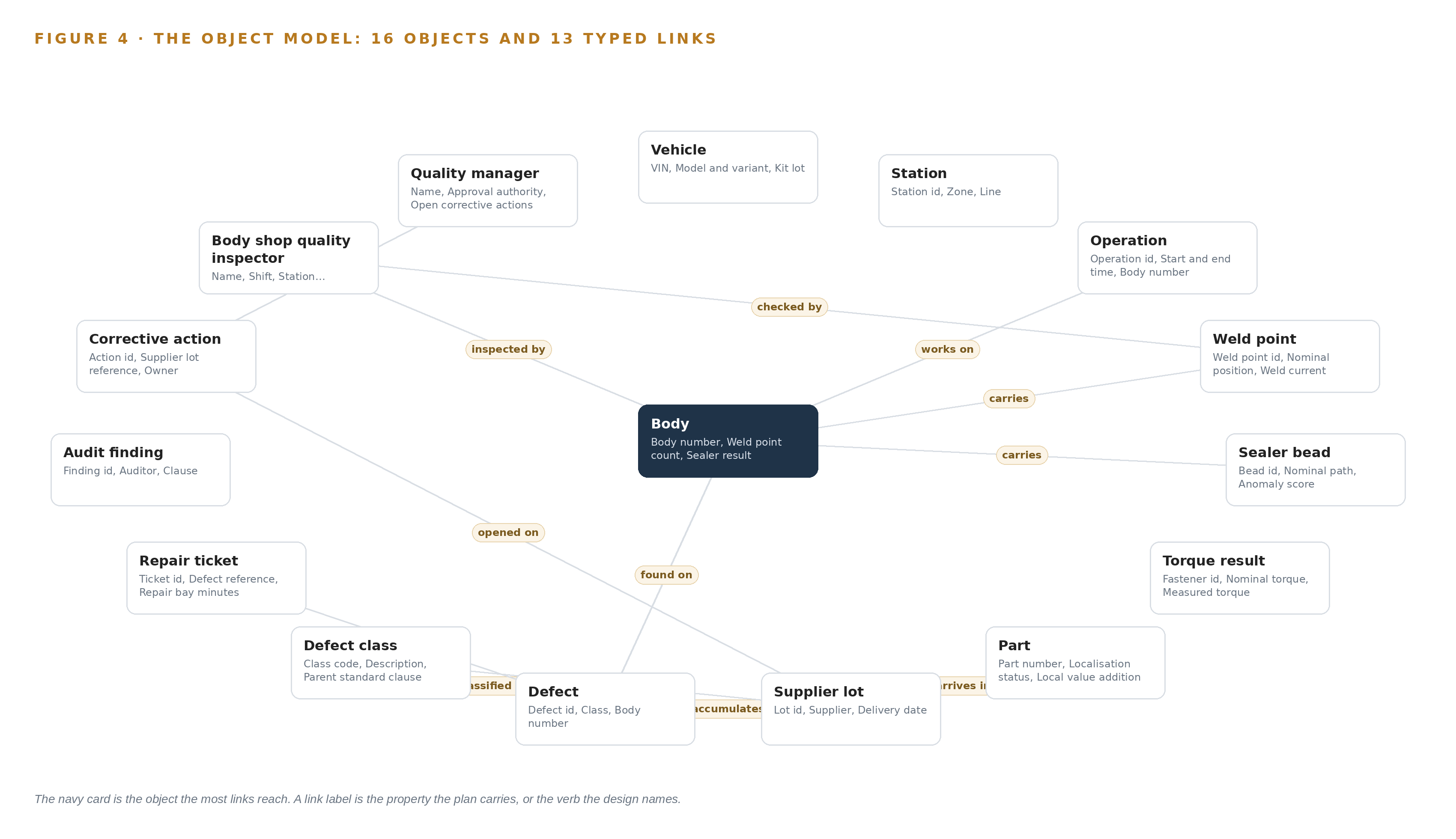
Sixteen objects carry the whole argument. Vehicle, Body, Station and Operation come from the manufacturing execution system, which owns orders, body numbers, genealogy and routing. Weld point and Sealer bead come from the robot and weld controller logs; Torque result from the torque tool controllers; Part and Supplier lot from the supplier parts receiving records; and Defect, Defect class, Repair ticket, Audit finding and Corrective action from the quality management system. Two objects are people: the body shop quality inspector, who confirms or dismisses what the cameras flag, and the quality manager, who approves repairs and corrective actions. Figure 4 shows every object and its typed links, with the defect object in focus.
The links are typed, which is what separates this governed plant model from the industrial ontology examples a search usually returns: every object here is anchored in a named system of record and every link is a stated relationship, not a co-occurrence. A defect links to the body it was found on; the body links to its weld points and sealer beads; a part links to the supplier lot it arrived in; the supplier lot links to the defects counted against it and onward to the corrective action opened on it. One query can walk from a flagged weld point to the body, the operation, the shift's inspector, the lots fitted that day and the open corrective actions, in a single traversal with lineage at every hop, where a document store would force a manual rebuild across exports. That manual rebuild is what the plant does today when the parent's auditors ask why a body shop defect rate rose on a given day. The platform prints Table 8 with this chapter, listing each object, the system it is anchored in and its typed links; the recorded form of one object follows in 5.3.
| Object | Anchored in | Typed links |
|---|---|---|
| Vehicle | Manufacturing execution system | no typed link recorded |
| Body | Manufacturing execution system | carries: Weld point; carries: Sealer bead; inspected by: Body shop quality inspector |
| Station | Manufacturing execution system | no typed link recorded |
| Operation | Manufacturing execution system | works on: Body |
| Weld point | Robot and weld controller logs | checked by: Body shop quality inspector |
| Sealer bead | Robot and weld controller logs | no typed link recorded |
| Torque result | Torque tool controllers | no typed link recorded |
| Part | Supplier parts receiving records | arrives in: Supplier lot |
| Supplier lot | Supplier parts receiving records | accumulates: Defect; traced to: Defect class |
| Defect | Quality management system | classified as: Defect class; found on: Body |
| Defect class | Quality management system | no typed link recorded |
| Repair ticket | Quality management system | resolves: Defect |
5.2 The Human Loop and the Hosting Posture
Every judgment in the model has a named owner. A flagged weld point or a missing clip is a Defect in the state Flagged until the body shop quality inspector moves it to Confirmed or Dismissed at the station terminal; a repair ticket exists in Draft until the quality manager approves it; a corrective action opens only under the quality manager's authority. The single write path back into a system of record is the approved record: agents draft into the ontology, and confirmed findings flow to the quality management system through the adapter, never around it.
The hosting posture follows the boundary constraint. The ontology and its memory run on the operator's own hardware in the plant server room in Pakistan, and nothing leaves the plant network. Identity is Keycloak, on site. There are no external links in the running system: model artifacts arrive through the air-gapped Harbor registry, and any transfer out of a network zone passes a one-way data diode. Data residency, personal-data tagging and a recorded lawful basis per data class follow the draft national data protection rules, which are a planning signal rather than settled law.
5.3 One Object in Its Recorded Form
The vehicle record below shows the shape of all sixteen: an identifier, a label, a kind, the system it is anchored in, its properties and its status vocabulary. The defect is recorded the same way, with the body number, the evidence frame, the person who confirmed it and a three state vocabulary (Flagged, Confirmed, Dismissed) that keeps a machine flag and a human confirmed defect distinct.
{ "id": "vehicle", "label": "Vehicle", "kind": "asset", "anchored_in": "Manufacturing execution system", "properties": [ "VIN", "Model and variant", "Kit lot", "End of line result" ], "status_vocabulary": [ "In build", "Complete", "Hold", "Released" ], "links": [] }Every Source Enters Through an Adapter, Never Directly
Nothing reaches the object model except through an adapter that owns its contract.
Chapter 5 described the sixteen objects the middle layer holds. This chapter describes how data reaches them: every source enters through an adapter that owns its contract, and nothing reaches the object model directly.
6.1 Six Sources, One Adapter Family
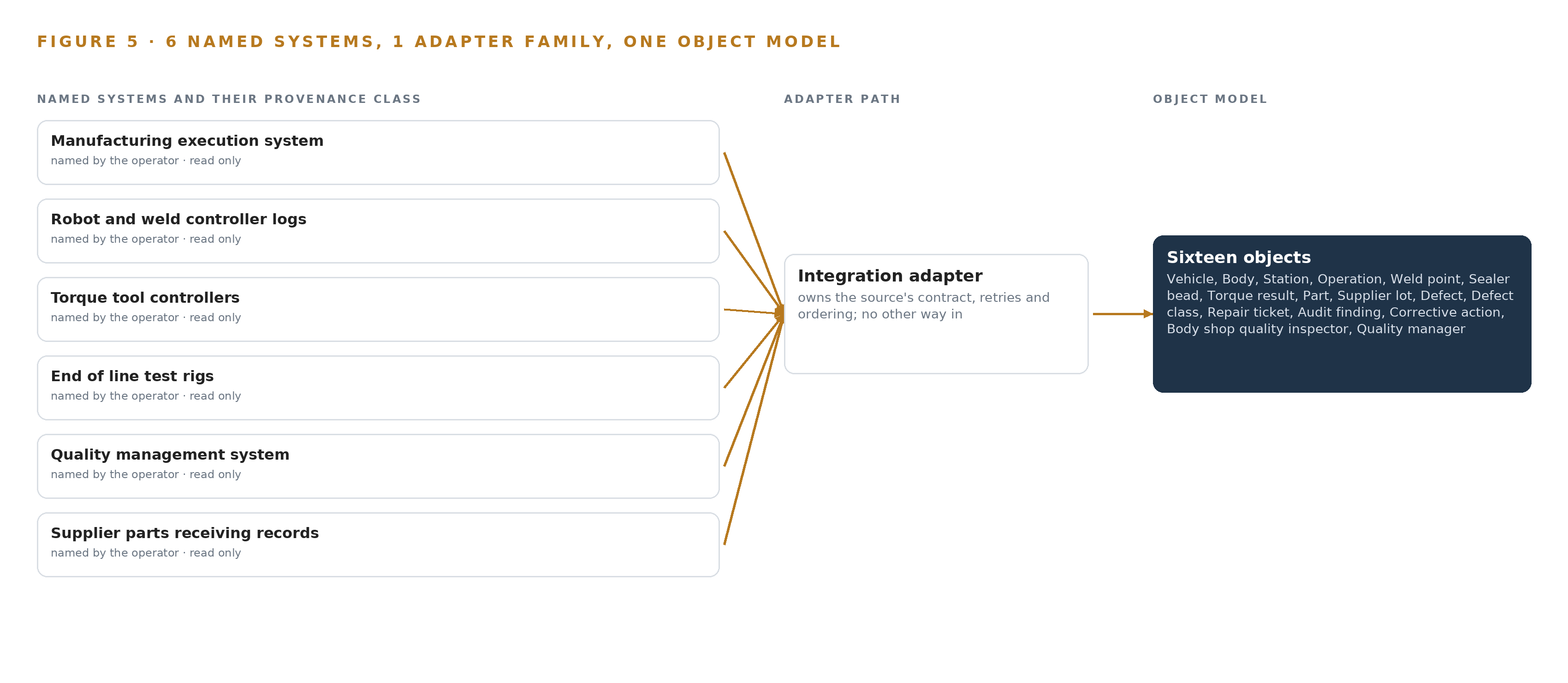
Six named source systems feed the model, and all six are the operator's own systems of record, read-only, classed as operator provenance. The manufacturing execution system owns orders, body numbers, genealogy and routing. The robot and weld controller logs own the weld point truth the weld check agent's flags are checked against. The torque tool controllers own per-fastener torque readings on the trim and final line. The end of line test rigs own the outcome the phase-one baseline is measured on. The quality management system owns defect records, repair tickets and corrective actions. The supplier parts receiving records own lot identity, supplier and delivery date, which is what turns a defect cluster into a supplier lot trace, the end to end chain that supplier quality frameworks in the sector treat as the baseline obligation (IAF n.d.). Figure 5 sets out the integration map: each named system, its provenance class and its adapter path into the model.
6.2 What the Adapter Tier Guarantees
One adapter family serves all six sources: the integration adapter. It guarantees a contract per source, so a schema change upstream surfaces as a broken contract rather than silent bad data. It guarantees identity resolution: controller, MES, QMS and receiving records are joined once, with lineage, inside the ontology rather than separately in each application, and the reconciliation is proved against yesterday's actual production before any agent runs on it. It guarantees read direction everywhere except the single approved write path to the quality management system. And it guarantees time discipline, with every event stamped from the PTP grandmaster so a camera frame, a torque reading and a weld log can be placed on one timeline. Change data capture through Debezium reads the MES and QMS databases without touching their transaction paths, and anything crossing a network zone passes the one-way transfer, so the boundary between office and plant networks stays one-directional. Lineage at every hop is also what national standards guidance asks of manufacturing data used for decisions: provenance, timestamping and a record of what was joined (NIST n.d.).
6.3 The Event Backbone
Apache Kafka 4.4 carries events between the adapters, the ontology and the services. Ordering is keyed by body number, so every record for one body arrives in sequence regardless of how the partitions are laid out. Delivery is at least once with idempotent writes in the ontology, which tolerates a replayed event without double-counting a defect. Buffering is on disk at the edge: if the link from a station unit to the backbone drops, capture continues locally and resynchronizes when the link returns, so a network blip never becomes a missed body. Replication runs inside the plant's Kafka cluster, so the loss of a broker does not lose an event. Telemetry and time series land in TimescaleDB, and Prometheus, Grafana and Loki watch the backbone itself, so capture completeness is an alert the command center sees rather than a gap the quality manager discovers at audit time.
Inference Belongs Where the Data Is
Each tier runs what its data and its link can carry.
Physical AI at the station only pays for itself when the model runs where the body is, at the pace the line already keeps. Chapter 6 described how all six source systems enter through the integration adapter and land in the plant ontology. This chapter fixes where each of the four models executes, which is a performance decision, a data-residency decision and an export-control decision at once.
7.1 Three Tiers and the Memory Arithmetic
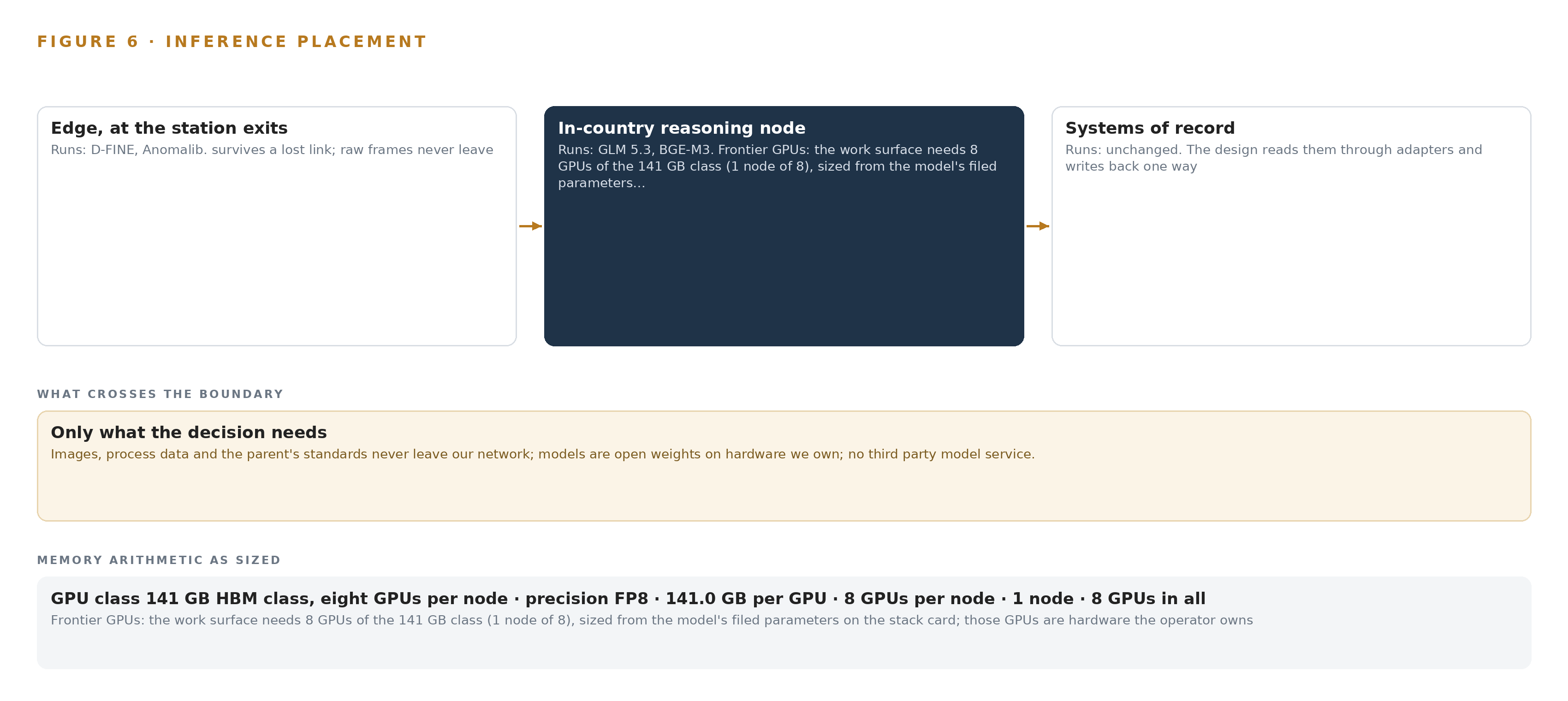
The design runs three inference tiers, and Figure 6 sets them side by side with what crosses between them. The edge tier sits at the body shop, trim and underbody station exits: 5 MP global shutter GigE Vision cameras with strobed lighting capture each body once, on a body-present trigger from the station PLC, and a fanless industrial edge unit on an octa-core 6 TOPS NPU SoC rated -40 to 85 C runs the check on the device. The D-FINE detectors run there at INT8, where the N variant is about 8 MB at 16 bit and the X variant about 124 MB. The Anomalib models that watch sealer beads are model dependent, typically tens to hundreds of MB at 32 bit, and PatchCore memory banks grow with the number of reference images, so each station sizes its model on its own variant and its own reference set.
One air-cooled 48 GB PCIe inference-class server in the plant server room is the site tier. It serves BGE-M3 at FP16, about 1.1 GB, and re-scores the borderline detections the edge tier flags, so a station-level doubt becomes a full-precision second opinion without any frame leaving the plant. A US ECCN 3A090 license determination for Pakistan is required before this class is quoted, which is why the class carries its own checkpoint in the rollout.
The central tier is GLM 5.3 on one node of eight 141 GB HBM GPUs, and the memory arithmetic decides it. 753B parameters at FP8 is 1 byte per parameter, so 753 GB of weights, and the 1.2 planning factor for KV cache and activations raises the requirement to 904 GB; one node of 8 x 141 GB holds 1,128 GB, leaving 375 GB beside the weights against the 151 GB the factor reserves. At the roughly 756 GB the published weights occupy, the KV cache ceiling is about 280 GB, which bounds concurrent sessions on the conversational surface rather than forcing a second node. The printed architecture table (Layer, Component, Choice, Why) carries the full stack card, and these three tiers are its inference rows.
7.2 A Latency Budget Set by Takt
The budget is set by takt time, the property the ontology carries on every station object. Each presence check must finish inside the station's takt, so no body waits on a model and no inspector waits on a queue. The edge tier meets this by construction, because the detector runs on the unit beside the camera with no network round trip, and the published 2.12 to 12.89 ms single-image latency on a T4 leaves wide margin at station pace. A seconds-scale budget governs the site tier, for re-scoring and for embedding records into the retrieval index. The central tier works on a human-scale budget: conversational answers with citations are read and judged by named people, so the cost of a longer answer is attention, not throughput. Recall chronologies show how late a defect pattern is usually caught when the check is not at the station (NHTSA 2024); that delay is what this budget exists to remove.
7.3 What Crosses the Boundary, and What Fails
Nothing leaves the plant network in Pakistan. Detections, evidence frames and ontology writes move from the edge units across the plant backbone; model and container updates enter through the on-site Harbor registry fed by a one-way Lidi transfer; no third-party model service is ever called. Every record carries provenance back to its source system, the practice recommended for trustworthy manufacturing data (NIST n.d.). When the link fails, the edge units keep capturing and checking against the last loaded model, buffer locally, and resynchronize once the backbone returns. When power fails, the sealed fanless units ride the wide-input 24 V buck from the plant supply, and the specified universal-input supplies restart clean on the country's 230 V 50 Hz mains. When the update path fails, the one-way gate means an interrupted update leaves the running detector in place while the registry holds the last complete artifact. The number that decides whether any of this is trusted is the false-flag gate, held under 10 per inspector per shift.
The License Decides What the Operator Can Own
Every model was chosen against its license before its accuracy.
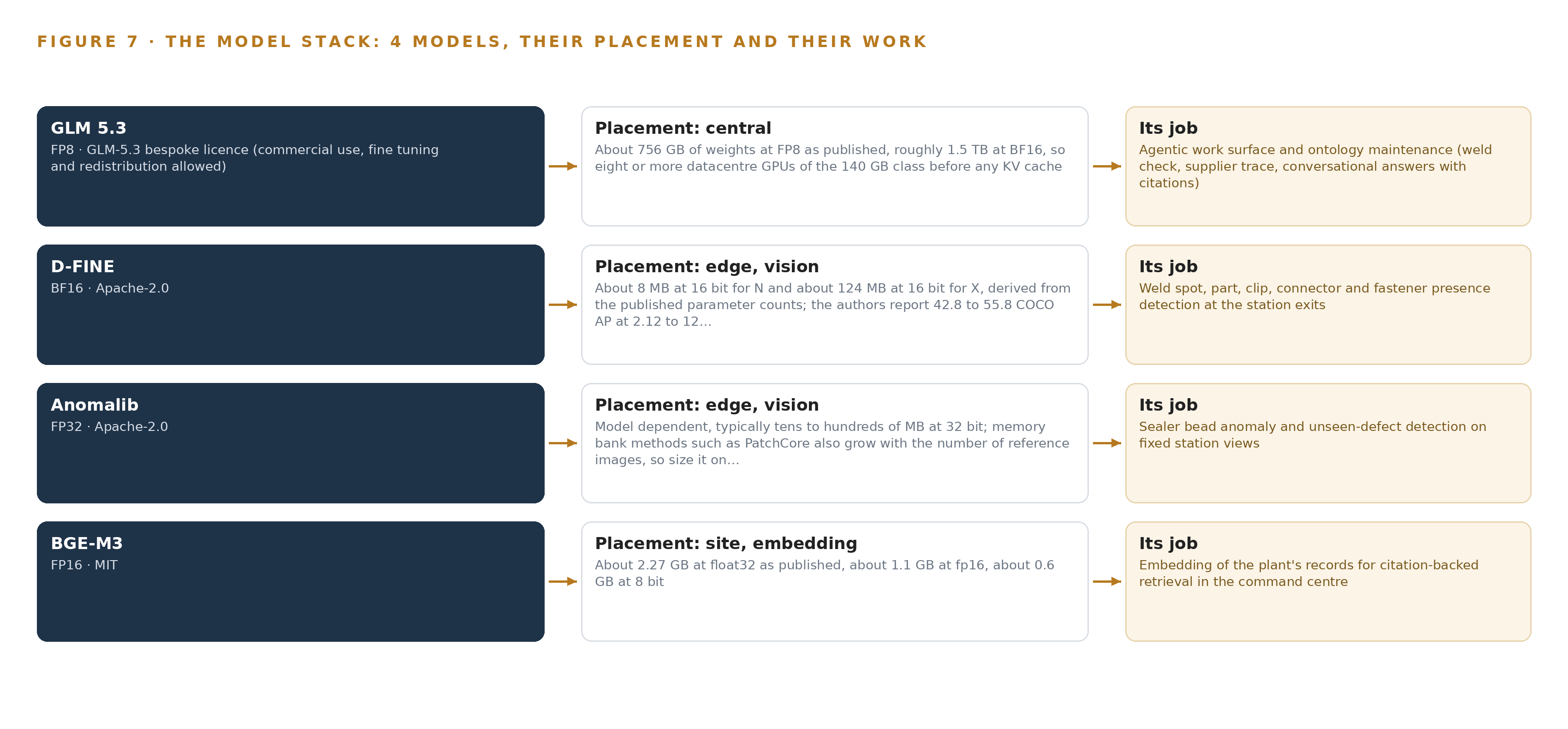
Chapter 7 placed each of the four models on the tier its data and its link could carry. This chapter shows that the placement was the second decision, because every model was chosen against its license first: the license decides whether the operator can hold the weights, fine-tune them and keep them running when a vendor's attention moves on. Figure 7 stacks the four models with their specifications and their jobs.
8.1 Four Models and Their Terms
GLM 5.3 is the agentic work surface and the ontology's maintainer: it drafts weld checks, traces supplier lots and answers questions conversationally with citations. It is frontier class, 753B parameters as filed, at or above the 300B threshold that defines the class, with about 756 GB of weights at FP8 as published and roughly 1.5 TB at BF16, which means eight or more data center GPUs of the 140 GB class before any KV cache. Its bespoke license permits commercial use, fine-tuning and redistribution, and that is what lets the operator run it on its own node in its own server room; the operator names the model itself and fixes it to its own hardware.
D-FINE is the station detector for weld spots, parts, clips, connectors and fasteners, on the unconditional Apache-2.0 terms that cover code and weights alike. The N variant is about 8 MB at 16 bit and the X variant about 124 MB, with 42.8 to 55.8 COCO AP at 2.12 to 12.89 ms on a single T4 at batch size 1, and it runs INT8 on the edge NPU. The COCO checkpoints are chosen because they avoid the Objects365 terms that ship with other checkpoints, and site nuisance images are collected and labelled before any threshold is set.
Anomalib, version 2.7.0, is the sealer bead watcher on the same Apache-2.0 terms with edge export. Sealer gaps are rare and varied, so an unsupervised model fitted on the plant's own good beads beats any defect catalog; its footprint is model dependent, typically tens to hundreds of MB at 32 bit, and PatchCore memory banks grow with the reference set. The plant's own images replace the non commercial benchmark data the library ships with, which is the license's practical edge.
BGE-M3 is the retrieval model, MIT licensed, served at FP16 on the 48 GB site server: about 2.27 GB at FP32, about 1.1 GB at FP16 and about 0.6 GB at 8 bit, with an 8,192 token window and dense, sparse and multi-vector retrieval in one pass, so part numbers and error codes stay retrievable and every conversational answer can cite the record behind it.
8.2 The Register and the Ground It Runs On
Table 4 gathers the choices with the hardware classes and sizing rules, the sensing, the patterns and the ground, so that one row shows why each piece sits where it does. Each row is also a license record: what the operator holds, on what terms, and what it may keep doing when a term ends. The register matters most at handover, when the engineers who set up the line leave and the plant's own team runs the system from written ground, because supplier quality frameworks of the kind the international federation publishes make traceability to source a member obligation rather than a courtesy (IAF n.d.). The ontology underneath is not one of the catalogued industrial ontology examples a team adopts wholesale; it is a governed model built from the operator's own six systems of record, and unifying that data is now also a regulatory clock, because meeting digital product passport deadlines depends on proving how products were actually made (Qualitymag 2026).
| The choice | What was picked | Why here |
|---|---|---|
| Station detection | D-FINE at INT8 on the 6 TOPS edge NPU | Apache-2.0 code and weights owned outright; COCO checkpoints avoid Objects365 terms |
| Sealer and unseen-defect watch | Anomalib 2.7.0 on the edge units | Apache-2.0 with edge export; the plant's own good beads replace the non commercial benchmark data the library ships with |
| Retrieval and citations | BGE-M3 at FP16 on the 48 GB site server | MIT license; dense, sparse and multi-vector retrieval in one pass, 8,192 token window |
| Agentic work surface and ontology maintenance | GLM 5.3 at FP8 on one node of eight 141 GB GPUs | Bespoke license allowing commercial use, fine-tuning and redistribution; the operator names it and fixes it to its own hardware |
| Hardware classes and sizing rules | a frontier inference cluster class (GPU nodes for 300B to 1T parameter open weight models); GLM 5.3 node count by GPU class; plant server room GPU node ASHRAE class | One node of 1,128 GB holds the 904 GB the 1.2 planning factor requires, and the ASHRAE class fixes the server room envelope |
| Sensing | Triggered 5 MP global shutter GigE Vision cameras at five station exits; controller, torque and end of line feeds; the body-present PLC trigger | One capture per body; identity comes from the body number and MES genealogy, so no tracker is committed |
| Patterns | Triggered one capture per body checks; nuisance images collected before thresholds; agents draft and named people approve | Cameras check bodies and vehicles, never worker performance; the false-flag gate stays under 10 per inspector per shift |
| The ground it runs on | The plant network in Pakistan, the operator's own hardware, the on-site Harbor registry and the one-way Lidi transfer | Nothing leaves the boundary, no third-party model service is called, and updates enter one way |
Shadow Mode Comes Before Any Flag Is Trusted
The rollout earns each phase at a gate the operator can read.
Chapter 8 closed the model register with licenses that let the operator hold every weight it runs. This chapter sets out how the build earns its place on the line: one gated phase, measured against the plant's own production, with no flag trusted until it has run in shadow beside the people who would act on it.
9.1 One Phase, Fifteen Items, Six Workstreams
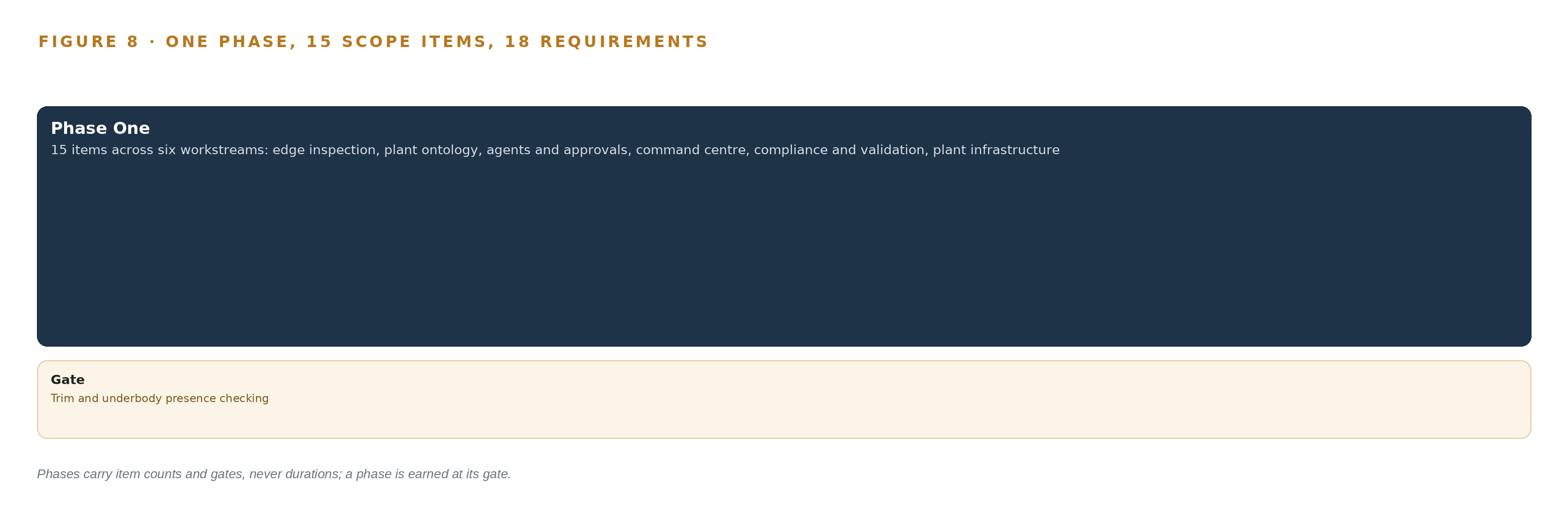
The rollout is a single phase, Phase One, carrying 15 items across six workstreams: edge inspection, plant ontology, agents and approvals, command center, compliance and validation, and plant infrastructure. The items run from the station camera and edge unit layout, through the weld and sealer check pipeline, to trim and underbody presence checking, and the phase's exit gate carries that last item's name: presence checking at the trim and underbody stations must run on every body and vehicle that passes before the phase closes. The phase covers the operator's 18 requirements, and coverage against each requirement is read at the gate, so a requirement that is only partly met holds the phase open. Figure 8 shows the phase, its item count, its workstreams and its gate on one page.
Shadow mode governs the whole phase. Every check runs alongside the manual inspection it supports, flags are drafted for a named inspector to confirm or dismiss, and no agent stops a line or rejects a supplier lot, because that authority was scoped out in Chapter 3 and stays out.
9.2 What the Rollout Measures
The phase measures itself on the plant's own numbers, not on laboratory ones. The end of line test rigs give the baseline: the defect classes the phase must catch earlier, counted per body before any camera is switched on. Against that baseline the phase tracks the false-flag count per inspector per shift, held under 10, because a budget above that is where inspectors stop trusting flags and switch the system off. It tracks capture completeness, meaning every body that passes a station has a frame, a verdict and a body number joined to its genealogy. It tracks the confirmation rate of flagged defects, the number of defect clusters that resolve to a supplier lot, and the time it takes to answer the parent's auditors when they ask why a body shop rate rose on a given day. Measurement data carries lineage and provenance so it can be defended under audit, following the recommendations on traceability and trustworthiness of manufacturing data published by the US national standards body (NIST n.d.).
9.3 Failure Modes
Table 5 lists what the design expects to fail and what it does about each, and every row is a risk the phase plans for rather than a surprise it absorbs.
| What fails | What the design does |
|---|---|
| Nuisance signatures, such as dust, spatter, oil and lighting, drive false alarms and inspectors switch the system off | Nuisance images are deliberately collected and labelled before thresholds are set, and the false-flag budget holds under 10 per inspector per shift |
| Worker acceptance of cameras at manual stations stalls under the national data protection rules | Masking, signage and retention limits are built in phase one, with worker consultation before the first camera is switched on |
| The US export license determination for the 141 GB HBM frontier node delays or blocks plant hardware | The license checkpoint runs at phase-one start, and an approved data center or phased precision fallback stays on the table without quietly shrinking the model |
| Entity resolution across controller, MES, QMS and receiving records joins the wrong things | Identities are resolved once in the ontology with lineage, and the reconciliation is proved against yesterday's actual production before agents run on it |
| The parent's validation calendar slips and station checks are not accepted before auditors rely on them | Validation acceptance is a phase-one gate, and the evidence pack is aligned with the parent's audit terms from the start |
| Experienced engineers leave at handover and the system loses its operators | Runbooks, the ontology and decision memory capture their knowledge, and the plant's own team performs the integration with their own hands |
9.4 Lessons
Shadow the flags before anyone trusts them. A flag that arrives unproven is a complaint, and inspectors treat it as one. Running every check in shadow, with confirmation and dismissal recorded per flag, turns the same hardware into evidence: the inspector who confirms ten flags and dismisses one has taught the system what this plant's bodies look like, and the record of those decisions is what the next check reads.
Collect the nuisance images before the thresholds are set. The case-study record is unambiguous on this: false alarms from ordinary plant grime are what switch inspection systems off, and thresholds tuned on clean images are tuned on a plant that does not exist. The nuisance set is a phase item with its own gate, not a tuning chore left to the end.
Resolve the body number once, in the ontology. Every join in this design rides on the body number and the MES genealogy, so a wrong resolution poisons weld truth, torque truth and defect records at once. Proving the reconciliation against yesterday's actual production, before any agent reads it, is cheaper than finding a wrong join inside an audit answer.
9.5 What Is Still Open
Four questions remain open, and settling each changes something specific. The US export license determination for the frontier node and every accelerator class is the first: settling it fixes the server room hardware as designed, or forces the fallback path to be chosen openly rather than by shrinking the model in place. The plant network design is still being finalised, and settling it fixes where the IEC 62443 zone boundaries and PTP-capable switch hops sit relative to the station exits. The scale figures behind the layout come from public reporting on plants of this class in the country and are assumptions to confirm, so settling them fixes the camera count and the per-station capture budget against the real takt. The parent's validation calendar is the last: settling it fixes when auditors may rely on the station checks, and therefore when the phase's evidence pack stops being preparation and becomes the answer.
The Intelligence Should Stay with the Operation That Produced It
What the design builds belongs to the operator.
Chapter 9 showed the phase earning trust at a gate the operator can read. This chapter settles who holds what the work produces once the gate is passed: the model of the plant, the weights, the record of decisions, and the boundary they run inside.
10.1 What the Operator Owns
The object model is the operator's. Its 16 objects are anchored in the operator's own systems of record, with the manufacturing execution system holding body numbers, genealogy and routing, and the ontology standing as a projection over it rather than a replacement. Published industrial ontology examples seldom anchor every object in a live system of record; this one does, and because the anchors are the operator's systems, the operator can extend the model as new parts are localised without asking anyone's permission. End to end traceability of this kind is what the International Automotive Federation's supplier requirements frame expects members to align against (IAF n.d.).
The weights are the operator's. The detectors carry Apache-2.0 terms and the embedding model an MIT license, both of which permit commercial use and modification outright, and the work surface model's bespoke license permits commercial use, fine tuning and redistribution. Every fine-tune, and every model hardened on the plant's own nuisance images, belongs to the operator and stays inside its boundary.
The decision record is the operator's. Every flag, confirmation, dismissal, approval and corrective action carries a named person, and that record is what the next check reads before it acts: memory improves the checks without any weight being trained, which was a scoping decision in Chapter 3 and holds here as ownership. Nothing about the operator's quality judgement lives anywhere it cannot be exported, audited or carried forward.
The boundary is the operator's. Everything runs inside the plant network in Pakistan, on hardware the operator owns, with no third-party model service in the path and evidence frames retained under the stated limits. Where the plant's data goes, and who may move it, is a decision the operator holds.
10.2 The Offer Behind the Design
CodeNinja built this design on Praxis, its platform for designing physical AI systems, and the design maps directly onto what CodeNinja offers: Adaptive Operations is the sensing, detection and forecasting of physical behavior at the station exits; Decision Systems is the ranking, attribution and recommendation a named person decides on, from weld flags to supplier lot traces; Hyper Ontology is the governed object model the whole argument runs through; Hyper Pragma is the work surface where the operator's own people build and run their agents; and Sovereign Infrastructure is the shape of the whole thing, own hardware, open-weight licenses and in-country operation, with the frontier node in the plant's own server room.
The Pattern Repeats Wherever Systems of Record Do Not Meet
Seen whole, the design is one object model over the systems a vehicle assembly company in Pakistan already runs, with inference placed where the data is and every decision left to a named person.
Running the same shape elsewhere takes the same four things: the named systems, an object model anchored in them, a first gate that can stop the work cheaply, and the license posture that lets the operator own what it learns.
How Praxis Contextualized and Reasoned This Design
Every choice above traces back to something Praxis recorded reading.
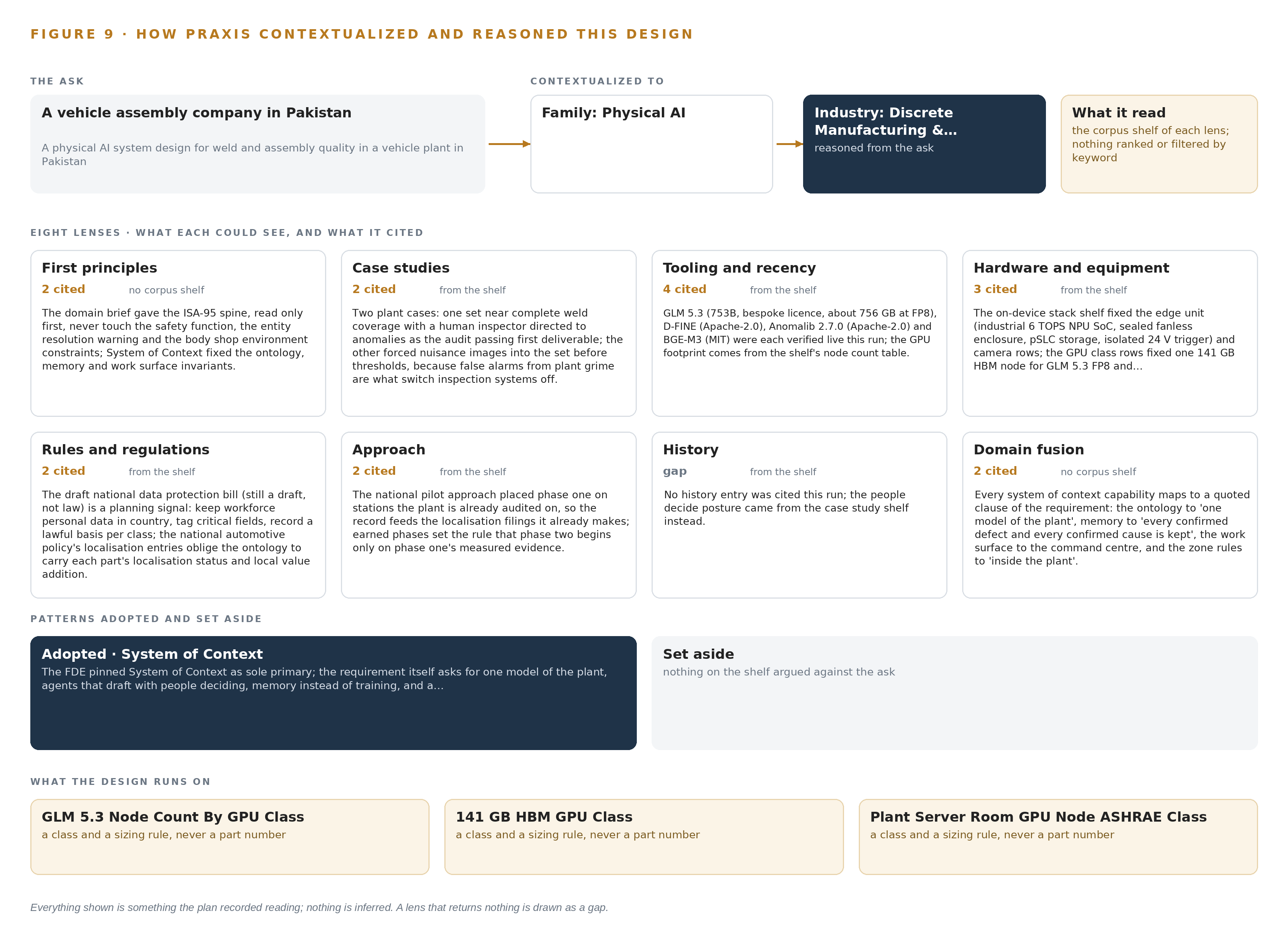
Chapter 10 settled ownership with the operator. This chapter opens the record of how the design was reasoned, so any choice above can be traced to the reading that justified it. Every design in this series is produced on Praxis, the platform for designing physical AI systems, and this chapter exists so a reader can audit the reasoning rather than take it on trust: Figure 9 shows the ask, the family and industry assigned, what it read, the eight lenses, the patterns and the equipment classes the reasoning landed on.
11.1 Contextualizing the Ask
The ask arrived as a requirement written in the operator's voice: physical AI at the station, with edge units and cameras at the body shop, trim and underbody exits, checking every body against the weld point list and the sealer bead, and landing every result in a governed plant ontology built from the systems of record, all inside the plant network in Pakistan. Praxis assigned it to the physical AI family in the discrete manufacturing and automotive industry. What Praxis read was the corpus shelf of each lens: the case study, tooling and recency, hardware and equipment, rules and regulations, approach and history shelves, beside the first principles domain brief.
11.2 The Lenses
Table 6 records each lens, how many records it could see, how many it cited, and what it contributed to the design. A lens that returned nothing is shown as a gap rather than smoothed over.
| Lens | Could see | Cited | What it contributed |
|---|---|---|---|
| First principles | no corpus shelf | 2 | The domain brief gave the ISA-95 spine, read only first, never touch the safety function, the entity resolution warning and the body shop environment constraints; System of Context fixed the ontology, memory and work surface invariants. |
| Case studies | the case study shelf | 2 | Two plant cases: one set near complete weld coverage with a human inspector directed to anomalies as the audit passing first deliverable; the other forced nuisance images into the set before thresholds, because false alarms from plant grime are what switch inspection systems off. |
| Tooling and recency | the tooling and recency shelf | 4 | GLM 5.3 (753B, bespoke licence, about 756 GB at FP8), D-FINE (Apache-2.0), Anomalib 2.7.0 (Apache-2.0) and BGE-M3 (MIT) were each verified live this run; the GPU footprint comes from the shelf's node count table. |
| Hardware and equipment | the hardware and equipment shelf | 3 | The on device stack shelf fixed the edge unit (industrial 6 TOPS NPU SoC, sealed fanless enclosure, pSLC storage, isolated 24 V trigger) and the camera rows; the GPU class rows fixed one 141 GB HBM node for GLM 5.3 at FP8 and the ASHRAE class for the plant server room. |
| Rules and regulations | the rules and regulations shelf | 2 | The draft national data protection bill (still a draft, not law) is a planning signal: keep workforce personal data in country, tag critical fields, record a lawful basis per class; the national automotive policy's localisation entries oblige the ontology to carry each part's localisation status and local value addition. |
| Approach | the approach shelf | 2 | The national pilot approach placed phase one on stations the plant is already audited on, so the record feeds the localisation filings it already makes; earned phases set the rule that phase two begins only on phase one's measured evidence. |
| History | the history shelf | 0 | No history entry was cited this run; the people decide posture came from the case study shelf instead. |
| Domain fusion | no corpus shelf | 2 | Every system of context capability maps to a quoted clause of the requirement: the ontology to 'one model of the plant', memory to 'every confirmed defect and every confirmed cause is kept', the work surface to the command centre, and the zone rules to 'inside the plant'. |
11.3 Patterns Adopted and Set Aside
Three patterns were adopted. Triggered one capture per body at each station exit, with identity from the body number and MES genealogy, was adopted over multi-object tracking because each body is captured once and identity is already owned by a system of record. Nuisance-image collection before threshold setting was adopted from the case-study record as a gate, not a chore. Memory over confirmed outcomes was adopted over any form of on the fly training, which the requirement rules out and the architecture makes unnecessary.
Two were set aside. Packaged smart cameras were set aside for the Apache-2.0 detectors on the operator's own edge units, because the packaged class is rated for ambient temperatures below a body shop summer in this climate and its weights would not belong to the operator. Personnel and vehicle positioning was set aside because cameras watch bodies and vehicles, and worker location sensing would collide with the national data protection rules for cameras on workers.
11.4 Where the Reasoning Lands
The reasoning lands on equipment classes rather than named products where the plant environment decides: the node count by GPU class that sizes the work surface model's node; the frontier inference cluster class (GPU nodes for 300B to 1T parameter open weight models) itself; the plant server room GPU node ASHRAE class; the industrial fanless edge unit on an octa-core 6 TOPS NPU SoC rated for minus 40 to 85 degrees Celsius in a sealed aluminium enclosure; the 5 MP global shutter GigE Vision cameras with strobed lighting that freeze a moving body without rolling-shutter skew; and the export-control determination that turns on total processing performance rather than memory, which is why the license checkpoint sits at phase-one start. Everything shown in this chapter was recorded reading, and nothing is inferred: where the plan holds an assumption to confirm, it is carried as one.
What the Operator's Own Inference Node Costs Over Three Years
The paper is written for a vehicle assembly company in Pakistan, with every model running inside the plant network on the operator's own hardware (chapter 1, section 1.3; chapter 3, section 3.2; chapter 7, section 7.3). This appendix therefore prices for Pakistan, with the national industrial electricity tariff for power and the AWS Asia Pacific (Mumbai) region, ap-south-1, as the rental reference. The design's central tier is "GLM 5.3 on one node of eight 141 GB HBM GPUs" serving FP8 weights on vLLM (chapter 7, section 7.1; Table 4, "Agentic work surface and ontology maintenance" and "Hardware classes and sizing rules"). The two lower tiers are named by class: "one air-cooled 48 GB PCIe inference-class server in the plant server room" for BGE-M3 and the borderline re-scoring (chapter 7, section 7.1), and "a fanless industrial edge unit on an octa-core 6 TOPS NPU SoC" with 5 MP global shutter GigE Vision cameras at five station exits (chapter 7, section 7.1; Table 4, "Sensing"). The paper gives the site server a count but no product and gives the edge units neither a product nor a price, so the node is priced in full, the site server is priced as a reference line from a reseller's eight card server, and the edge tier is named and left out rather than guessed. Every input is dated and cited, and the arithmetic is shown.
A.1 The Answer
Owning the node for three years costs about 572,000 US dollars, inside a range of 542,000 to 610,000. Renting the same eight H200 cards around the clock costs about 751,000 dollars on the deepest three year commitment (an AWS EC2 Instance Savings Plan, all upfront, for p5en.48xlarge in Asia Pacific (Mumbai)), about 1.33 million dollars on the three year Compute Savings Plan, all upfront, and about 2.00 million dollars on demand. Against the deepest commitment, ownership costs about three quarters (571,792 / 750,535 = 0.76, and 0.72 to 0.81 across the range); against on demand, a little over a quarter (571,792 / 1,996,103 = 0.29). No rented option can sit inside Pakistan: the AWS region index lists no region in the country on the day read (AWS 2026a), and every rented option would carry evidence frames, process data, the parent's standards and the decision record across the border, which the design's own rule that nothing leaves the plant network rules out (chapter 3, section 3.2; chapter 7, section 7.3). Renting is therefore a price reference only. GLM 5.3 carries the GLM-5.3 bespoke licence, which "permits commercial use, fine-tuning and redistribution" (chapter 8, section 8.1); no price is asserted for it here. D-FINE and Anomalib (Apache-2.0) and BGE-M3 (MIT) carry no licence line (chapter 8, section 8.1).
A.2 What the Hardware Would Cost
| Option | Basis | Three year cost (USD) |
|---|---|---|
| Owned, in the plant's own server room | One 8x H200 node with support and power, broken out below | 542,000 to 610,000, typical 572,000 |
| AWS, Asia Pacific (Mumbai), on demand | p5en.48xlarge, eight H200 cards, 1,128 GB of HBM3e (AWS 2026c), at 75.9552 dollars an hour (AWS 2026b), 26,280 hours; outside Pakistan | 1,996,103 |
| AWS, Asia Pacific (Mumbai), three year Compute Savings Plan, all upfront | p5en.48xlarge at 50.6602 dollars an hour (AWS 2026a), 26,280 hours; outside Pakistan | 1,331,350 |
| AWS, Asia Pacific (Mumbai), three year EC2 Instance Savings Plan, all upfront | p5en.48xlarge at 28.55916 dollars an hour, the deepest three year plan for this instance in the region (AWS 2026a), 26,280 hours; outside Pakistan | 750,535 |
The purchase option priced as the rental reference is the three year EC2 Instance Savings Plan, all upfront, the lowest three year rate the ap-south-1 file lists for p5en.48xlarge (the partial upfront and no upfront three year Instance plans list 30.38208 and 32.81265 dollars an hour). Egress, storage of the mirrored record and the network link to the region are excluded, and the all upfront plans are paid in full on day one, so every rented figure is a floor.
The owned line, item by item:
| Line | Basis | Three year cost (USD) |
|---|---|---|
| Node | Thinkmate GPX GXS5-2508-8HGX-H2, 5U, NVIDIA HGX H200 with eight H200 SXM5 cards (1.1 TB of HBM3), two Intel Xeon Platinum 8558 processors of 48 cores and 330 W each, 32 x 32 GB of DDR5 memory, 3000 W 4+2 redundant power and a three year depot warranty, the configurator's default build: barebone 309,855, processors 2 x 5,584, memory 32 x 2,688, assembly and testing 330, warranty 45, a configured price of 407,660 dollars (Thinkmate 2026, as read for the ep34 appendices on 2 November 2026; the configurator refused an automated read on 8 November 2026) | 407,660 |
| Support | 8 to 12 percent of hardware value a year (Introl 2026), 10 percent typical, over three years | 97,838 to 146,758, typical 122,298 |
| Power | The paper states no power figure for the node, so this line takes the 10.2 kW maximum NVIDIA gives for its own eight H200 system (NVIDIA 2026b): 10.2 kW x 26,280 hours = 268,056 kWh, times a power usage effectiveness of 1.6 (above the 1.54 industry average, Uptime Institute 2025) = 428,890 kWh, about 11,914 kWh a month, priced at the national industrial tariff for the B3 category (11 to 33 kV supply, the class a vehicle plant's incomer sits in) as notified from 11 February 2026: an average of 27 rupees per kWh, 23.67 off peak and 35.68 peak (Dawn 2026), at 276.8121 rupees to the dollar, the central bank's weighted average customer selling rate (SBP 2026) | 36,674 to 55,282, typical 41,834 |
| Total | Low: 8 percent support, the off peak rate throughout. High: 12 percent, the peak rate throughout. Typical: 10 percent, the notified average rate, because a node running around the clock meets both rate bands | 542,172 to 609,700, typical 571,792 |
The power line is a ceiling: it takes the system maximum around the clock, against an H200 card's "up to 700W" (NVIDIA 2026a), and a plant quality work surface will rarely hold eight cards at full draw outside an audit or a supplier review. The tariff is the one notified for 2026, and the national regulator revises it through quarterly and monthly adjustments, so the three years will not run at one rate. The reseller price is a United States dollar price from a United States reseller, before Pakistani customs duty, regulatory duty and sales tax, and a written quote delivered to the plant will differ.
The site tier, priced for reference and not added to the total: the paper fixes "one air-cooled 48 GB PCIe inference-class server" (chapter 7, section 7.1; Table 4, "Retrieval and citations") without a product. One 48 GB L40S class card with its share of host, memory and power supply, priced as one eighth of an eight card L40S server at 85,271 dollars (Newegg 2026), is about 10,700 dollars; renting one L40S card around the clock in Asia Pacific (Mumbai) costs 22,085 dollars over three years on the three year EC2 Instance Savings Plan, all upfront, for g6e.xlarge at 0.84036 dollars an hour, and 58,736 dollars on demand at 2.235 dollars an hour (AWS 2026a; AWS 2026b). The paper requires "a US ECCN 3A090 license determination for Pakistan" before this class is quoted (chapter 7, section 7.1), so its order date, like the node's, is set by that determination.
Why this hardware: the paper's sizing line is explicit, "753B parameters at FP8 is 1 byte per parameter, so 753 GB of weights, and the 1.2 planning factor for KV cache and activations raises the requirement to 904 GB; one node of 8 x 141 GB holds 1,128 GB" (chapter 7, section 7.1), and Table 4 fixes the class as "GLM 5.3 at FP8 on one node of eight 141 GB GPUs". Eight H200 cards at 141 GB are 1,128 GB, and that is the node priced, as Thinkmate's HGX H200 configuration and as p5en.48xlarge, whose eight H200 cards carry the same 1,128 GB (AWS 2026c; NVIDIA 2026b).
One inconsistency in the paper's own numbers, which does not change the node count or the price: the weights are 753 GB in chapters 3 and 7 and Table 4, but "about 756 GB of weights at FP8 as published" in chapter 8, section 8.1, and Figure 7; this appendix uses chapter 7 and Table 4, and 756 GB times 1.2 is 907 GB, which the same 1,128 GB node holds.
A.3 What the Price Does Not Include
- An export licence determination, which is a checkpoint, not a price. The paper puts "the license checkpoint" at phase one start for the 141 GB HBM node and names the 3A090 determination for the site server class (chapter 7, section 7.1; Table 5; chapter 9, section 9.5). Pakistan sits in Country Groups D:2, D:3 and D:4 (eCFR 2026a), and 15 CFR 742.6(a)(6)(iii), as it reads on the day, carries a worldwide licence requirement for 3A090.a and 4A090.a items (eCFR 2026b). The paper claims no exemption, and the order date for the node is set by that determination.
- The edge tier: the fanless industrial edge units on the 6 TOPS NPU SoC, the 5 MP global shutter GigE Vision cameras, the strobed lighting, the PLC trigger wiring and the OCP Time Card grandmaster at the five station exits are named by class (chapter 7, section 7.1; Table 3, "Sensing"; Table 4, "Sensing") and carry no product or price in the paper, and the scale figures behind the layout "are assumptions to confirm" (chapter 9, section 9.5).
- Everything the paper's scope boundary keeps out: paint shop and end of line cameras, held for the phase after the first quarter (Table 2, "Scope boundary"), model training, replacement of a system of record and historic data migration. The MES, the controllers, the test rigs, the quality management system and the receiving records are the operator's own and carry no line here.
- The servers for the rest of the stack: the Kafka backbone, TimescaleDB, Keycloak, the air gapped Harbor registry, K3s at the edge and the observability stack are chosen by class and not sized in the paper (chapter 4, Table 7; chapter 6, section 6.3).
- The one way boundary hardware: the Lidi transfer and the data diode on any transfer out of a network zone (chapter 5, section 5.2; chapter 7, section 7.3), for which the paper gives no part or size.
- Facilities work for the node's load and cooling in the plant server room, whose envelope the paper fixes only as "the plant server room GPU node ASHRAE class" (Table 4).
- People: the engineers who build and run the platform, and the inspectors and managers who confirm every flag and approve every draft, whom every option carries.
- Customs duty, regulatory duty, sales tax, freight and installation on the hardware, which a written quote delivered to the plant settles, and residual value at the end of three years.
- Double counted cover. The configured price already carries a three year depot warranty, so the support line may count some cover twice.
- A closed model token comparison, which is not printed because the paper states no token volume for the work surface.
A.4 Sources for This Appendix
- AWS. 2026a. EC2 Instance and Compute Savings Plans price files, region index and ap-south-1, version 20261107012235, as read 8 November 2026. https://pricing.us-east-1.amazonaws.com/savingsPlan/v1.0/aws/AWSComputeSavingsPlan/current/region_index.json and https://pricing.us-east-1.amazonaws.com/savingsPlan/v1.0/aws/AWSComputeSavingsPlan/20261107012235/ap-south-1/index.json
- AWS. 2026b. EC2 on demand price data for the AWS pricing page, Linux, shared tenancy, Asia Pacific (Mumbai), published 7 November 2026, as read 8 November 2026. https://b0.p.awsstatic.com/pricing/2.0/meteredUnitMaps/ec2/USD/current/ec2-ondemand-without-sec-sel/Asia%20Pacific%20(Mumbai)/Linux/index.json
- AWS. 2026c. Amazon EC2 P5 instances, p5en.48xlarge, eight NVIDIA H200 GPUs, 1,128 GB HBM3e, as read 27 October 2026 for the ep28 appendix and not re-read. https://aws.amazon.com/ec2/instance-types/p5/
- Dawn. 2026. Govt notifies cut in industrial power tariffs, 17 February 2026: B3 average 31 to 27 rupees per unit, off peak 28.24 to 23.67, peak 36.68 to 35.68, effective 11 February 2026, as read 8 November 2026. https://www.dawn.com/news/1973828
- eCFR. 2026a. 15 CFR Part 740, Supplement No. 1, Country Groups, Pakistan marked in D:2, D:3 and D:4, version of 5 November 2026, as read 8 November 2026. https://www.ecfr.gov/current/title-15/part-740/appendix-Supplement%20No.%201%20to%20Part%20740 (read through https://www.ecfr.gov/api/versioner/v1/full/2026-11-05/title-15.xml?part=740&appendix=Supplement%20No.%201%20to%20Part%20740)
- eCFR. 2026b. 15 CFR 742.6(a)(6)(iii)(A), worldwide license requirement for 3A090.a and 4A090.a items, version of 29 October 2026, as read 2 November 2026 for the ep34 appendices and not re-read. https://www.ecfr.gov/current/title-15/section-742.6
- Introl. 2026. GPU infrastructure TCO model, "Vendor support agreements typically cost 8-12% of hardware value annually", as read 2 November 2026 for the ep34 appendices. https://introl.com/blog/gpu-infrastructure-tco-model-5-year-enterprise-ai-deployment
- Newegg. 2026. Supermicro SYS-421GE-TNRT-02-G1, eight L40S cards, 85,271 dollars, as read 12 October 2026 for the ep15 appendix and not re-read. https://www.newegg.com/p/N82E16859152404
- NVIDIA. 2026a. H200 specifications, H200 SXM, up to 700W (configurable), 141GB, as read 2 November 2026 for the ep34 appendices. https://www.nvidia.com/en-us/data-center/h200/
- NVIDIA. 2026b. DGX H100/H200 User Guide, Introduction, Table 3 Power Specifications, "10.2 kW max", and 8 x H200 GPUs with 1,128 GB total GPU memory, as read 2 November 2026 for the ep34 appendices. https://docs.nvidia.com/dgx/dgxh100-user-guide/introduction-to-dgxh100.html
- SBP. 2026. State Bank of Pakistan, Weighted Average Customer Exchange Rates as on 05-Nov-26, USD buying 276.3552, selling 276.8121, as read 8 November 2026. https://www.sbp.org.pk/assets/document/weighted-average-customer-exchange-rates-05-November-2026.pdf
- Thinkmate. 2026. GPX GXS5-2508-8HGX-H2 5U H200 Xeon server, online configurator, default configuration as stated, configured price 407,660 dollars (sum of the page's default selections), as read 2 November 2026 for the ep34 appendices; the page returned HTTP 403 to an automated read on 8 November 2026. https://www.thinkmate.com/system/gpx-gxs5-2508-8hgx-h2
- Uptime Institute. 2025. Global Data Center Survey 2025, average annual PUE of 1.54, as read 2 November 2026 for the ep34 appendices through https://mgrid.org/2025/10/01/uptime-institute-data-center-pue-stagnation-2025-liquid-cooling/ (survey page https://intelligence.uptimeinstitute.com/resource/uptime-institute-global-data-center-survey-2025)
Source Register
NIST. n.d. Recommendations on Ensuring Traceability and Trustworthiness of Manufacturing-Related Data. https://nvlpubs.nist.gov/nistpubs/ams/NIST.AMS.300-10.pdf
IAF. n.d. Supplier Quality & Traceability Requirements, Suppliers & Technology Providers, International Automotive Federation. https://www.iaf.com/membership/industry/suppliers-technology-providers/supplier-quality-traceability-requirements/
NHTSA. 2024. Chronology of Defect / Noncompliance Determination. https://static.nhtsa.gov/odi/rcl/2025/RMISC-25V169-3609.pdf
Safeinindia. 2024. Why do many supplier factories of auto mobile brands misrepresent facts about work-accidents?: A lost opportunity for improvement in Indian manufacturing. https://www.safeinindia.org/post/why-do-many-supplier-factories-of-auto-mobile-brands-misrepresent-facts-about-work-accidents-a-los
Qualitymag. 2026. Manufacturers Must Unify Data Now to Meet First Digital Product Passport Deadlines Quality Magazine. https://www.qualitymag.com/articles/99560-manufacturers-must-unify-data-now-to-meet-first-digital-product-passport-deadlines
About CodeNinja
CodeNinja is a Middle Eastern American artificial intelligence lab and system of context company. It builds sovereign self-improving systems that organizations own, run inside their own boundary and improve with every decision they make.