

CodeNinja Atoms
Engineering blog
Writing from the engineers building a sovereign AI operating system for the physical world.
State of the Dataset: 10 November 2026
Forty four published designs, 643 ontology objects and 565 register rows, covering twelve of thirteen sectors and twenty seven of the thirty nine cells in the sector by country grid.
CodeNinja Atoms · November 10, 2026 · 6 min read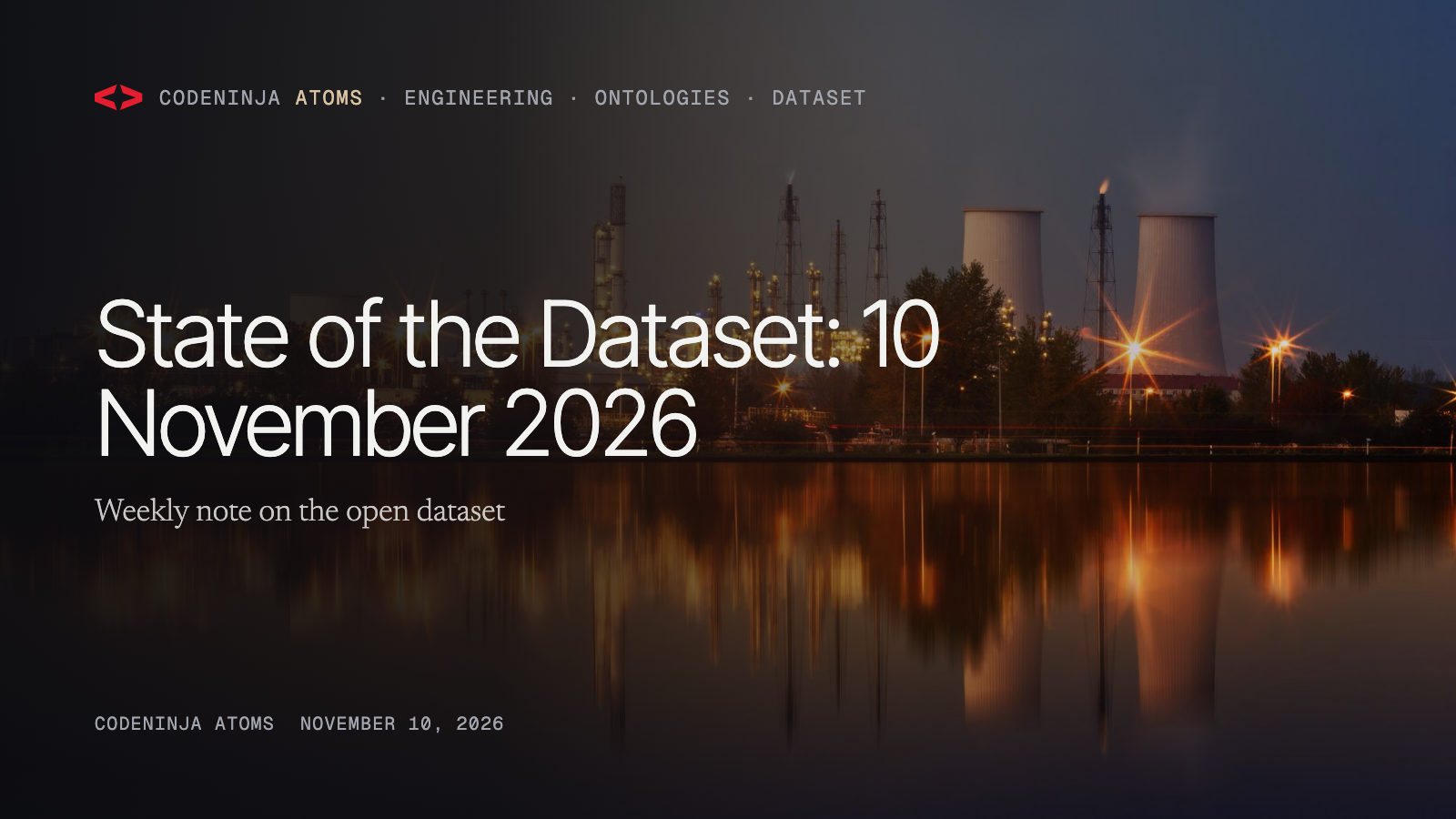
An Industrial Data Ontology for Freight Wagon Records in Pakistan
The requirement, in the operator's own voice: one governed model of the freight wagon fleet built from paper registers and builders' files, named agents that draft and officers who decide, and open weight models self hosted in Pakistan.
CodeNinja Atoms · November 9, 2026 · 6 min read
A Physical AI System Design for a Semiconductor Assembly and Test Line in Pakistan
The requirement, in the operator's own voice: edge units that read the inspection cameras at every critical station, one governed ontology of the line, named agents that classify and trace while engineers decide, and memory that makes every confirmed outcome improve the next one.
CodeNinja Atoms · November 9, 2026 · 6 min read
A Sovereign AI Architecture for Refinery Operations Knowledge in Saudi Arabia
The requirement, in the operator's own voice: one governed ontology of the whole refinery, named agents that draft and shift engineers who decide, open weight models self hosted in country, and memory that makes every trip analysis better than the last.
CodeNinja Atoms · November 9, 2026 · 5 min read
A Sovereign AI Reference Architecture for a Container Terminal in Pakistan
The requirement, in the operator's own voice: one governed ontology of every box from discharge to gate, named agents that draft the chases and the stack moves while planners decide, and open weight models on hardware the operator owns in the country.
CodeNinja Atoms · November 9, 2026 · 6 min read
State of the Dataset: 3 November 2026
Twenty eight published designs, 397 ontology objects and 290 register rows, covering eleven of thirteen sectors and eighteen of the thirty nine cells in the sector by country grid.
CodeNinja Atoms · November 3, 2026 · 5 min read
A Self-Improving AI System for a Gas Compressor Fleet in Saudi Arabia
The requirement, in the operator's own voice: one governed ontology of every compression train, named agents that draft and people who decide, and a loop that learns from every closed work order through memory, never by retraining weights.
CodeNinja Atoms · November 2, 2026 · 5 min read
State of the Dataset: 27 October 2026
Twenty three published designs, 317 ontology objects and 238 register rows, covering nine of thirteen sectors and fifteen of the thirty nine cells in the sector by country grid.
CodeNinja Atoms · October 27, 2026 · 4 min read
Physical AI System Design for Supply Chain and Logistics: What the Published Designs Already Answer
No supply chain design has been published in this series yet. Eight of the eighteen open reference architectures already answer the questions a logistics network asks first: one picture across the nodes from the systems they already run, gate and yard turn time, whether a terminal's inventory reading can be trusted, which vehicle in the fleet is raising a fault, what is connected to the control networks at each site, counting what moves, incidents before they happen, and what a records only study can settle before any sensor is bought.
CodeNinja Atoms · October 19, 2026 · 11 min read
What Does It Take to Vibe Code a Truck?
Software can now be described into existence. Physical systems cannot, because the knowledge needed to design them lives in the heads of senior engineers. This is how CodeNinja Atoms is building the missing piece: deep domain expertise for physical AI system design, carried as context instead of trained into weights.
Muhammad Umar · October 18, 2026 · 7 min read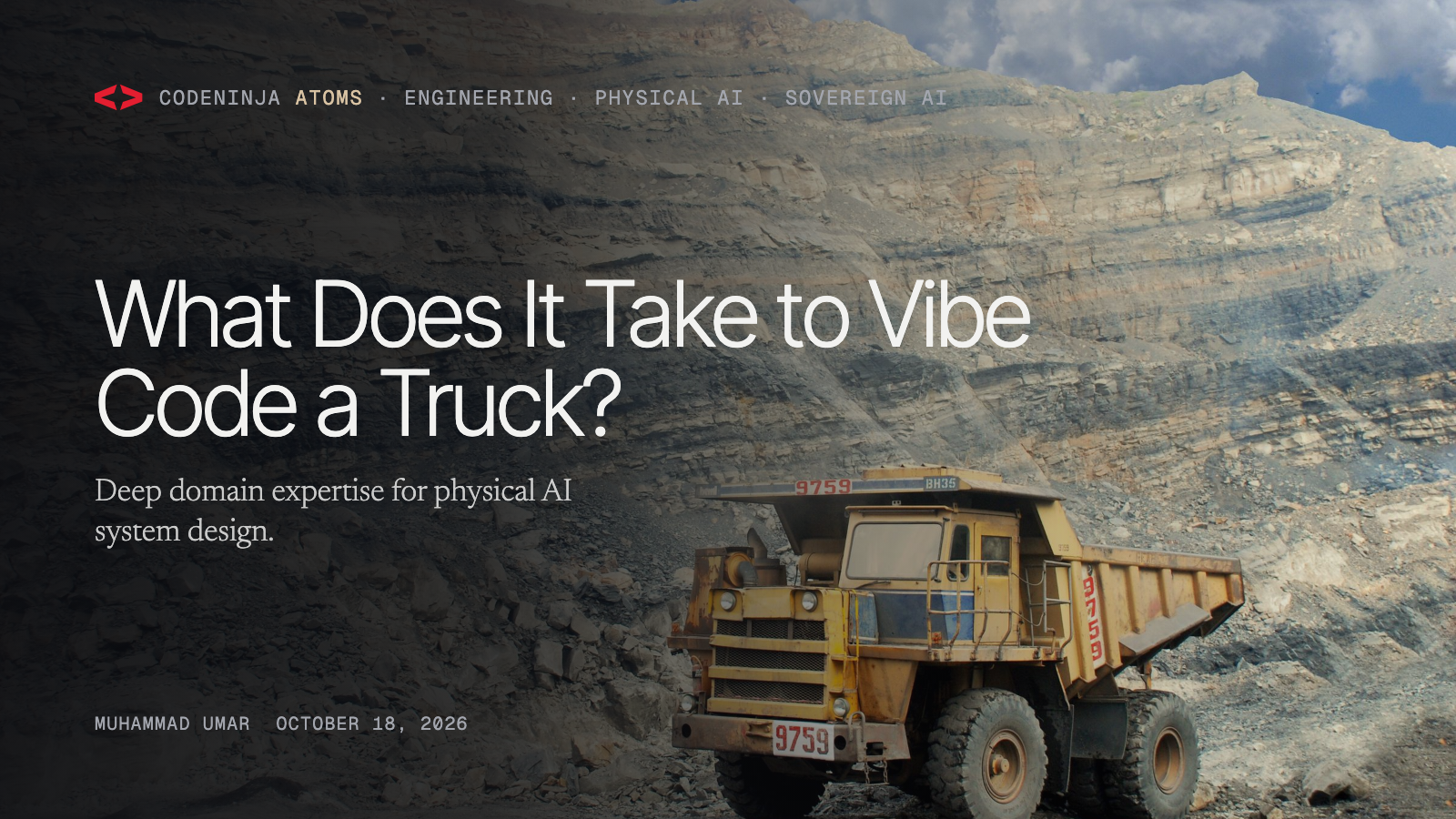
Physical AI System Design for Semiconductors: What the Published Designs Already Answer
No semiconductor design has been published in this series yet. Nine of the eighteen open reference architectures already answer the questions a fab or a packaging and test plant asks first: one picture of the operation from the systems it already runs, subfab and facility equipment condition, what is connected to the control networks and how to prove it, bulk tank readings that can be trusted, fire and life safety, people near equipment on camera, incidents before they happen, counting what leaves, and what a records only study can settle before any sensor is bought.
CodeNinja Atoms · October 17, 2026 · 12 min read
Physical AI System Design for Warehousing and Intralogistics: What the Published Designs Already Answer
No warehousing design has been published in this series yet. Nine of the eighteen open reference architectures already answer the questions a warehouse or distribution center asks first: one picture of the operation from the systems it already runs, dock and yard turn time, people and vehicles seen on camera, fleet and fixed equipment condition, fire and life safety, counting what leaves, and what a records only study can settle before any sensor is bought.
CodeNinja Atoms · October 16, 2026 · 10 min read
Physical AI System Design for Mining: What the Published Designs Already Answer
No mining design has been published in this series yet. Eight of the eighteen open reference architectures already answer the questions a mine asks first: people and vehicles on haul roads, mobile fleet and fixed plant condition, incidents before they happen, fire and life safety, counting what leaves the plant, and what a records-only study can settle before any sensor is bought.
CodeNinja Atoms · October 15, 2026 · 8 min read
From a CISA Advisory to a Closed Finding
What an operational technology security team does with an advisory about an actively exploited vulnerability, traced through one published system of context: the advisory becomes a threat intelligence item, the item seeds detection rules, a finding scores the operator's own assets, a named analyst accepts or rejects the risk, and the evidence a NERC CIP audit asks for is assembled on the way.
CodeNinja Atoms · October 14, 2026 · 7 min read
The Model Register Across Sixteen Designs
Sixteen open reference architectures for physical operations, each with a model register the operator owns outright. Twelve models, four empty registers by decision, and one licence pattern that repeats in every design.
CodeNinja Atoms · October 13, 2026 · 7 min read
Sensing Comes Before the Model
Three published earth observation architectures decide what to watch from law, revisit and ownership, never from model accuracy. Two of the three ship with an empty model register.
CodeNinja Atoms · October 11, 2026 · 5 min read
Own or Rent the GPUs
Seven published reference architectures, priced the same way, say owning the reasoning node costs between about half and nearly all of the deepest three year cloud commitment. Not a tenth.
CodeNinja Atoms · October 10, 2026 · 5 min read
Don't Baptize the GPUs
Why AI systems should be measured by running them, trained to seek truth and owned by the organizations that depend on them, rather than blessed into a theological category.
Muhammad Umar · October 6, 2026 · 10 min read