


Industrial Ontology Examples: A Port Equipment and Berth Object Model in Saudi Arabia
Maritime & Ports Watch: One Living Picture of the Operation
For the leaders accountable for maritime & ports operations, their supervisors, and the data and platform engineers who would build and run it.
Vertical-Driven Architectures is a CodeNinja series of system designs. Every design in the series is driven by a real-world problem and scenario in a single industry, and every one is designed on Praxis, CodeNinja's platform for designing physical AI systems. Operations are described by class, never by name.
Industrial Ontology Examples: A Port Equipment and Berth Object Model in Saudi Arabia
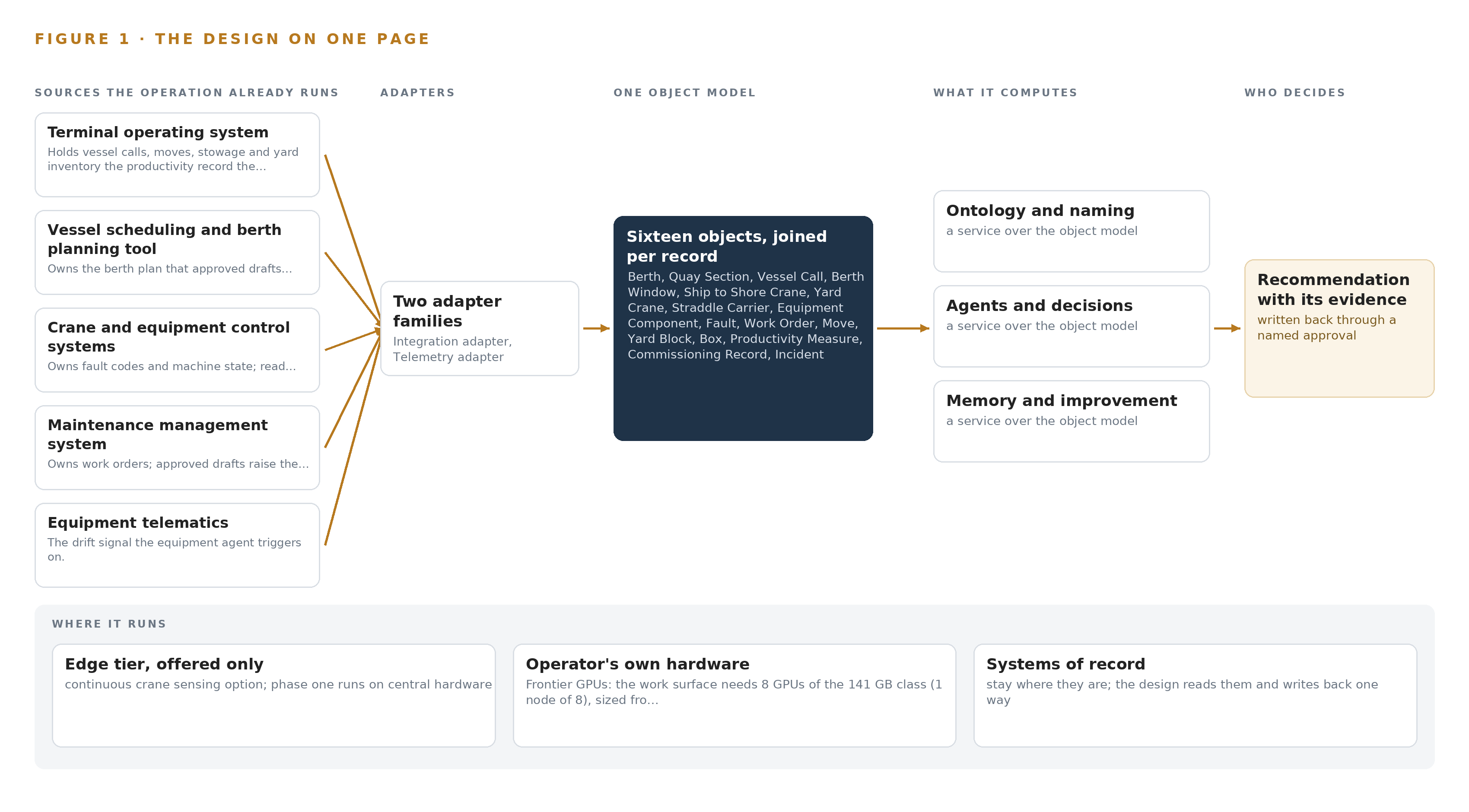
What this is. One of the industrial ontology examples in the Vertical-Driven Architectures series: an open reference architecture for system design in physical AI, built for a container terminal operator in Saudi Arabia whose expansion lengthens the quay, deepens the berths and adds ship to shore cranes and a yard block while the terminal keeps running, where owning the inference node that runs it costs about 570,000 US dollars over three years. When berth productivity drops on a working vessel call, the design joins the moves, the fault codes, the yard occupancy, the stowage plan, the granted berth window, the work orders and the commissioning records into one argument, so the operations manager sees which of the four candidate causes it was, the crane's fault, the yard block, the vessel's stowage or the berth window, within the shift. The models run entirely on the operator's own hardware in the country under the port authority's terms, the national data protection law, the port facility security code and export control on the GPU node. It is written for the leaders accountable for terminal operations, their engineering and operations managers, and the data and platform engineers who would build and run it. The operator is described by class, never by name.
The answer in numbers.
| Part | The design |
|---|---|
| Sources | Eight read only systems of record, entering through two adapter families (an integration adapter over APIs and read only views, a telemetry adapter into the time series store behind a hardware data diode) that stamp every event with its source, provenance class and read time: the terminal operating system, the vessel scheduling and berth planning tool, the crane and equipment control systems, the maintenance management system, equipment telematics, the port authority's vessel traffic and berth window data, the civil works and commissioning records and the safety incident register; the single write path back is a named approval into the maintenance system or the berth plan, never into a control system |
| Object model | 16 typed objects in six kinds with 13 typed links, from the berth, quay section and yard block through the ship to shore crane, yard crane, straddle carrier and equipment component, the vessel call, berth window, fault, move and incident, the work order and commissioning record, the box and the productivity measure, each anchored in one system of record and published as JSON for reuse |
| Models | GLM 5.3 (GLM-5.3 bespoke licence, 753B at FP8) for the three drafting agents (productivity, equipment, commissioning), the command centre and ontology maintenance; GLM-5.3-Flash (MIT, 320B total, 18B active, multimodal) reading the builders' commissioning drawings and pages on the terminal tier; BGE-M3 (MIT) for retrieval whose sparse leg keeps container numbers and fault codes exact; no third party model service, nothing trained into weights |
| Compute | One node of eight 141 GB HBM cards (1,128 GB) in the operator's own machine room in the Kingdom, holding 753 GB of FP8 weights with a 1.2 planning factor, 904 GB, 375 GB beside the weights; a two socket air cooled server class for the terminal tier; no edge tier committed (continuous crane sensing is offered and priced separately). The node is a 4A090 class item for a D:3 and D:4 destination, so an export licence determination naming the importer of record is a phase one start item |
| Rollout | Three phases carrying 18 scope items (15, 2 and 1), each closed by a gate, never a date: two berths, their cranes and yard blocks for one quarter with the object model proven on one week of production joins before any agent runs and the commissioning agent as the exit gate, then the whole terminal with the continuous crane sensing option as its gate, then the group's other ports; 21 requirements read against the build at every gate; baselines frozen on berth moves per hour, faults joined to a vessel call effect within the shift, days to commission a new crane's records and hours spent reconciling names |
| Three-year cost | About 570,000 US dollars to own the node for three years (a range of 542,000 to 594,000: server, support and power at the national commercial electricity tariff), against about 751,000 to rent the same eight cards on the deepest three year commitment in AWS Middle East (UAE), so ownership costs about three quarters of it, and about 2.00 million on demand, against which ownership costs a little over a quarter. Renting is a price reference only, because AWS listed no Saudi region on the day read and every rented option would carry cargo, vessel and equipment data across the border (Appendix A) |
| Human control | Agents draft and people decide, by name: the operations manager confirms the productivity agent's ranked causes, the engineering manager approves the equipment agent's work order and berth plan effect, and the expansion project engineer approves the commissioning agent's objects; approval latency is instrumented and known answer probes sit in the draft queue from day one, and every confirmation is kept as the memory the next trace reads |
Reuse it. The object model, the model register and the figures are free to reuse under CC BY 4.0. Cite as https://codeatoms.ai/port-equipment-berth-ontology-saudi-arabia/.
Made with. Reasoned on [CodeNinja Praxis](https://codeatoms.ai/praxis/), the CodeNinja Atoms platform for designing physical AI systems. The object model imports into [Hyper Ontology](https://codeatoms.ai/hyper-ontology/), which turns it into a living system. Load it with the [hyper-ontology loader](../hyper-ontology-py/): `hyper-ontology show port-equipment-berth-ontology-saudi-arabia`. Both are in beta; access by request.
The Answer Already Exists in the Systems the Operation Runs
Berth productivity drops and nobody can say whether the cause was the crane's hydraulic fault, the yard block that could not keep up, the vessel's stowage or the berth window the authority granted; this paper, one of the industrial ontology examples in this series, is a port equipment and berth object model that lets a container terminal operator in Saudi Arabia answer that question.
The design reads 9 source systems through 2 adapter families into one object model of 16 objects, runs 10 services over it and opens 4 surfaces to the people who decide, with 3 models placed where the data is. A governed industrial ontology of the terminal's berths, equipment and moves, built from the operator's eight named systems of record and kept current move by move, with three drafting agents (productivity, equipment, commissioning) whose outputs managers confirm and which write back only through named approvals. Reasoning runs on GLM 5.3 open weights self hosted by a container terminal operator in Saudi Arabia on one 141 GB HBM class node, with a kept record of decisions and outcomes that the next decision reads, memory improving every next trace without training.
The paper covers the operation and the problem its systems cannot answer, the constraints, the stack, the object model, ingestion, inference placement, the models and their licenses, the rollout and its proof, ownership, and finally how Praxis contextualized and reasoned the design.
Contents
Each chapter is tagged for the reader it serves most directly: Executive, Team Lead, FDE, Reference.
| Abstract · The Answer Already Exists in the Systems the Operation Runs | Executive | |
| PART I · THE PROBLEM | ||
| 1 | A Daily Question Goes Unanswered in the Systems That Hold the Data | Executive |
| 2 | Every System Sees One Slice of the Operation | ExecutiveTeam Lead |
| PART II · THE DESIGN | ||
| 3 | Four Constraints Shape Everything Downstream | Team Lead |
| 4 | One Stack Runs From the Systems of Record to the Surfaces | Team LeadFDE |
| 5 | Sixteen Objects Turn Operational Data Into One Argument | FDE |
| 6 | Every Source Enters Through an Adapter, Never Directly | FDE |
| 7 | Inference Belongs Where the Data Is | FDE |
| 8 | The License Decides What the Operator Can Own | FDEExecutive |
| PART III · THE ROLLOUT | ||
| 9 | Shadow Mode Comes Before Any Flag Is Trusted | Team LeadExecutive |
| 10 | The Intelligence Should Stay with the Operation That Produced It | Executive |
| PART IV · HOW IT WAS DESIGNED | ||
| Conclusion · The Pattern Repeats Wherever Systems of Record Do Not Meet | Executive | |
| 11 | How Praxis Contextualized and Reasoned This Design | Team LeadFDE |
| Sources | Reference | |
A Daily Question Goes Unanswered in the Systems That Hold the Data
The operation holds every fact the question needs and no system answers it.
The abstract promised one of the industrial ontology examples in this series, a system that answers a daily operational question from data the operation already holds. This chapter states that question exactly, documents what its absence costs, and sets out the scenario the rest of the design answers.
1.1 The Question, the Data and the Regimes
When berth productivity drops on a working vessel call, the person accountable needs one ranked answer drawn from four candidate causes: a crane fault such as a hydraulic failure, a yard block that could not keep up, the vessel's stowage, or the berth window the authority granted. A terminal that can rank those causes daily belongs to the family of industrial ontology examples: reasoning held in country, on the operator's own hardware, projected over the systems of record rather than copied out of them. The data the ranking requires already exists, but only as separate facts in separate systems: moves with their seconds and equipment identity, fault codes with clearing times, yard occupancy and reshuffle ratios, stowage plan references, window grants against actual arrivals, work orders with their berth plan effect, and the commissioning status of newly installed cranes.
The regulatory regimes shape the design as much as the data does. Marine casualty investigation standards require timely, evidence-based reconstruction of what equipment did and when (IMO 2008), and a fatal injury at a port shows how such reconstruction depends on joining equipment behavior to the sequence of operations (TAIC n.d.). Port facility security obligations put a named officer's approval on anything touching the secured area. National cybersecurity and communications controls demand auditable segmentation of operational technology. The kingdom's personal data protection law sets transfer conditions, including its Article 29 assessment, before gang, incident and driver records reach group ports. Export control rules attach to the accelerator class the reasoning runs on.
1.2 The Documented Cost
The cost of an unanswered attribution question is not one bad shift but a recurring one. Ports carry national weight: ports deliver 95 per cent of the country's imports and exports, including much of its food, fuel and materials, according to the ports safety code (Service 2025), so every unexplained fall in berth productivity propagates into supply chains rather than stopping at the quay. The safety record compounds the same failure, because accidents are documented to be underreported to vessel accident databases (NIH 2011), and an incident register that cannot be joined to the equipment and the vessel call it involved leaves every investigation to rebuild the same links by hand, under the timeliness the investigation code expects (IMO 2008).
1.3 The Operation as a Scenario
The operator is a container terminal operator in Saudi Arabia. It berths container ships against a quay served by ship to shore cranes, moves boxes with yard cranes, straddle carriers and terminal tractors, and hands them to road and rail at the gate. A terminal expansion under way lengthens the quay, deepens the berths, adds ship to shore cranes and a new yard block, and raises capacity toward two and a half million containers a year; by the operator's own assessment the expansion roughly doubles the objects under management and adds a second builder's equipment carrying its own vocabulary. The people in the loop are operations managers, engineering managers, maintenance planners, berth planners, the port facility security officer and the authority's vessel traffic staff; the planners who know which crane behaves how are few, and name reconciliation happens in meetings today. The physical environments are the quayside in Gulf heat and salt air, the yard blocks, the terminal machine room, and the road and rail gate. The operation runs eight named systems of record, counted roles spanning operations, engineering, maintenance, planning, security and the authority, and counted places spanning berths, yard blocks, the gate and the machine room, and the design in Part II stands on those counts.
Every System Sees One Slice of the Operation
Each system of record sees its own part of the answer and none sees the whole.
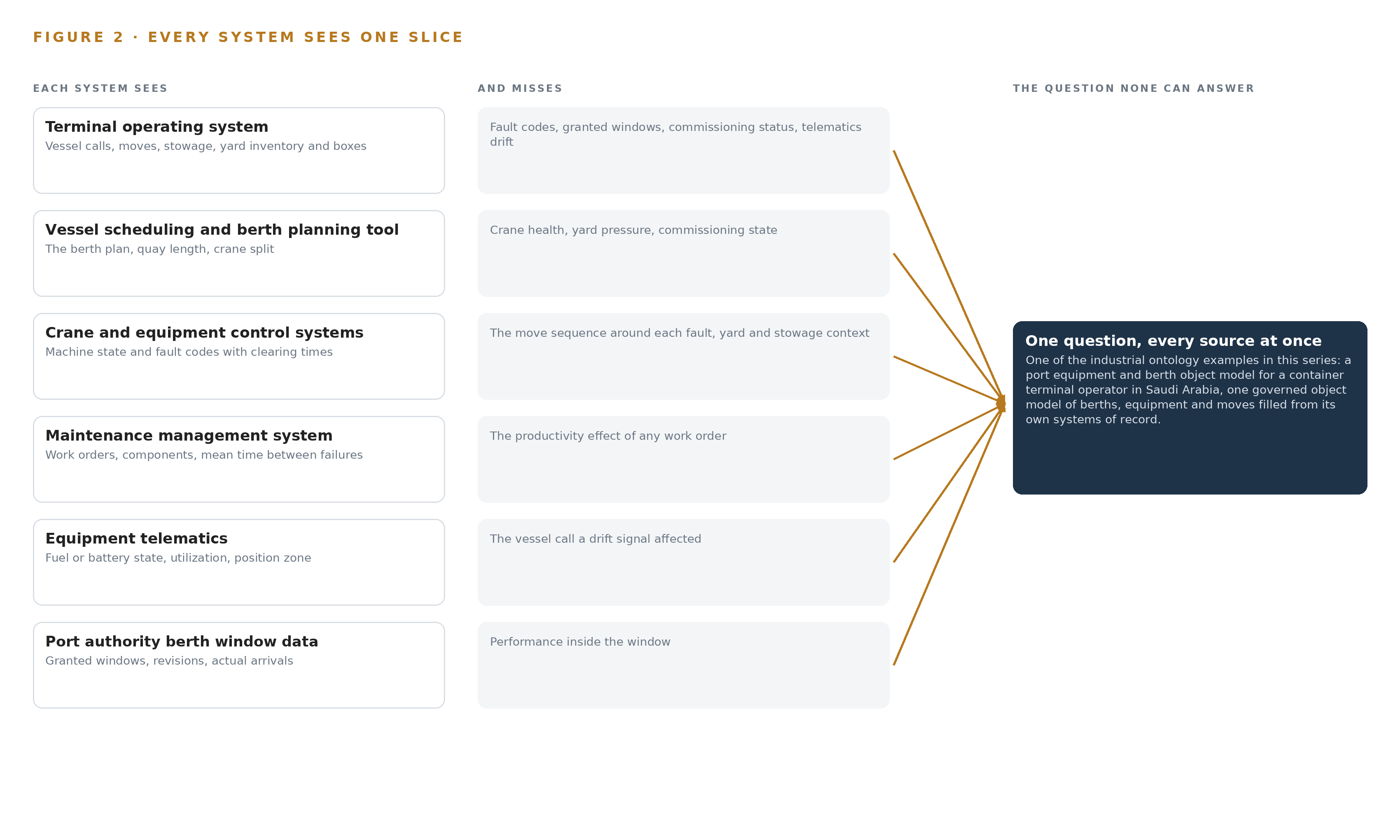
Chapter 1 stated the question and priced its absence. This chapter shows why none of the existing systems can answer it: each sees one slice of the operation, and each names the same physical thing differently.
2.1 What Each System Sees
The terminal operating system holds vessel calls, moves, stowage and yard inventory, which makes it the productivity record, but it never sees the fault code that slowed the crane, the window the authority actually granted, or the commissioning state of the newest machine. The vessel scheduling and berth planning tool owns the berth plan, the quay length and the crane split, yet cannot see whether the crane it assigned is under repair. The crane and equipment control systems own machine state and fault codes, but not the move sequence around each fault or the yard pressure behind it. The maintenance management system owns work orders and component history, but not what any work order did to berth productivity. Equipment telematics carries fuel state, utilization and position, but cannot join a drift signal to the call it affected. The port authority's vessel traffic and berth window data holds the granted window, but nothing about performance inside it. The civil works and commissioning records hold the expansion's objects and the builders' cited documents, but nothing about how those objects perform once handed over. The safety incident register holds incidents, but not, on its own, the equipment component and the vessel call each incident belongs to. Figure 2 sets these slices side by side.
2.2 What None of Them See Together
The question of Chapter 1 crosses all eight slices at once, and no system crosses even two. In practice the cost is paid in meetings: managers resolve names by hand, because a crane is an asset in maintenance, a resource in operations, a controller in automation and a line item in the commissioning records. The few planners who know which crane behaves how become a single point of failure for the whole operation, and the expansion doubles the object count while the second builder's vocabulary reopens the reconciliation the first builder's equipment already needed, so the manual join gets harder at exactly the moment productivity matters most.
Four Constraints Shape Everything Downstream
The goals, the scoping decisions and the exclusions were fixed before any component was chosen.
Chapter 2 showed eight systems, each holding one slice and none able to join even two. This chapter fixes the goals and exclusions that every component choice in Part II answers to.
3.1 The Systems of Record Stay in Place
The design sits beside the systems of record, never replacing them, never modifying them, never loading their databases out. This is hardest exactly where it matters most: the terminal operating system is the operational clock the design reads productivity from, and the crane and equipment control systems are safety-rated, so writing to them is not a shortcut but a boundary breach. The expansion runs alongside live operations, which removes any window in which systems could be swapped.
3.2 The Weights Stay in the Country
Open weight models run on the operator's own hardware inside the country, and nothing about cargo, vessels or equipment leaves the network. The easy path in this industry is a hosted frontier API, which the requirement forbids; the sovereign path carries real friction, because the accelerator class the reasoning needs attracts an export license determination for the destination country, national cybersecurity controls demand auditable segmentation of the operational technology zone, and the operator, not a vendor, carries the hardware.
3.3 Named People Decide Every Write
Agents draft, managers confirm, and the single write path back to a system of record is an approved draft, raising a work order under the confirmer's name or adjusting the berth plan through the planning tool. The difficulty is behavioral rather than technical: approvals drift into rubber-stamping, and a false confirmation poisons the memory the system improves on, so approval latency is instrumented and known-answer probes are injected into the draft queue from the start of phase one.
3.4 Improvement Comes From Memory, Not Training
The system improves by reading a memory of confirmed outcomes before each run, never by updating weights. This inverts the standard machine learning loop, whose natural answer is fine tuning, and it holds because the requirement says the next call and the next crane must be modelled better without training a model on the fly; the constraint also protects the boundary, since no training pipeline means no data ever leaves for one.
3.5 Scoping Decisions
Table 1 records the three decisions that bound the work.
| Decision | What it buys | What it costs |
|---|---|---|
| Prove the object model on two berths before any agent runs | A first gate that can stop the work cheaply, with joins validated against production data | Value is held back from the rest of the terminal until the gate passes |
| Commit to existing telematics and fault logs, with continuous crane sensing quoted as an option | A committed price built on signals the operator already owns | If drift resolution proves too coarse, the sensing tier is exercised later rather than in place |
| Write back only through named approvals | An auditable decision record and a memory built on true confirmations | Every draft waits on a person, so approval latency becomes a managed quantity |
3.6 What the Design Chose Against
Table 2 records the rejected alternatives and the exclusions that close the scope.
| Where | What was picked | Instead of, and why |
|---|---|---|
| Reasoning | GLM 5.3 self hosted on one 141 GB class node at FP8 | A hosted frontier API or a mid-size dense model: the operator names GLM 5.3 and forbids third party services, and one node holds the FP8 weights with room for KV cache |
| Improvement | A kept record of decisions and outcomes that the next decision reads: memory of confirmed outcomes | Fine tuning on confirmed traces: the requirement states the next call and the next crane are modelled better without training a model on the fly |
| Control system egress | A hardware data diode enforcing one-way transfer of fault logs and telematics | A firewalled bidirectional conduit: the control zone stays strictly read-only, and the diode settles the argument in hardware rather than in policy |
| Crane sensing | Existing telematics and fault logs, with a camera tier on critical cranes offered and priced separately | Committed continuous crane vision: existing signals get a fair test first, and the offered tier carries its own gate |
| Scope boundary | Equipment control changes, model training, third party model service, group ports, hardware and infrastructure, historic migration and round the clock cover are out of scope | A broader build: control changes breach the safety boundary, training breaches the improvement doctrine, group ports wait on the phase one gate, and hardware, vendor fees and support beyond working hours stay with the operator |
One Stack Runs From the Systems of Record to the Surfaces
Systems of record below, one object model in the middle, services and surfaces above.
Chapter 3 fixed the four constraints and the scoping decisions they force. This chapter turns those decisions into a stack, in a fixed order from the systems of record up to the surfaces the managers watch.
4.1 A Projection Over the Systems of Record
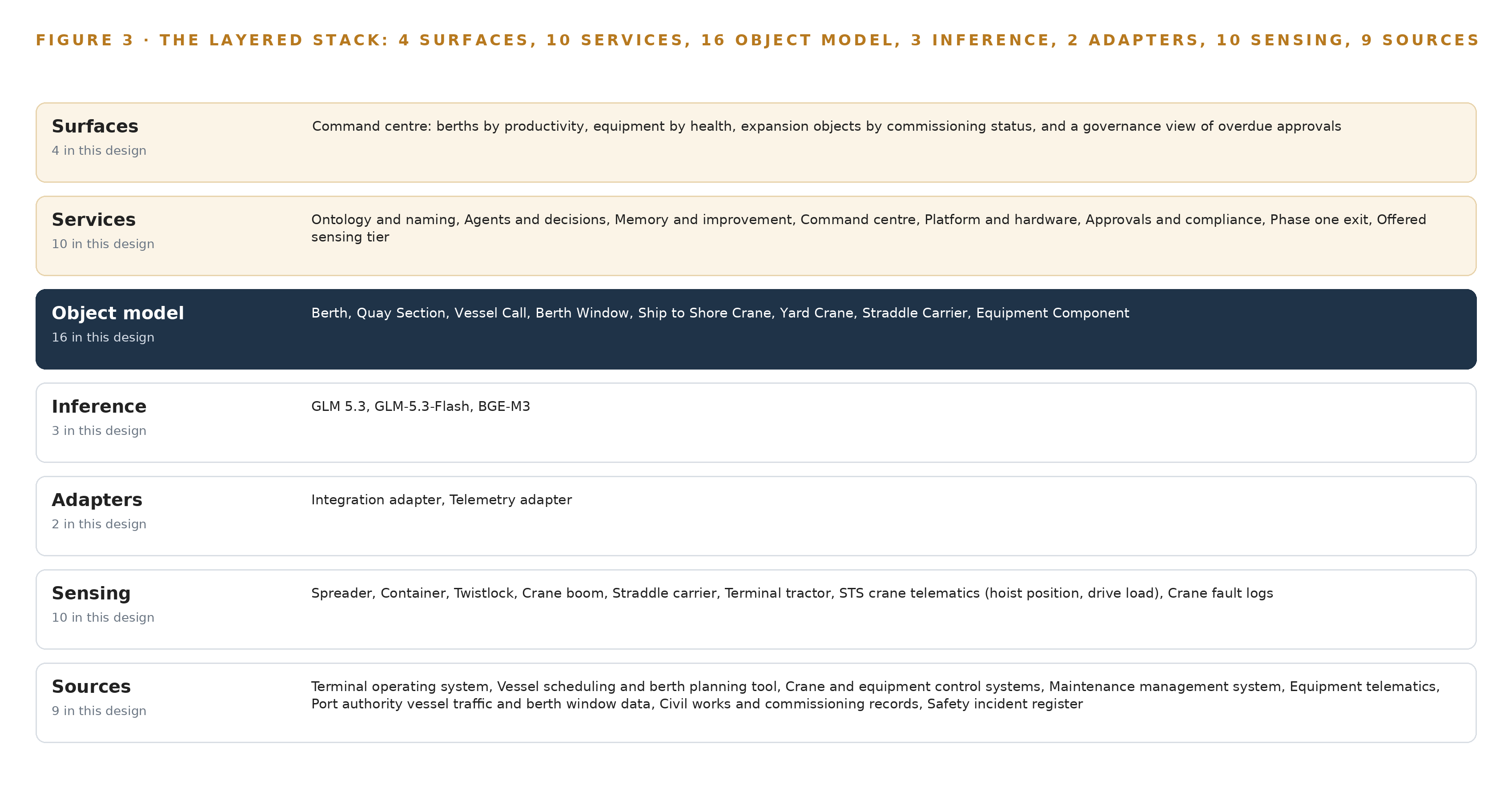
The pattern is a projection, not a replacement. The eight systems of record stay below, untouched and still authoritative, each keeping its own names and its own duties. Above them sits one object model of 16 objects, filled move by move and never holding a shadow copy of any record, and above the model sit ten services, four surfaces and three models. This is the shape that sovereign AI reference architectures converge on when cargo data cannot leave the country: bind the records where they are, govern one vocabulary over them, and keep the inference inside the boundary on owned hardware. Figure 3 shows the layered stack with the count at each layer, and Table 7 names the component chosen at each layer and the reason for it.
| Layer | Component | Choice | Why |
|---|---|---|---|
| Event streaming and messaging | by class, no product named | Product | Apache Kafka 4.3.x (KRaft) |
| The ontology or graph store | by class, no product named | Product | Hyper Ontology v0.9 (Semantics and Kinetics) |
| Time series and telemetry storage | by class, no product named | Product | InfluxDB 3 Core |
| Video ingest, recording and management | by class, no product named | Product | MediaMTX |
| Edge model serving | by class, no product named | Product | OpenVINO |
| On site language model serving | by class, no product named | Product | vLLM |
| Object tracking and trajectory forecasting | by class, no product named | Not needed | No tracking duty; moves carry equipment identity from the TOS and ECS. |
| Edge orchestration of containers | by class, no product named | Not needed | Phase one runs on the operator's central hardware; only the offered crane tier would add gateways. |
| An air gapped artifact and model registry | by class, no product named | Product | Harbor |
| Labelling and retraining | by class, no product named | Not needed | Under system of context nothing is trained or distilled into weights; memory of confirmed outcomes is the improvement path the requirement names. |
| Time synchronisation across sensors and systems | by class, no product named | Product | Chrony (NTP) with linuxptp |
| Observability of the running system | by class, no product named | Product | Prometheus 3.13 LTS with Grafana and Loki |
4.2 The Stack Stage by Stage
Table 3 walks the seven stages, what each is responsible for, and how. The Sources stage is the eight operator systems, all read only, named with their provenance in Chapter 6. The Sensing stage turns four feeds into ordered streams: crane telematics with hoist position and drive load, crane fault logs, move events and the authority's berth window feed, with an offered camera tier of three fixed cameras priced as an option. The Adapters stage is two families, an integration adapter over APIs and read-only views and a telemetry adapter into the time series store, the control systems reached only through a hardware data diode. The Object model stage holds the 16 objects in a governed graph store keyed to one naming service, so a crane is one thing whichever system it arrived from. The Inference stage runs GLM 5.3 at FP8 on one node of eight 141 GB GPUs under vLLM, with GLM-5.3-Flash on the builders' commissioning documents and BGE-M3 on retrieval. The Services stage carries ten services, from ontology and naming through agents and decisions, memory and improvement, command center and approvals to the scaling workstreams. The Surfaces stage is four command center views: berths by productivity, equipment by health, expansion objects by commissioning status, and a governance view of overdue approvals.
| Stage | What it is responsible for | How |
|---|---|---|
| Sources | Hold the authoritative records the model projects | Eight operator systems, all read only, from the terminal operating system to the safety register |
| Sensing | Turn machine and authority feeds into ordered streams | Crane telematics, fault logs, move events, berth window feed; offered tier adds three fixed cameras |
| Adapters | Own each source's contract and provenance | Integration adapter on APIs and read-only views; telemetry adapter to the time series store; control systems via data diode |
| Object model | Keep one governed vocabulary of 16 objects | Graph store filled move by move, keyed to the naming service |
| Inference | Read the model and the builders' documents | GLM 5.3 at FP8 on one node of eight 141 GB GPUs under vLLM; GLM-5.3-Flash and BGE-M3 beside it |
| Services | Draft, confirm, remember and scale | Ten services, from ontology and naming and agents and decisions to command center and approvals |
| Surfaces | Show managers what to decide on | Four command center views: productivity, equipment health, commissioning status, overdue approvals |
4.3 A Reusable Pattern
The pattern underneath this design is one a team carrying a similar brief can reuse: systems of record below, one adapter per system family, one object model in the middle, and services and surfaces above that resolve every answer back to that model.
In this design the shape holds 9 sources, 16 objects, 4 surfaces. What a reader swaps is the sources, the objects and the models; what they keep is the adapter tier, the one object model and the rule that inference runs where its latency budget allows.
Sixteen Objects Turn Operational Data Into One Argument
The object model is the join the systems never made.
Chapter 4 ended the stack at the object model, the one layer every service reads and no source system writes. This chapter opens that layer: what it holds, where people enter it, and the exact form one object takes in the record.
5.1 Sixteen Objects and the Links Between Them
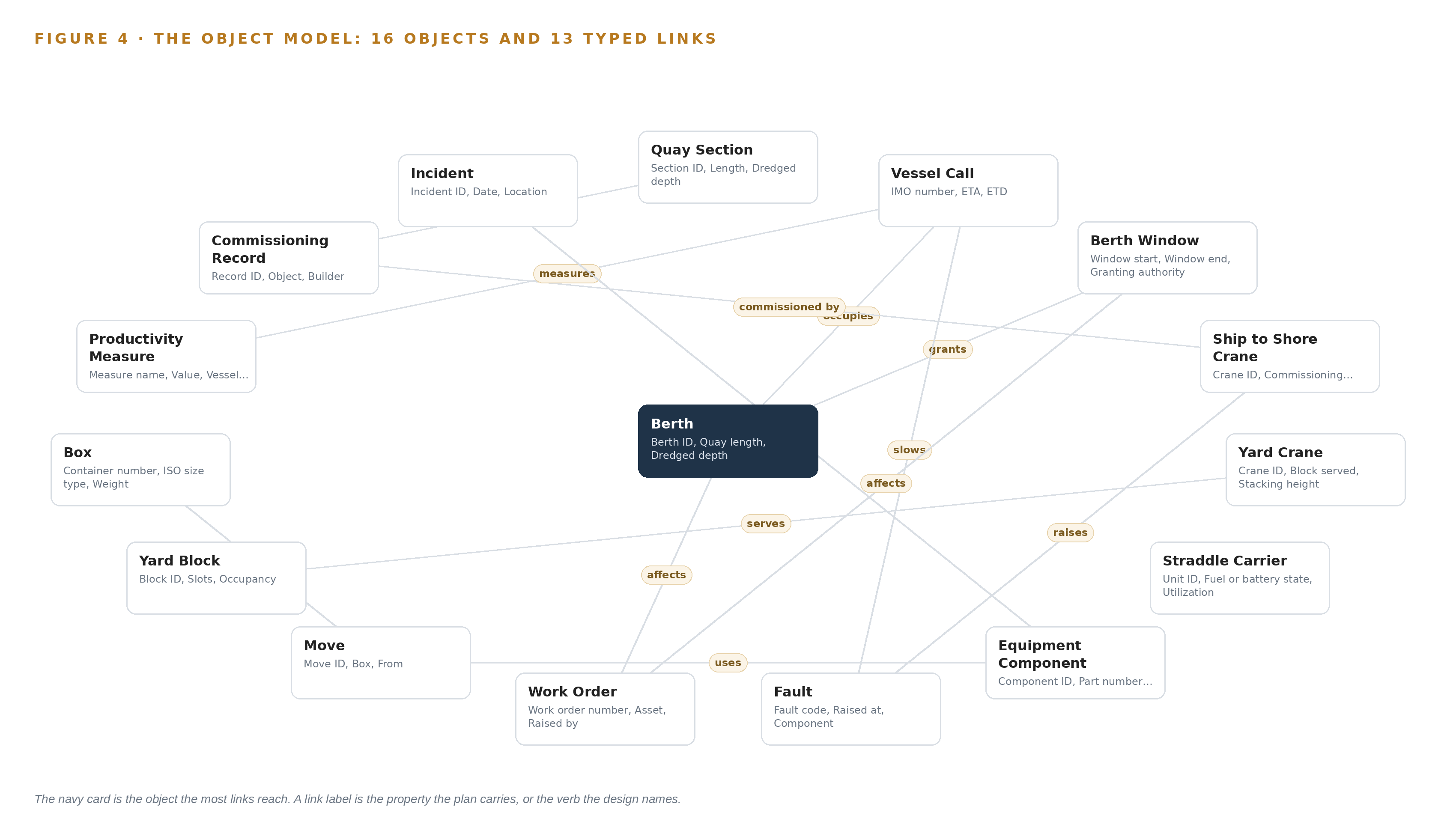
The model holds sixteen objects in six kinds: three sites (Berth, Quay Section, Yard Block), four assets (Ship to Shore Crane, Yard Crane, Straddle Carrier, Equipment Component), five events (Vessel Call, Berth Window, Fault, Move, Incident), two records (Work Order, Commissioning Record), one material (Box) and one measure (Productivity Measure). Each object is anchored in exactly one system of record, the system whose word on that object is final: the Berth in the vessel scheduling and berth planning tool, the Move and the Box in the terminal operating system, the Fault in the crane and equipment control systems, the Incident in the safety incident register. Table 8 sets out every object with its anchor and its typed links. Anchoring is what keeps the model a projection over the systems of record rather than a second copy of them: the ontology claims nothing the sources do not hold, and it never becomes the place a record is kept.
The typed links are the join the systems never made. Move carries Box and names Equipment Component; Productivity Measure names its Vessel Call; a Work Order records its berth plan effect against both Berth and Berth Window; an Incident names its Equipment Component. A query can therefore start at a berth's productivity measure, walk back through the vessel call to the individual moves and the equipment that performed them, continue to the faults that equipment raised and the work orders those faults produced, and end at the berth window the authority granted, all in one traversal. Figure 4 draws every object and every link. A document store holds each of these facts somewhere, but it cannot answer the operator's question, whether the drop was the crane, the yard, the stowage or the window, because that answer lives in the joins, and typed links are the one structure that carries them. The same traversal is why the Incident object matters: maritime accidents are documented to be underreported to official databases (NIH 2011), and an incident that joins to its equipment and its call in the same model as the fault codes is an incident that can be found.
| Object | Anchored in | Typed links |
|---|---|---|
| Berth | Vessel scheduling and berth planning tool | grants: Berth Window |
| Quay Section | Civil works and commissioning records | carries: Commissioning Record |
| Vessel Call | Terminal operating system | occupies: Berth |
| Berth Window | Port authority vessel traffic and berth window data | no typed link recorded |
| Ship to Shore Crane | Crane and equipment control systems | commissioned by: Commissioning Record; raises: Fault |
| Yard Crane | Crane and equipment control systems | serves: Yard Block |
| Straddle Carrier | Equipment telematics | no typed link recorded |
| Equipment Component | Maintenance management system | no typed link recorded |
| Fault | Crane and equipment control systems | slows: Vessel Call |
| Work Order | Maintenance management system | affects: Berth; affects: Berth Window |
| Move | Terminal operating system | carries: Box; uses: Equipment Component |
| Yard Block | Terminal operating system | no typed link recorded |
5.2 The Human Loop and the Hosting Posture
People enter the model at the confirmation step. The three drafting agents, for productivity, equipment and commissioning, propose; managers confirm; and the single write path out of the ontology is the named approval: an approved work order lands in the maintenance management system under the confirmer's name, and an approved berth plan adjustment lands in the planning tool. No agent dispatches equipment, and no agent writes to a control system. The hosting posture follows the same line: the model runs on the operator's own hardware inside the country, identity is issued on site so every confirmation carries a person, the port authority feed is the one inbound external link, and a hardware data diode carries fault logs out of the control zone one way. Nothing about cargo, vessels or equipment leaves the network, the boundary that sovereign AI reference architectures in regulated industries draw.
5.3 One Object in Its Recorded Form
The Berth, the object a productivity argument starts from, is recorded in the form the platform prints beneath this section: identifier, label, kind, properties, status vocabulary and links; the Ship to Shore Crane, the object every productivity argument passes through, is recorded the same way.
{ "id": "berth", "label": "Berth", "kind": "site", "anchored_in": "Vessel scheduling and berth planning tool", "properties": [ "Berth ID", "Quay length", "Dredged depth", "Crane split" ], "status_vocabulary": [], "links": [ { "to": "berth-window", "label": "grants" } ] }Every Source Enters Through an Adapter, Never Directly
Nothing reaches the object model except through an adapter that owns its contract.
Chapter 5 showed sixteen anchored objects with typed links between them. This chapter shows how data reaches them: every source enters through an adapter that owns its contract, and nothing reaches the object model directly.
6.1 Every Named Source and Its Provenance
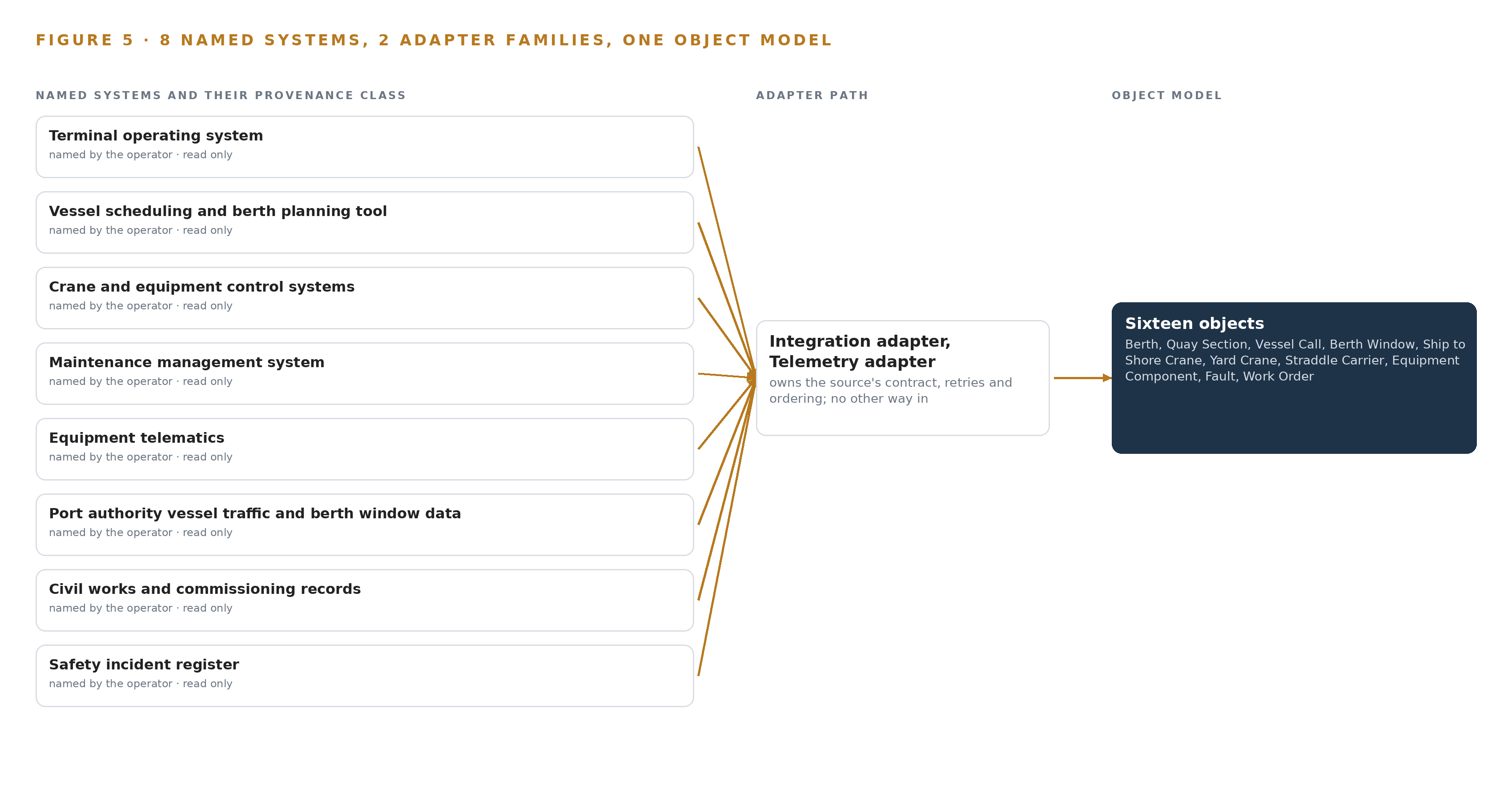
Eight named source systems feed the model. The terminal operating system holds vessel calls, moves, stowage and yard inventory, the productivity record the ontology is built on. The vessel scheduling and berth planning tool owns the berth plan that approved drafts adjust. The crane and equipment control systems own fault codes and machine state, read through a one-way path with no write back. The maintenance management system owns work orders, and receives the ones approvals raise. Equipment telematics is the drift signal the equipment agent triggers on. The port authority's vessel traffic and berth window data supplies the granted window, one of the four ranked causes of a productivity drop. The civil works and commissioning records hold the expansion's objects and the builders' cited documents. The safety incident register feeds the Incident object, the record safety investigations are built on under the international code for casualty investigation (IMO 2008). All eight carry first-party provenance, systems the operator or its authority owns, named by role because their products are confirmed on site; all are read except the single approved write back to work orders. Figure 5 maps each system, its provenance class and its adapter path.
6.2 What the Adapter Tier Guarantees
Two adapter families cover the eight systems. The integration adapter serves the transactional sources, the operating system, the planning tool, the maintenance system, the commissioning records and the incident register, over APIs and read-only views built per system. The telemetry adapter serves the high-rate sources, the control systems' fault logs and the equipment telematics, and carries the hardware data diode that makes the control zone read-only in silicon rather than in policy. The tier guarantees five things: each adapter owns its contract, so a source change breaks one adapter and not the model; every event is stamped with its source, provenance class and read time; source names are resolved to governed object identities, so the second builder's vocabulary maps rather than invents; events are buffered and replayed when a link fails; and no adapter ever writes to a source except the approval path already described.
6.3 The Event Backbone
The backbone is Kafka 4.3.x in KRaft mode. Ordering is per key: move events are keyed by vessel call so a call's moves arrive in sequence, and fault events are keyed by crane so a fault history reads true. Delivery is at least once, made safe by idempotent upserts keyed on object identifiers, so a replayed event converges on the same record instead of duplicating it. Brokers replicate, adapters buffer against source outages, and the terminal's own network carries everything committed. Time is the quiet dependency: operating system events, control system fault logs and telematics join on one clock disciplined by Chrony and linuxptp under an OCP Time Card grandmaster, because a fault joined to the wrong shift is worse than a fault not joined at all.
Inference Belongs Where the Data Is
Each tier runs what its data and its link can carry.
Chapter 6 described how every source enters through an adapter and never directly, and how the event backbone carries each record to the object model in order. This chapter decides where the models that read those records run, and why each tier of hardware carries only what its data and its link can support.
7.1 Three Tiers and the Arithmetic That Fixed Them
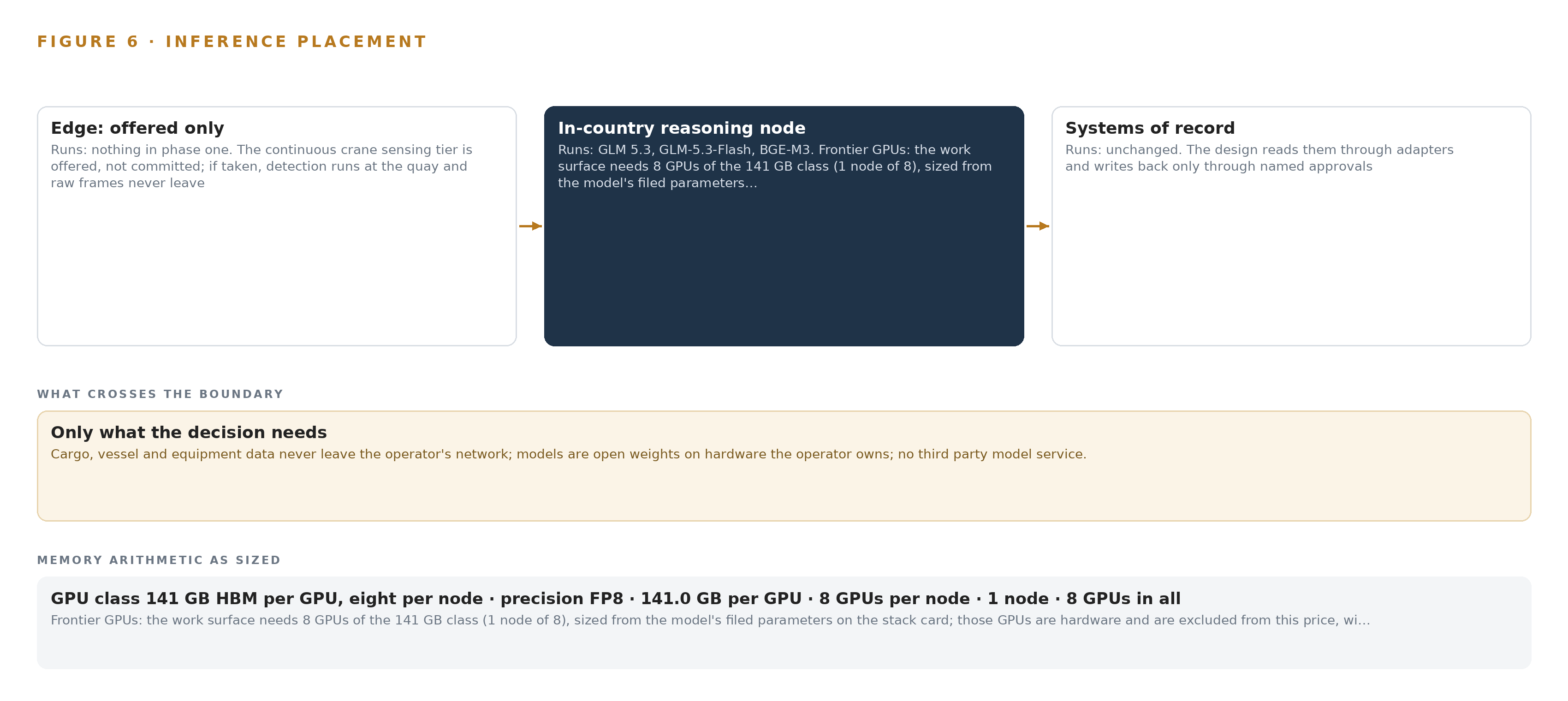
The committed design runs inference on three tiers, and the memory arithmetic of the frontier tier fixed the whole placement. The central tier holds GLM 5.3, the frontier-class work surface model, on the operator's own hardware in country: one node of eight GPUs of the 141 GB high bandwidth memory class, which is 1,128 GB of usable memory. The model's filed parameter count is 753 billion, served at FP8 precision, where each parameter occupies one byte, so the weights alone occupy 753 GB. The 1.2 planning factor reserves a further 151 GB for the KV cache, the per-conversation attention memory a running model allocates, and for activations, so the node must hold 904 GB in total; it holds that with margin, leaving 375 GB beside the bare weights. Serving runs on vLLM, and because the node is inside the country and owned by the operator, no reasoning request crosses a border.
The terminal tier hosts GLM-5.3-Flash on a two-socket air-cooled server class in the terminal machine room, reading the builders' commissioning documents and carrying retrieval volume so the frontier node stays reserved for reasoning. The embedding tier runs BGE-M3 on the central node. A fourth tier is offered, not committed: continuous crane sensing, which would add edge compute of the fanless, sealed, sunshielded class rated for Gulf quayside heat, serving detection through OpenVINO, with a development-board measurement as the gate before any unit is fixed. Figure 6 sets the four tiers side by side, with what runs on each and what crosses between them.
7.2 The Latency Budget
The budget is set by the decision each output serves, not by a number quoted for a component. Move events must join in stream order on the backbone, because a productivity argument assembled out of order is wrong, not merely late. The productivity question itself is answered after the vessel call, on the terminal operating system's own clock, because that is the clock the measure is defined against. Drift signals from telematics must surface within the shift, so a superintendent can act while the crane is still the problem of this shift rather than the next one's investigation. Commissioning document reading is working-hours work, and conversational retrieval answers within a session. Nothing committed needs a model to answer faster than a manager can read it, because agents draft and managers decide; the one latency the ontology itself carries is event ordering, which time synchronization through Chrony with linuxptp and the backbone's ordering guarantee hold.
7.3 The Boundary, and What Happens When It Fails
What crosses the network boundary crosses it inward, and only as a read. The crane and equipment control systems are read through Lidi over a hardware data diode, so fault logs and machine state leave the control zone and nothing can return: the control-zone segmentation required of operational technology is satisfied by construction rather than by firewall policy that a misconfiguration could undo. Nothing about cargo, vessels or equipment leaves the country, because the frontier node is the operator's own hardware in country and no third party model service is called anywhere in the design.
The failure paths are each specified. When the link between the terminal and the central node drops, the backbone buffers events and replays them in order on recovery, so the object model catches up rather than gaps. When power fails, each tier restarts against its last committed offsets and time resynchronizes through Chrony with linuxptp, so joins made after restart still line up by timestamp. When the update path is the failure, model artifacts arrive through Harbor, the air-gapped artifact and model registry: they are staged, verified and applied on the operator's schedule rather than pulled live from outside. The systems of record are never the point of failure for the intelligence, because the intelligence writes to none of them, and the one write path that exists goes through named approvals into the maintenance system and the berth plan, never into the control zone.
The License Decides What the Operator Can Own
Every model was chosen against its license before its accuracy.
Chapter 7 fixed where each tier runs and what each node must hold. This chapter turns to the models themselves, and to the licenses that decide whether the operator can keep what it runs: a model the operator cannot legally hold on its own hardware is not a sovereign choice, however accurate it is.
8.1 Three Models and the Terms That Bind Them
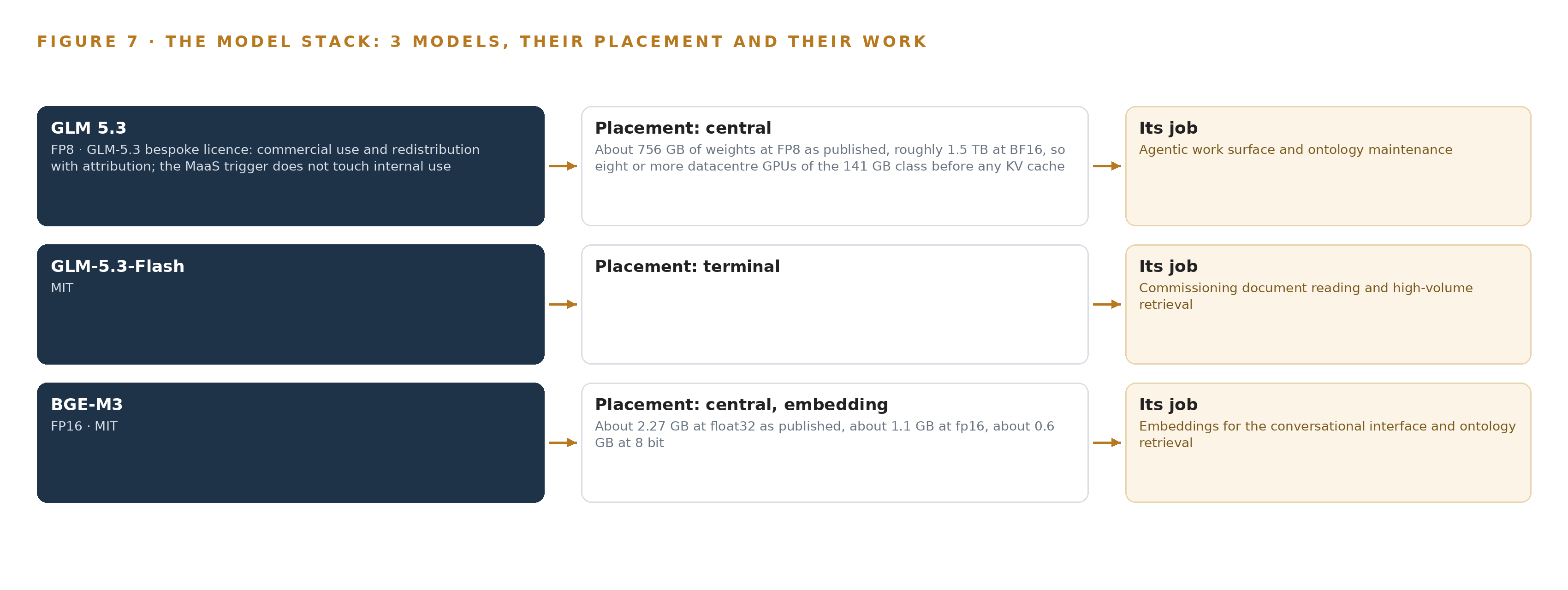
Figure 7 sets the model stack on one page: a frontier reasoning model on the central node, a multimodal reader on the terminal tier, and an embedding model beside the reasoning model, each with its license written under it. GLM 5.3 is the work surface model, the frontier-class reasoning tier where the drafting agents work and the ontology is maintained. Its filed parameter count is 753 billion, served at FP8, where each parameter occupies one byte: about 756 GB of weights as published, and roughly 1.5 TB if carried at BF16, the two-byte precision, which is why the design serves it at FP8 on one node of eight 141 GB GPUs with the KV cache ceiling Chapter 7 sets out. Its license is the GLM-5.3 bespoke license, whose terms permit commercial use and redistribution with attribution, and whose model as a service trigger governs offering the model as a service to others; it does not touch a terminal operator's internal use. The operator names this model and forbids third party services, and this license is what lets the operator hold the weights, host them in country and keep them.
GLM-5.3-Flash is the terminal tier reader: 320 billion total parameters with 18 billion active per token, a mixture of experts shape that carries a large vocabulary of knowledge at a small serving cost, and natively multimodal, so it reads scanned drawings and photographed pages of the builders' commissioning records as well as text. It carries the MIT license, which permits use, copying, modification and redistribution with the license text carried and carries no trigger of any kind, so the operator can hold and redistribute the weights without a determination. Its work is deliberately volume work: reading documents at the rate the expansion produces them, and leaving the frontier node to reasoning.
BGE-M3 is the embedding model, the piece that turns text into the vectors search runs on. It performs dense, sparse and multi-vector retrieval in a single pass over an 8,192 token context, occupies about 1.1 GB at FP16 on the central node, and carries the MIT license. The sparse leg matters more than the size: container numbers and fault codes are exact strings, and a purely dense vector blurs them, while the sparse leg keeps them retrievable exactly.
8.2 The Model and Equipment Register
The license is the line of sovereign AI reference architectures most often left vague: which weights the operator may hold, on what ground, under whose trigger. Table 4 closes that vagueness by registering not only the three models but everything the design stands on: the GPU class and the sizing rule that fixed the node count, the diode and the thermal camera legality line, the sensing the offered tier would add and the telemetry signals the committed design already holds, the patterns the architecture rests on, and the ground it all runs on. One entry deserves its emphasis stated plainly: the improvement path is a kept record of decisions and outcomes, a memory of confirmed outcomes which the next trace reads before it acts and which does not update model weights, so no license with a training or distribution trigger can ever be tripped by the system getting better at its job.
| The choice | What was picked | Why here |
|---|---|---|
| Work surface model | GLM 5.3, 753 billion parameters at FP8, served with vLLM on the frontier node | Named by the operator; the bespoke license permits commercial use and redistribution with attribution and its MaaS trigger does not touch internal use |
| Document reading model | GLM-5.3-Flash, 320B total with 18B active, natively multimodal, on the terminal tier | MIT terms let the operator hold the weights outright; it reads commissioning documents at volume and keeps load off the frontier node |
| Embedding model | BGE-M3 at FP16, dense, sparse and multi-vector retrieval over 8,192 tokens, on the central node | MIT; the sparse leg keeps container numbers and fault codes exactly retrievable |
| GPU class | 141 GB HBM GPU class, eight per node | The node holds the FP8 weights, the KV cache reserve and headroom beside them |
| Sizing rule | Frontier Model GPU Footprint Sizing Rule for vLLM and SGLang | One byte per FP8 parameter, times the 1.2 factor for KV cache and activations, fixes the node count at one |
| One-way transfer | Lidi over a hardware data diode | Control-zone egress ends in hardware; read-only is a property of the wire, not of policy |
| Thermal camera legality | Any US-sourced thermal unit held at 9 Hz or less | Stays under ECCN 6A003.b.4.b, which otherwise requires a BIS license for the operator |
| Sensing | Cameras on hoist machinery, the quay crane rail and a yard block transfer zone, detecting spreader, container, twistlock, crane boom, straddle carrier and terminal tractor | Belongs to the offered crane tier only; existing telematics is the committed signal |
| Telemetry signals | STS crane telematics, crane fault logs, TOS move events and the port authority berth window feed | The drift and productivity arguments run on records the operator already holds |
| Pattern | System of context, with Hyper Ontology v0.9 Semantics and Kinetics | The ontology is a projection over the systems of record, never a shadow copy of them |
| Pattern | a work surface where the operator's people build their own agents with a kept record of decisions and outcomes that the next decision reads | Agents draft in a work surface inside the boundary, and memory of confirmed outcomes improves the next trace without training |
| Ground | The operator's own hardware, in country, on the terminal's own network | Cargo, vessel and equipment data never leave the country, and no third party model service is called |
Shadow Mode Comes Before Any Flag Is Trusted
The rollout earns each phase at a gate the operator can read.
Chapter 8 settled which models run, where they run and under what licenses. This chapter sets out how the build earns trust in stages, what each stage must prove before the next begins, and what the operator should still be asking about.
9.1 Three Phases, Eighteen Items, Two Hard Gates
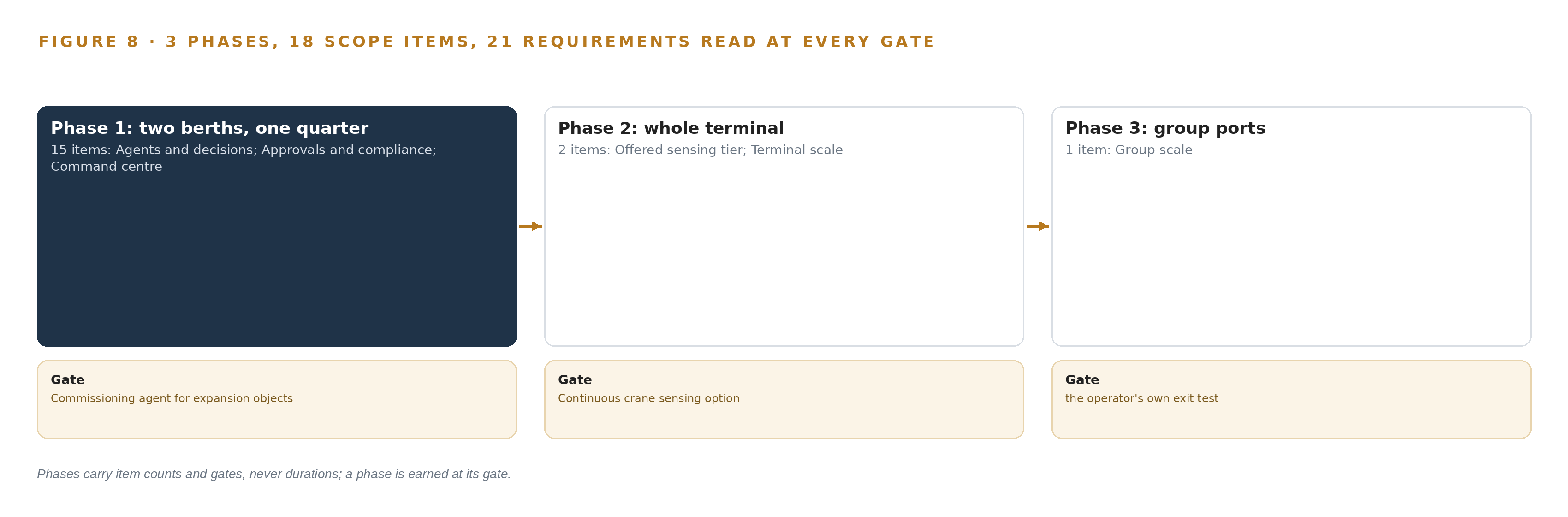
The rollout is shaped by the requirement's own phasing, and Figure 8 shows it whole: three phases, 18 items, two gates, and the register of 21 requirements read against the build at every gate. Phase 1 covers two berths and carries 15 items across six workstreams: ontology and naming, agents and decisions, approvals and compliance, command center, memory and improvement, and phase one exit. Its named items include the port equipment and berth object model, the source system mappings and joins, and name reconciliation across systems. Its exit gate is the commissioning agent for expansion objects: the agent must draft commissioning records from the civil works and commissioning records for the new berth sections and cranes, and a manager must confirm them, before anything widens. Phase 2 carries two items across the offered sensing tier and terminal scale workstreams: the whole-terminal rollout and the continuous crane sensing option. Its gate is that option itself, taken on phase-one evidence rather than assumption, which is why the sensing tier is priced and quoted separately rather than built in. Phase 3 carries a single item, the group ports worked example, on the terminal scale workstream; the group's other ports inherit the worked example only when the running terminal has proven it, and that inheritance is the requirement's stated purpose, that the ontology becomes the worked example for the rest of the ports in the group.
9.2 What the Rollout Measures
The phase-one measurements are chosen so the gate reads evidence, not opinion. The object model is proven on one week of production joins before any agent runs: berths, windows, cranes, faults, moves and measures must join across the eight systems of record with every object resolved to one governed name. Approval latency is instrumented from the start, because the confirmations are the training data of the memory, and known-answer probes are injected into the draft queue so rubber-stamping shows up as a number rather than a suspicion. Drift resolution is measured on the phase-one cranes at shift sensitivity, which decides whether existing telematics can carry the equipment agent's trigger or the offered continuous sensing tier is needed. Attribution is measured against confirmed outcomes: when a manager confirms a ranked cause among the crane's fault, the yard block, the vessel's stowage and the granted window, that confirmation is recorded and the next similar call must rank better. The incident join is measured too, and the join rate matters beyond the terminal because underreporting of maritime accidents to official databases is documented (NIH 2011), so a safety register that reaches equipment and vessel calls through the ontology is itself a finding.
9.3 Failure Modes
Table 5 states what fails and what the design does about it, and every row is a live risk with a named mitigation rather than a residual accepted in silence.
| What fails | What the design does |
|---|---|
| TOS, ECS and telematics products are unnamed, so connector effort is unpriced | Confirm products and interfaces in the first week of phase one; scope the connectors by system role now |
| Approvals drift into rubber-stamping and poison the memory with false confirmations | Instrument approval latency and inject known-answer probes into the draft queue |
| The 141 GB GPU class needs an export license determination before order | Run the determination at phase one start and name the importer of record |
| Existing telematics may not resolve a hoist drift within the shift | Measure drift resolution on phase-one cranes; the continuous sensing tier is the fallback |
| The second builder's vocabulary diverges and reopens name reconciliation | Govern the vocabulary centrally so new builders map to it, not invent beside it |
| Personal data in gang, incident and driver records reaches group ports without a transfer basis | Complete the Article 29 assessment and safeguards before any group-wide rollout |
9.4 Lessons
Shadow the drafts before anyone signs them. The agents begin in shadow mode, drafting productivity explanations, equipment health notes and commissioning summaries that managers read and correct before any draft can raise a work order or adjust a berth plan, and the probes in the queue keep the confirmation honest. Trust in a ranked cause is earned one confirmed explanation at a time, and the gate trusts nothing that a named person has not confirmed. Govern the vocabulary centrally or the second builder reopens the war. The expansion doubles the objects and adds a second builder's equipment with its own names, and the design answers with one naming service that every new object passes through, so the builder's terms are mapped to the governed vocabulary instead of accumulating beside it. Price the connectors before promising the joins. The eight systems are named by role, not by product, and the join quality of the whole ontology rests on interfaces that are confirmed in the first week of phase one, which is why the system survey is an item with a gate behind it and not a formality.
9.5 What Is Still Open
Four questions remain open, and settling each changes something concrete. The system survey settles the connector effort and with it the true cost of the join layer. The export license determination for the 141 GB GPU class settles the license path the hardware order follows, and names the importer of record. The drift resolution measurement settles whether the offered continuous sensing tier moves from option to commitment. The Article 29 assessment under the personal data protection law settles what, if anything, may flow to the group's other ports in phase 3 beyond the worked example itself.
The Intelligence Should Stay with the Operation That Produced It
What the design builds belongs to the operator.
Chapter 9 showed how the build earns each phase at a gate the operator can read. This chapter settles the quieter question behind the gates: who owns what the build produces.
10.1 The Model, the Weights and the Record Belong to the Operator
The object model is the operator's asset in the fullest sense: 16 objects, from Berth and Vessel Call through Ship to Shore Crane, Fault, Move and Commissioning Record, each anchored in one named system of record, linked by typed joins, and named through one governed vocabulary. Nothing in the model is a shadow copy of a vendor's database; it is a projection over systems that stay in place, which means it cannot be repossessed by any of them. The requirement asks that this model become the worked example for the rest of the ports in the group, and that is a statement of ownership before it is a statement of reuse. The weights are equally the operator's to hold: GLM 5.3 runs under its bespoke license, whose commercial terms and attribution requirement permit self-hosted internal use without touching its model as a service trigger, and GLM-5.3-Flash and BGE-M3 run under MIT, so the operator holds every model it depends on, on its own hardware, in country. There are no fine-tunes to own, and that is deliberate: improvement runs through the memory of confirmed outcomes, which records what managers decided and never touches a weight. The decision record is the third asset: every approved draft carries the confirmer's name, every raised work order is raised under that name in the maintenance management system, and the accumulated memory of confirmed explanations stays inside the operator's boundary as the corpus the next decision reads. The boundary itself is the fourth: a hardware data diode enforces one-way egress from the control systems, nothing about customers' cargo leaves the country, and the single write path into any system of record runs through a named approval.
10.2 The Offer Behind the Design
CodeNinja designed this system on Praxis, its platform for designing physical AI systems, and the design maps directly onto what CodeNinja builds: Hyper Ontology holds the governed object model of berths, equipment and moves; Hyper Pragma is the work surface where the operator's own people extend the drafting agents in the command center; Decision Systems is the ranking and attribution layer that puts four candidate causes in front of a named manager who decides; Adaptive Operations is the offered sensing tier that would watch crane behavior continuously; and Sovereign Infrastructure is the posture the whole design stands on, with open weights on the operator's own hardware inside the country and hardware-enforced one-way egress from the control zone. The intelligence stays with the operation that produced it, and the platform that produced the design is the reason it could be specified that way.
The Pattern Repeats Wherever Systems of Record Do Not Meet
Seen whole, the design is one object model over the systems a container terminal operator in Saudi Arabia already runs, with inference placed where the data is and every decision left to a named person.
Running the same shape elsewhere takes the same four things: the named systems, an object model anchored in them, a first gate that can stop the work cheaply, and the license posture that lets the operator own what it learns.
How Praxis Contextualized and Reasoned This Design
Every choice above traces back to something Praxis recorded reading.
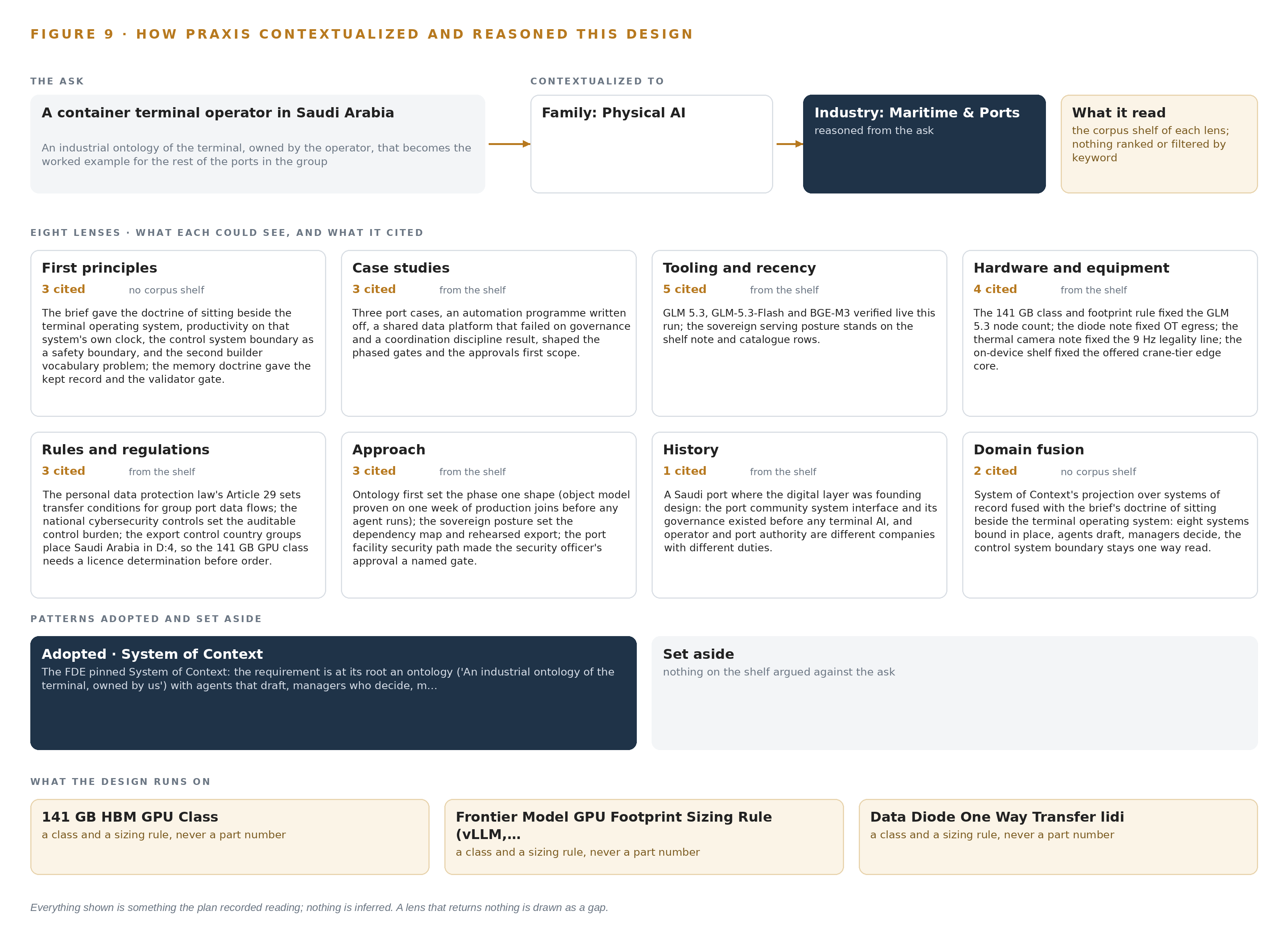
Chapter 10 settled where the intelligence lives. This chapter opens the record behind it, so a reader can trace any choice above back to what justified it. Every design in this series is produced on Praxis, the design team platform for designing physical AI systems, and this chapter lets a reader audit the reasoning rather than take it on faith. Figure 9 shows the ask as Praxis received it, the family and industry it assigned, what it read, the eight lenses it read through, the patterns it adopted and set aside, and the equipment classes the reasoning landed on.
11.1 Contextualizing the Ask
The ask, in the operator's own words, was an industrial ontology of the terminal, owned by the operator, filled from its systems of record, with open weight models on its own hardware in the country, and nothing about customers' cargo leaving it. Praxis assigned the design to the Physical AI family and the Maritime and Ports industry, a pin made by the forwarding design engineer on this project and read as reasoning input rather than a matched conclusion. What Praxis read was the corpus shelf of each lens, and those shelves are the corpus behind every lens that follows.
11.2 The Lenses
Table 6 records each lens, what it could see, how many items it cited, and what it contributed to the design. All eight lenses returned a contribution on this project; none is shown as a gap.
| Lens | Could see | Cited | What it contributed |
|---|---|---|---|
| First principles | no corpus shelf | 3 | The brief gave the doctrine of sitting beside the terminal operating system, productivity on that system's own clock, the control system boundary as a safety boundary, and the second builder vocabulary problem; the memory doctrine gave the kept record and the validator gate. |
| Case studies | the case study shelf | 3 | Three port cases, an automation programme written off, a shared data platform that failed on governance and a coordination discipline result, shaped the phased gates and the approvals first scope. |
| Tooling and recency | the tooling and recency shelf | 5 | GLM 5.3, GLM-5.3-Flash and BGE-M3 verified live this run; the sovereign serving posture stands on the shelf note and catalog rows. |
| Hardware and equipment | the hardware and equipment shelf | 4 | The 141 GB class and footprint rule fixed the GLM 5.3 node count; the diode note fixed control zone egress; the thermal camera note fixed the 9 Hz legality line; the on device shelf fixed the offered crane tier edge core. |
| Rules and regulations | the rules and regulations shelf | 3 | The personal data protection law's Article 29 sets transfer conditions for group port data flows; the national cybersecurity controls set the auditable control burden; the export control country groups place Saudi Arabia in D:4, so the 141 GB GPU class needs a license determination before order. |
| Approach | the approach shelf | 3 | Ontology first set the phase one shape (object model proven on one week of production joins before any agent runs); the sovereign posture set the dependency map and rehearsed export; the port facility security path made the security officer's approval a named gate. |
| History | the history shelf | 1 | A Saudi port where the digital layer was founding design: the port community system interface and its governance existed before any terminal AI, and operator and port authority are different companies with different duties. |
| Domain fusion | no corpus shelf | 2 | System of context's projection over systems of record fused with the brief's doctrine of sitting beside the terminal operating system: eight systems bound in place, agents draft, managers decide, the control system boundary stays one way read. |
11.3 Patterns Adopted and Set Aside
System of context was adopted as the primary pattern, because the requirement is at its root an ontology with agents that draft, managers who decide, memory instead of training, and a command center. Its three layers sit in a fixed order: systems of record below, never replaced, never modified, never loaded; the operator-owned object model in the middle as a projection over those systems, never a shadow copy, with crossing mappings that answer questions no single system can; and applications and agents above, governed by one small grammar in which nouns become objects, facts become properties, relationships become typed links and actions change them. Three patterns were set aside with reasons. Object tracking and trajectory forecasting were set aside because moves already carry equipment identity from the terminal operating system and the equipment control systems. Edge orchestration was set aside because phase one runs on the operator's central hardware and only the offered crane tier would add gateways. Labelling and retraining were set aside because the improvement path the requirement names is memory of confirmed outcomes, not weight updates.
11.4 Where the Reasoning Lands
The reasoning lands on four equipment classes, each carried from the shelf into the design: the 141 GB HBM GPU class that hosts the frontier model on one node of eight GPUs; the frontier model GPU footprint sizing rule for vLLM and SGLang serving, under which 753 billion parameters at FP8 are 753 GB of weights on 1,128 GB of memory, leaving 375 GB beside the weights against the 151 GB the 1.2 planning factor reserves; the hardware data diode carrying one-way transfer out of the control zone; and the fixed thermal camera class held at 9 Hz or less to stay under the export control line that would otherwise require a license. Every one of these choices, and every figure in this paper, traces to recorded reading: nothing shown was inferred, and nothing rests on a source the register does not hold.
What the Operator's Own Inference Node Costs Over Three Years
The paper is written for a container terminal operator in Saudi Arabia, with every model running on the operator's own hardware inside the country (chapter 3, section 3.2; chapter 5, section 5.2; chapter 7, section 7.1). This appendix therefore prices for Saudi Arabia, with the national commercial electricity tariff for power and the AWS Middle East (UAE) region, me-central-1, as the rental reference. The design's frontier tier is "one node of eight GPUs of the 141 GB high bandwidth memory class, which is 1,128 GB of usable memory", serving GLM 5.3 at FP8 on vLLM (chapter 7, section 7.1; Table 4, "GPU class" and "Sizing rule"; Table 2, "Reasoning"). The other two models add no hardware line here: BGE-M3 "occupies about 1.1 GB at FP16 on the central node" (chapter 8, section 8.1), and GLM-5.3-Flash runs on the terminal tier, "a two-socket air-cooled server class in the terminal machine room" (chapter 7, section 7.1), which the paper names by class and does not size, so nothing is added for it rather than a server guessed. The offered continuous crane sensing tier is not committed and is priced separately by the design itself (Table 2, "Crane sensing"; chapter 7, section 7.1), so it carries no line. The node is priced two ways: owned, from a reseller's published configured price with support and power added, and rented, from the AWS price files for the nearest region that offers the same card, on demand and on the two three year all upfront plans. The sourced prices are the ones read for the 2 November 2026 set (ep34, grid control room and open pit mine, the same instance class in the same region) and are cited with that date; nothing has been re-read. Every input is dated and cited, and the arithmetic is shown.
A.1 The Answer
Owning the node for three years costs about 570,000 US dollars, inside a range of 542,000 to 594,000. Renting the same eight H200 cards around the clock costs about 751,000 dollars on the deepest three year commitment (an AWS EC2 Instance Savings Plan, all upfront, for p5en.48xlarge in Middle East (UAE)), about 1.33 million dollars on the three year Compute Savings Plan, all upfront, and about 2.00 million dollars on demand. Against the deepest commitment, ownership costs about three quarters (569,988 / 750,535 = 0.76, and 0.72 to 0.79 across the range); against on demand, a little over a quarter (569,988 / 1,996,103 = 0.29). No rented option can sit inside the Kingdom on the day the prices were read: AWS's Saudi region is scheduled to open by December 2026 (W.Media 2026) and its price files list no Saudi region (AWS 2026a), and every rented option would carry vessel calls, moves, fault logs, telematics and the decision record across the border, which the design's own rule that cargo, vessel and equipment data never leave the network rules out (chapter 3, section 3.2; chapter 7, section 7.3). Renting is therefore a price reference only. GLM 5.3 carries the GLM-5.3 bespoke license, "whose terms permit commercial use and redistribution with attribution, and whose model as a service trigger governs offering the model as a service to others; it does not touch a terminal operator's internal use" (chapter 8, section 8.1); no price is asserted for it here. GLM-5.3-Flash and BGE-M3 carry the MIT license and no license line (chapter 8, section 8.1).
A.2 What the Hardware Would Cost
| Option | Basis | Three year cost (USD) |
|---|---|---|
| Owned, in the operator's own machine room | One 8x H200 node with support and power, broken out below | 542,000 to 594,000, typical 570,000 |
| AWS, Middle East (UAE), on demand | p5en.48xlarge, eight H200 cards, 1,128 GB of HBM3e (AWS 2026c), at 75.9552 dollars an hour (AWS 2026b), 26,280 hours; outside the Kingdom | 1,996,103 |
| AWS, Middle East (UAE), three year Compute Savings Plan, all upfront | p5en.48xlarge at 50.66046 dollars an hour (AWS 2026a), 26,280 hours; outside the Kingdom | 1,331,357 |
| AWS, Middle East (UAE), three year EC2 Instance Savings Plan, all upfront | p5en.48xlarge at 28.55916 dollars an hour, the deepest three year plan for this instance in the region (AWS 2026a), 26,280 hours; outside the Kingdom | 750,535 |
The purchase option priced as the rental reference is the three year EC2 Instance Savings Plan, all upfront, the lowest three year rate the me-central-1 file lists for p5en.48xlarge (the partial upfront and no upfront three year Instance plans list 30.38208 and 32.81265 dollars an hour). Egress, storage of the mirrored record and the network link to the region are excluded, and the all upfront plans are paid in full on day one, so every rented figure is a floor.
The owned line, item by item:
| Line | Basis | Three year cost (USD) |
|---|---|---|
| Node | Thinkmate GPX GXS5-2508-8HGX-H2, 5U, NVIDIA HGX H200 with eight H200 SXM5 cards (1.1 TB of HBM3), two Intel Xeon Platinum 8558 processors of 48 cores and 330 W each, 32 x 32 GB of DDR5 memory, 3000 W 4+2 redundant power and a three year depot warranty, the configurator's default build: barebone 309,855, processors 2 x 5,584, memory 32 x 2,688, assembly and testing 330, warranty 45, a configured price of 407,660 dollars (Thinkmate 2026) | 407,660 |
| Support | 8 to 12 percent of hardware value a year (Introl 2026), 10 percent typical, over three years | 97,838 to 146,758, typical 122,298 |
| Power | The paper states no power figure for the node, so this line takes the 10.2 kW maximum NVIDIA gives for its own eight H200 system (NVIDIA 2026b): 10.2 kW x 26,280 hours = 268,056 kWh, times a power usage effectiveness of 1.6 (above the 1.54 industry average, Uptime Institute 2025, and a fair allowance for a terminal machine room in Gulf heat) = 428,890 kWh, about 11,914 kWh a month, which sits in the commercial tier above 6,000 kWh a month: 32 halalas per kWh today and 35 halalas from 1 January 2027, both excluding VAT (Tariff 2026a; Tariff 2026b), at 3.75 riyals to the dollar (SAMA 2026) | 36,599 to 40,030, typical 40,030 |
| Total | Low: 8 percent support, today's tariff. High: 12 percent, the 2027 tariff. Typical: 10 percent, the 2027 tariff, because the node is ordered only after the export license determination that Table 5 places at phase one start, and its three years run under the 2027 schedule | 542,097 to 594,447, typical 569,988 |
The power line is a ceiling: it takes the system maximum around the clock, against an H200 card's "up to 700W" (NVIDIA 2026a), and a work surface whose drafting agents answer after the vessel call and within the shift (chapter 7, section 7.2) will rarely hold eight cards at full draw. It also prices every kilowatt hour at the upper commercial tier, which is right if the machine room shares a meter with the terminal's other loads; a dedicated meter would bill the first 6,000 kWh a month at 22 halalas today and 25 from 2027, and would add the 2027 fixed charge of 350 to 900 riyals a month by breaker size, at most 8,640 dollars over three years (Tariff 2026b). The reseller price is a United States dollar price from a United States reseller, before Saudi customs duty and 15 percent VAT, and a written quote delivered to the Kingdom will differ.
Why this hardware: the paper's sizing line is explicit, "The model's filed parameter count is 753 billion, served at FP8 precision, where each parameter occupies one byte, so the weights alone occupy 753 GB. The 1.2 planning factor reserves a further 151 GB for the KV cache ... so the node must hold 904 GB in total; it holds that with margin, leaving 375 GB beside the bare weights" (chapter 7, section 7.1), and Table 4 fixes the class as "141 GB HBM GPU class, eight per node" with the sizing rule that "fixes the node count at one" (Table 4, "GPU class" and "Sizing rule"). Eight H200 cards at 141 GB are 1,128 GB, and that is the node priced, as Thinkmate's HGX H200 configuration and as p5en.48xlarge, whose eight H200 cards carry the same 1,128 GB (AWS 2026c; NVIDIA 2026b).
One inconsistency in the paper's own numbers, which does not change the node count or the price: the weights are 753 GB in chapter 7, Table 4 and chapter 11, but "about 756 GB of weights as published" in chapter 8, section 8.1, and Figure 7; this appendix uses chapter 7 and Table 4, and 756 GB times 1.2 is 907 GB, which the same 1,128 GB node holds.
A.3 What the Price Does Not Include
- An export license determination, which is a checkpoint, not a price. The paper makes the determination for the 141 GB GPU class a phase one start item that names the importer of record (Table 5; chapter 9, section 9.5). Saudi Arabia sits in Country Groups D:3 and D:4 (eCFR 2026a), and 15 CFR 742.6(a)(6)(iii), as read on 2 November 2026, carries a worldwide license requirement for 4A090.a items (eCFR 2026b). The order date for the node is therefore set by that determination.
- Everything the paper's scope boundary keeps out: equipment control changes, model training, any third party model service, the group's other ports, hardware and infrastructure beyond this node, historic migration and round the clock cover (Table 2, "Scope boundary"). The eight systems of record are the operator's own and carry no line here.
- The servers for the rest of the stack: the terminal tier's two socket air cooled server class for GLM-5.3-Flash (chapter 7, section 7.1), and the hosts for the ontology and graph store, the time series store, the Kafka backbone, the observability stack and the air gapped Harbor registry, chosen by class and not sized in the paper (chapter 4, Table 7).
- The one way boundary hardware: Lidi over a hardware data diode is committed (Table 4, "One-way transfer"; chapter 7, section 7.3), and the paper gives no part or size.
- The offered continuous crane sensing tier: three fixed cameras, the fanless sealed edge compute class and any thermal unit held at 9 Hz or less, which the design offers and prices separately and which Phase 2's gate decides (chapter 7, section 7.1; Table 4, "Sensing"; chapter 9, section 9.1).
- Facilities work for the node's load and cooling in the terminal machine room, which the paper does not discuss.
- People: the engineers who build and run the platform, and the operations managers, engineering managers and the expansion project engineer who confirm every draft, whom every option carries.
- Customs duty, 15 percent VAT, freight and installation on the hardware, which a written quote delivered to the Kingdom settles, and residual value at the end of three years.
- Double counted cover. The configured price already carries a three year depot warranty, so the support line may count some cover twice.
- A closed model token comparison, which is not printed because the paper states no token volume for the work surface.
A.4 Sources for This Appendix
- AWS. 2026a. EC2 Instance and Compute Savings Plans price files, region index and me-central-1, version 20261029175641, as read 2 November 2026. https://pricing.us-east-1.amazonaws.com/savingsPlan/v1.0/aws/AWSComputeSavingsPlan/current/region_index.json and https://pricing.us-east-1.amazonaws.com/savingsPlan/v1.0/aws/AWSComputeSavingsPlan/20261029175641/me-central-1/index.json
- AWS. 2026b. EC2 on demand price data for the AWS pricing page, Linux, shared tenancy, Middle East (UAE), published 29 October 2026, as read 2 November 2026. https://b0.p.awsstatic.com/pricing/2.0/meteredUnitMaps/ec2/USD/current/ec2-ondemand-without-sec-sel/Middle%20East%20(UAE)/Linux/index.json
- AWS. 2026c. Amazon EC2 P5 instances, p5en.48xlarge, eight NVIDIA H200 GPUs, 1,128 GB HBM3e, as read 27 October 2026 for the ep28 appendix and not re-read. https://aws.amazon.com/ec2/instance-types/p5/
- eCFR. 2026a. 15 CFR Part 740, Supplement No. 1, Country Groups, Saudi Arabia in D:3 and D:4, version of 29 October 2026, as read 2 November 2026. https://www.ecfr.gov/current/title-15/part-740/appendix-Supplement%20No.%201%20to%20Part%20740
- eCFR. 2026b. 15 CFR 742.6(a)(6)(iii)(A), worldwide license requirement for 3A090.a and 4A090.a items, version of 29 October 2026, as read 2 November 2026. https://www.ecfr.gov/current/title-15/section-742.6
- Introl. 2026. GPU infrastructure TCO model, "Vendor support agreements typically cost 8-12% of hardware value annually", as read 2 November 2026. https://introl.com/blog/gpu-infrastructure-tco-model-5-year-enterprise-ai-deployment
- NVIDIA. 2026a. H200 specifications, H200 SXM, up to 700W (configurable), 141GB, as read 2 November 2026. https://www.nvidia.com/en-us/data-center/h200/
- NVIDIA. 2026b. DGX H100/H200 User Guide, Introduction, Table 3 Power Specifications, "10.2 kW max", and 8 x H200 GPUs with 1,128 GB total GPU memory, as read 2 November 2026. https://docs.nvidia.com/dgx/dgxh100-user-guide/introduction-to-dgxh100.html
- SAMA. 2026. Saudi Central Bank affirms its commitment to the riyal's peg to the US dollar at the official rate of 3.75, listed in search on 2 November 2026; the page did not load for direct reading that day. https://sama.gov.sa/en-US/MediaCenter/News/Pages/news-557.aspx
- Tariff. 2026a. National electricity consumption tariffs, published by the Kingdom's electricity service provider, commercial 22 halalas per kWh for 1 to 6,000 kWh a month and 32 above, as read 2 November 2026. https://www.se.com.sa/en/Ourservices/ColumnC/Bills-and-Consumption/ConsumptionTariffs/CT1/
- Tariff. 2026b. National electricity consumption tariffs after amendment, published by the same provider, applied from 1 January 2027, commercial 25 halalas per kWh for 1 to 6,000 kWh a month and 35 above, fixed charge 350 to 900 riyals a month by breaker capacity, excluding VAT, as read 2 November 2026. https://www.se.com.sa/ar-SA/ourservices/columnc/bills-and-consumption/consumptiontariffs/ct2/ct2
- Thinkmate. 2026. GPX GXS5-2508-8HGX-H2 5U H200 Xeon server, online configurator, default configuration as stated, configured price 407,660 dollars (sum of the page's default selections), as read 2 November 2026. https://www.thinkmate.com/system/gpx-gxs5-2508-8hgx-h2
- Uptime Institute. 2025. Global Data Center Survey 2025, average annual PUE of 1.54, as read 2 November 2026 through https://mgrid.org/2025/10/01/uptime-institute-data-center-pue-stagnation-2025-liquid-cooling/ (survey page https://intelligence.uptimeinstitute.com/resource/uptime-institute-global-data-center-survey-2025)
- W.Media. 2026. AWS Saudi Arabia cloud region set for December 2026 launch, 1 September 2026, as read 2 November 2026. https://w.media/aws-saudi-arabia-cloud-region-set-for-december-2026-launch/
Source Register
Service. 2025. Ports & Marine Facilities Safety Code April 2025. https://assets.publishing.service.gov.uk/media/67fd175bed87b81608546666/port-marine-safety-code.pdf
IMO. 2008. RESOLUTION MSC.255(84) (adopted on 16 May 2008) ADOPTION OF THE CODE OF THE INTERNATIONAL STANDARDS AND RECOMMENDED PRACTICES FOR A SAFETY INVESTIGATION INTO A. https://wwwcdn.imo.org/localresources/en/KnowledgeCentre/IndexofIMOResolutions/MSCResolutions/MSC.255(84).pdf
TAIC. n.d. Marine Inquiry 09-202: Passenger vessel Oceanic Discoverer Fatal injury, Port of Napier 19 February 2009. https://taic.org.nz/sites/default/files/inquiry/documents/09-202%20Final%20report.pdf
NIH. 2011. Underreporting of maritime accidents to vessel accident databases. https://pubmed.ncbi.nlm.nih.gov/21819835/
About CodeNinja
CodeNinja is a Middle Eastern American artificial intelligence lab and system of context company. It builds sovereign self-improving systems that organizations own, run inside their own boundary and improve with every decision they make.