


Sovereign AI Architecture for a Freight Corridor and Customs Clearance in Saudi Arabia
Corridor Command: Industrial AI for the Whole Consignment Story
For the corridor and customs lead, the corridor planners and yard controllers in the loop, and the platform, data and reliability engineers who would build and run it.
Vertical-Driven Architectures is a CodeNinja series of system designs. Every design in the series is driven by a real-world problem and scenario in a single industry, and every one is designed on Praxis, CodeNinja's platform for designing physical AI systems. Operations are described by class, never by name.
Sovereign AI Architecture for a Freight Corridor and Customs Clearance in Saudi Arabia
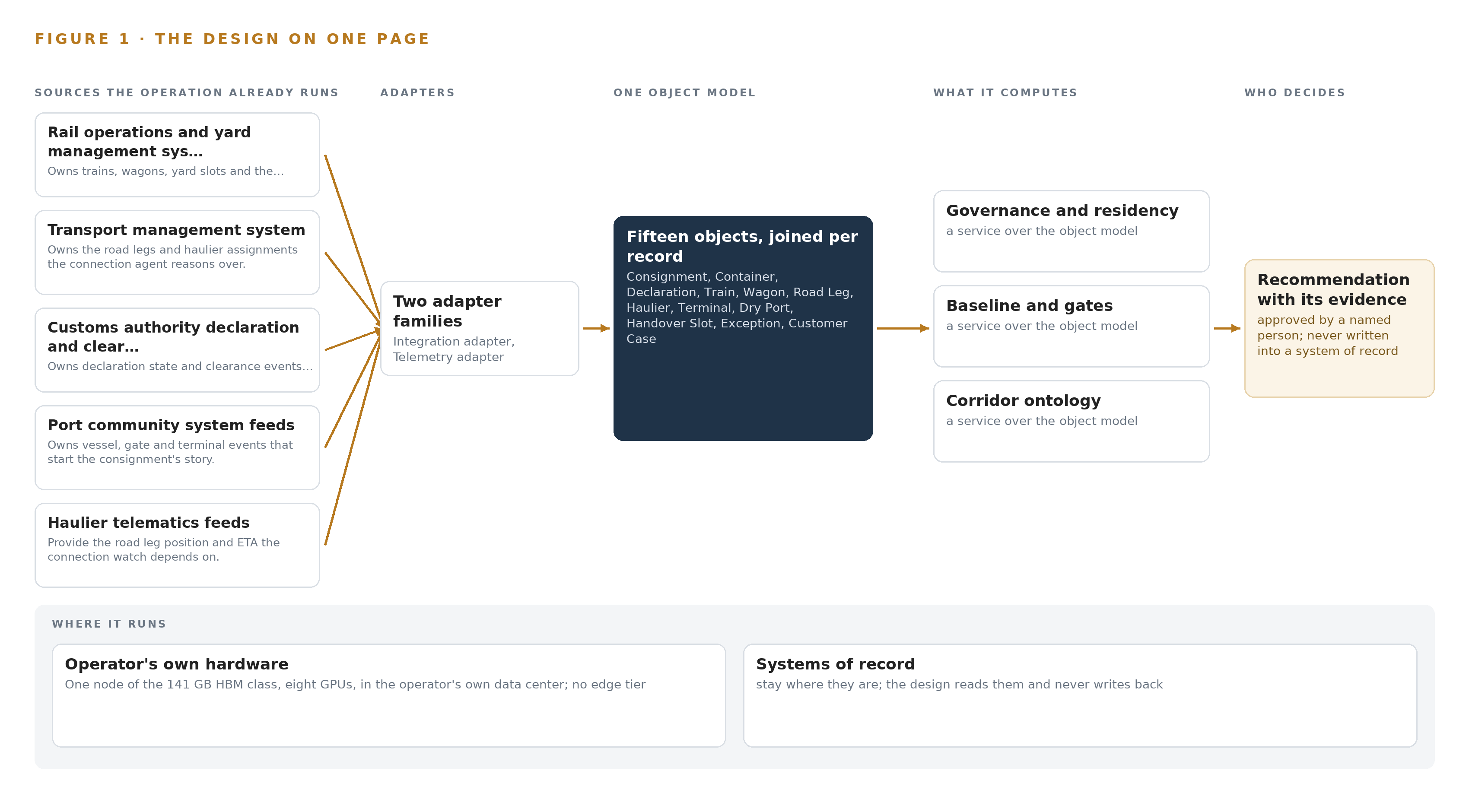
What this is. An open reference architecture for system design in physical AI, built for a national freight and logistics operator in Saudi Arabia that moves containers and bulk from seaports to dry ports and freight yards by rail and road across corridors of more than two thousand kilometres, where owning the inference node that runs it costs about 569,000 US dollars over three years. When a declaration stalls at the seaport while the road leg runs late for its train, the design joins the declaration, the container, the train and its handover slot, the road leg and the open customer case into one consignment story, so a corridor planner sees the stall, the connection it will cost and the customer who will call, and approves the chase and the re booking before the call comes. All reasoning runs on the operator's own hardware in the country under the national data protection law, the customs authority's interface terms and export control on the GPU node. It is written for the corridor and customs lead, the corridor planners and yard controllers in the loop, and the platform, data and reliability engineers who would build and run it. The operator is described by class, never by name.
The answer in numbers.
| Part | The design |
|---|---|
| Sources | Seven read only systems of record entering through two adapter families (the integration adapter on Debezium with Apache Camel and the telemetry adapter) that guarantee lineage, ordering and staleness flags: the rail operations and yard management system, the transport management system, the customs authority's declaration and clearance interfaces, the port community system feeds, the haulier telematics feeds, the container tracking system and the customer service case log; no agent files, amends, re books or cancels a declaration or booking, and the design never writes into a system of record |
| Object model | 15 typed objects with 11 typed links, from the consignment, container and declaration through the train, wagon, road leg and haulier to the terminal, dry port, handover slot, exception and customer case, with the corridor planner, yard controller and service desk agent as actors; a projection over the seven systems joined on the container number, never a copy, published as JSON for reuse |
| Models | GLM 5.3 (class open weights, self hosted, frontier class) named by the requirement for the command center that answers questions about a consignment with citations, with GLM 5.2 under MIT as the licence fallback; the register commits no model row until a live verification passes; no third party model service, nothing trained into weights |
| Compute | One node of eight 141 GB HBM cards in the operator's own in-country data center, holding about 756 GB of FP8 weights on about 1,038 GB of usable memory with about 280 GB of KV cache ceiling, planned at about ten kilowatts; no edge tier, no cameras, no new field sensing. The node is a 4A090 class item for a D:3 and D:4 destination, so an export licence determination against ECCN 3A090 and 4A090 is a phase zero checkpoint before any GPU class is quoted |
| Rollout | Three phases carrying 17 scope items (2, 14 and 1), each closed by a gate, never a date: baseline and approvals, whose gate is the residency approvals closed and the baseline recorded; one corridor between one seaport and one dry port through one measured quarter, whose exit gate is source system bindings and lineage proven on one real week of production data; then extension gates to the other corridors; headline measure dry port dwell in hours against a nominal of 96, with stalled declarations, missed connections and answered questions counted beside it |
| Three-year cost | About 569,000 US dollars to own the node for three years (a range of 541,000 to 594,000: server, support and power at the national commercial electricity tariff), against about 751,000 to rent the same eight cards on the deepest three year commitment in AWS Middle East (UAE), so ownership costs about three quarters of it, and about 2.00 million on demand, against which ownership costs a little over a quarter. Renting is a price reference only, because AWS listed no Saudi region on the day read and every rented option would carry cargo, customer and declaration data across the border (Appendix A) |
| Human control | Agents draft and people decide, by name: the corridor planner approves the stall chase and the revised handover slot, the yard controller approves every re booking, and the service desk agent sends the cited answer; approval authority is a property of the actor objects, a per shift alert budget is agreed before thresholds are set, the action rate is itself a gate, and every confirmed stall cause and accepted re booking is kept as memory the next plan reads |
Reuse it. The object model, the model register and the figures are free to reuse under CC BY 4.0. Cite as https://codeatoms.ai/freight-corridor-customs-saudi-arabia/.
Made with. Reasoned on [CodeNinja Praxis](https://codeatoms.ai/praxis/), the CodeNinja Atoms platform for designing physical AI systems. The object model imports into [Hyper Ontology](https://codeatoms.ai/hyper-ontology/), which turns it into a living system. Load it with the [hyper-ontology loader](../hyper-ontology-py/): `hyper-ontology show freight-corridor-customs-saudi-arabia`. Both are in beta; access by request.
Where a Box Is Should Not Take Six Systems to Answer
A sovereign AI architecture for a freight corridor in Saudi Arabia starts from the one question the operation needs answered continuously: where is this consignment, and when will it clear. It cannot be answered today because the answer lives in six systems of record carrying six identifiers, and it is assembled by hand by a planner whenever a consignee asks. Corridors of more than two thousand kilometers mix rail legs with road legs run by contracted hauliers, each consignment crossing the port terminal, the customs authority's clearance system, the operator's rail yard, a haulier, the dry port and the consignee, while the authority's single declaration transit with pre clearance and smart inspection now runs on some lanes of a national truck fleet of around half a million vehicles. Dwell at the dry port grows when a declaration stalls, and the stall is learned from the consignee rather than from the systems; a late road leg is visible in telematics but never joined to the train it will miss.
The design is a sovereign corridor and customs system built for a national freight and logistics operator in Saudi Arabia: seven read-only source systems, two adapter families covering integration and telemetry, fifteen objects in one governed object model, seven services covering governance, baselines, the ontology, agents and approvals, the sovereign platform, memory and the command center, and three surfaces consisting of the command center, the connection view and the answer queue. Every part runs on the owner's own central node in its in-country data center, on open weights the owner holds, with no edge inference and no third party model service, so cargo, consignee and declaration data never leave the country. The model register carries no committed weights on this plan: no open weight model survived this run's live verification, so the choice of weights is recorded open work with its sizing line, the inference cluster class (GPU nodes for 300B to 1T parameter open weight models), held ready rather than fixed.
The paper covers the industry problem and the join failure across the six systems, the constraints and the scoping decisions they force, the layered stack and the fifteen-object model of the consignment story, the adapter tier and event backbone that feed it, the placement of all reasoning on the owner's central node, the model register and the licenses that decide what the owner can own, the three phases with their item counts and gates, and who owns the intelligence the system produces, closing with the chapter on how Praxis contextualized and reasoned the design.
Contents
Each chapter is tagged for the reader it serves most directly: Executive, Team Lead, FDE, Reference.
| Abstract · Where a Box Is Should Not Take Six Systems to Answer | Executive | |
| PART I · THE PROBLEM | ||
| 1 | Industrial AI Starts with the Consignment, Not the Systems | Executive |
| 2 | Six Identifiers Hide One Consignment From Every Planner | ExecutiveTeam Lead |
| PART II · THE DESIGN | ||
| 3 | Sovereignty and Six Systems Shape Everything Downstream | Team Lead |
| 4 | One Stack Runs From Records to Reasoning In-Country | Team LeadFDE |
| 5 | Fifteen Objects Turn Corridor Data Into One Story | FDE |
| 6 | Every Source Enters Through an Adapter, Never Directly | FDE |
| 7 | All Reasoning Runs on the Operator's Own Node | FDE |
| 8 | The Register Holds No Weights Until Verification Stands | FDEExecutive |
| PART III · THE ROLLOUT | ||
| 9 | A Measured Quarter Gates Every Corridor Extension | Team LeadExecutive |
| 10 | The Intelligence Stays with the Corridor That Produced It | Executive |
| PART IV · HOW IT WAS DESIGNED | ||
| Conclusion · One Projection, One Memory, One Answer, Held Sovereignly | Executive | |
| 11 | How Praxis Contextualized and Reasoned This Design | Team LeadFDE |
| Sources | Reference | |
Industrial AI Starts with the Consignment, Not the Systems
The corridor's cost is not a missing system but a missing object: the consignment no single system holds, in a country whose customs programs and new corridors are moving faster than the operators' ability to see one box end to end.
The abstract put the whole sovereign AI architecture on one page: seven sources of record, two adapter families, fifteen objects, seven services and three surfaces, all inside the owner's own hardware in the country. This chapter begins where industrial AI has to begin, with the question the operation cannot answer today, the documented cost of that silence, and the scenario the design must fit without replacing anything.
1.1 The Question, the Data and the Regimes
The question the operation needs answered is narrow and constant: where is this container, and when will it clear? The answer requires one key and every story told about it. The container number carries the whole join, and around it sit the vessel, gate and terminal events that open the consignment's story; the declaration with its lane, broker and clearance state; the train, its wagons and the handover slot; the road leg with its haulier and its ETA; the yard state at the destination dry port; and the case log of questions already asked and answered. The question must also be answered inside four regimes at once. The customs authority now offers single declaration transit with pre clearance and smart inspection on some lanes, which the design reads but never acts in. The national data protection regime fixes residency, cross-border transfer bases and the data protection officer's records of processing duties. The national AI authority's ethics risk tiers govern how the reasoning tier is classified. The road transport law of 2025 links the haulier fleet to the authority's electronic platform, which decides which telematics can be relied upon.
1.2 The Documented Cost
The cost of not answering lands in three places: planner hours spent assembling an answer by hand from six identifiers, dwell hours that grow at the dry port while a stalled declaration goes unnoticed, and the same questions answered week after week for the authority and for cargo owners. The exposure is documented at industry scale. Cross-border data transfers are integral to international supply chains, which depend on information moving across borders for sourcing, finance, logistics and risk management (Globaldataalliance n.d.), and third-party breaches doubled as a share of all security incidents in the most recent year, with regulators across Europe and the United States now holding leadership personally accountable for vendor risk (Cybelangel 2026). When an operator's data flows stop, the physical operation stops with them: a ransomware attack on a logistics company in October 2025 encrypted its data and caused a large-scale service stoppage, with leakage of the information it held confirmed by the company's own investigation (Askullogist 2025). An operator that cannot see one consignment across its systems cannot even rank which flows it depends on.
1.3 The Operation as a Scenario
The owner runs inland corridors linking seaports to dry ports and freight yards by rail and road, with corridors of more than two thousand kilometers mixing rail legs with road legs run by contracted hauliers, and new corridors opened in 2026. The national truck fleet it draws on is around half a million vehicles. Each consignment crosses several hands: the port terminal, the customs clearance system, the rail yard, a haulier, the dry port and the consignee. Three roles sit in the loop by name: corridor planners who own train and slot decisions on shift, yard controllers who hold re booking authority at the dry ports, and service desk agents who work the case queues. The physical environments are the seaport terminals, the rail corridors, the yards and dry ports inland, and the road network between them. The regulatory ground is the national data protection regime, the AI authority's ethics tiers, the road transport law of 2025 and the customs authority's clearance programs. The estate holds seven named systems of record, three named roles and four classes of place, and every system is read, never replaced.
Six Identifiers Hide One Consignment From Every Planner
Each system of record sees one slice of the consignment's story and none can answer the question they collectively hold, which is why dwell grows silently and knowledge of stalling lanes, brokers and hours lives only in experienced planners' heads.
Chapter 1 stated the question and the scenario that cannot answer it. This chapter walks each of the seven systems of record in turn, because the shape of the design follows directly from what each one sees and what each one misses.
2.1 What Each System Sees
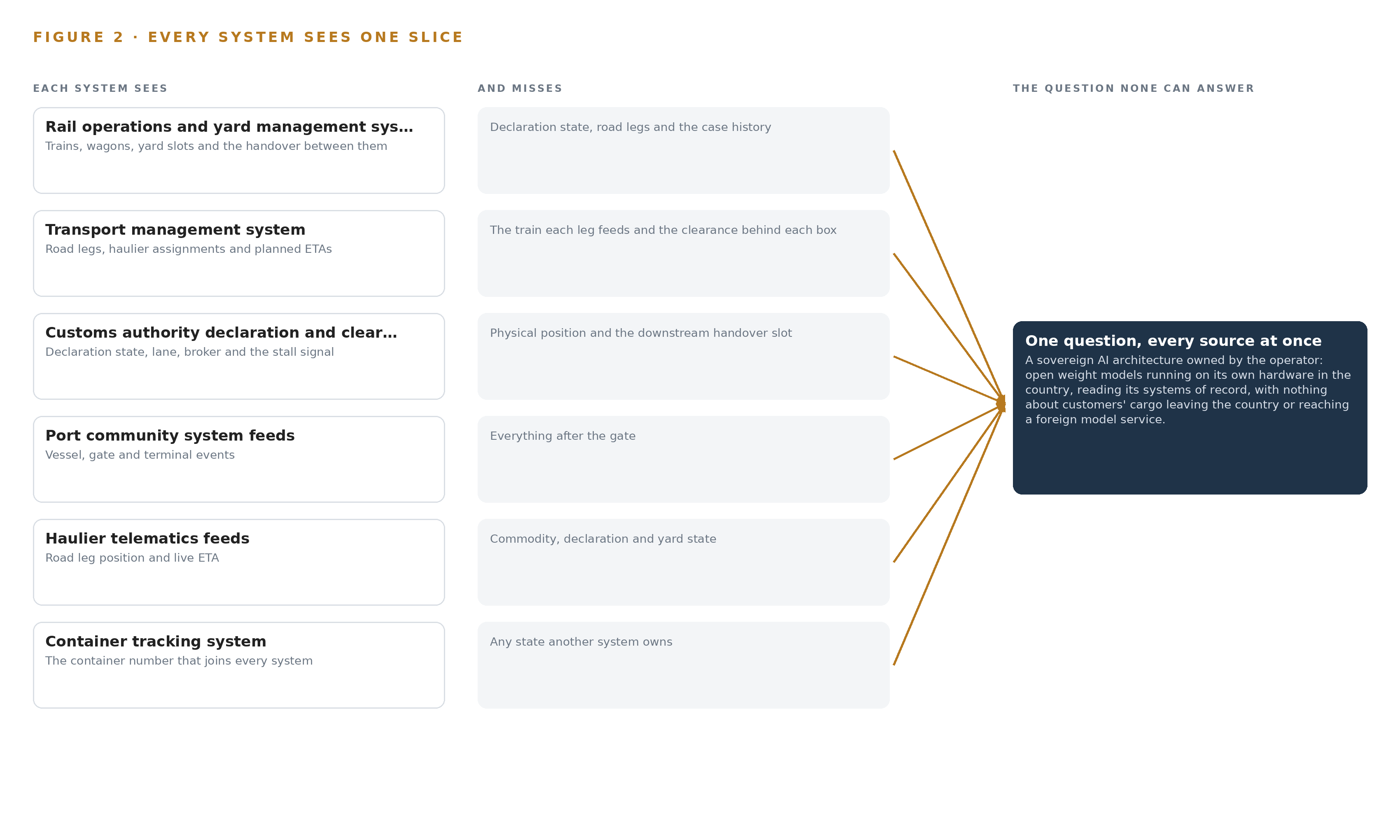
The rail operations and yard management system owns trains, wagons, yard slots and the handover, the moment the whole corridor story turns on; it cannot see the declaration state behind a wagon's box, so it schedules a train that clearance will hold. The transport management system owns the road legs and the haulier assignments; it cannot see the train each leg feeds, so a late truck is late in isolation. The customs authority's declaration and clearance interfaces own declaration state, the stall signal and the single declaration transit lanes; they cannot see the physical position of the box a declaration covers, or the slot its delay consumes. The port community system feeds own the vessel, gate and terminal events that start the story; they go quiet at the gate. The haulier telematics feeds provide road leg position and ETA; they carry no commodity, no declaration and no yard state. The container tracking system owns the container number that joins every system to one consignment; it is a register rather than a story, holding no state any other system owns. The customer service case log holds the questions asked and the answers sent; it records what was said about a consignment, not what was true of it. Figure 2 sets these seven slices side by side, and the register at the end of this chapter states each system's sees and misses in one line.
2.2 What None of Them See Together
What no system holds is the consignment as one object with one identifier and a continuous state, and the costs follow directly. Dwell at the dry port grows while a declaration stalls, and the operation learns of the stall from the consignee rather than from any system. A road leg that runs late is visible in telematics but never joined to the train it will miss, so the handover slot is lost rather than re booked. Experienced planners know which lane, which broker and which hour of the day stall most often, and none of that is written anywhere, so it leaves with the shift. The same questions about the same consignments arrive week after week, because the answer is assembled by hand each time. The join failure is therefore not a reporting gap but a structural one: the data exists, in seven systems, and no identifier in any one of them reaches across all six others.
Sovereignty and Six Systems Shape Everything Downstream
Four constraints, in-country residency under the national data protection regime, ownership of the weights, projection over the existing systems of record, and a named person behind every action, decide the architecture before any component is chosen.
Chapter 2 ended with the join failure: one consignment, six identifiers, and knowledge of stalling lanes, brokers and hours living only in planners' heads. This chapter sets the four constraints that decide the architecture before any component is chosen, then records what the design bought, what it refused and what sits outside scope altogether.
3.1 Residency Under the National Data Protection Regime
The first constraint is that cargo, declaration and case data stay on the owner's own hardware in the country, with nothing reaching a foreign model service. This is hard in this industry because supply chains are inherently cross-border: their information flows underpin sourcing, finance, logistics and risk management across jurisdictions (Globaldataalliance n.d.), and haulier telematics in particular may transit a foreign cloud before they reach the estate, which is a covenant and contract question settled at phase zero with egress monitoring at the boundary. The regime's transfer bases, the data protection officer's records of processing duties and the residency rules are carried as phase-zero approvals, not as assumptions the build outlives.
3.2 Ownership of the Weights
The second constraint is that the reasoning tier runs open weights the owner holds on its own hardware in the country. This is hard for two reasons the industry cannot negotiate away. The GPU class the sizing rule names faces export licensing whose timeline sits outside anyone's control, so the license determination is a phase-zero checkpoint before purchase. And model licenses carry triggers, including one that fires for a corporate group running a Model as a Service business above 10 billion USD, which is checked against the owner's group at phase zero, with an MIT-licensed fallback standing behind it.
3.3 A Projection Over the Systems of Record
The third constraint is that the one model of the corridor is a projection over the seven systems, never a migration and never a shadow copy. A projection differs from the industrial ontology examples a reader may know: it owns no copy of any record, only the crossing mappings that answer the questions no single system can. This is hard because each system is a system of record with its own identifier and the join runs on the container number alone, so the design carries a weekly join-success gate at 95 per cent with failures triaged by source system, on the grounds that a join failing silently is worse than no join at all.
3.4 A Named Person Behind Every Action
The fourth constraint is that no agent files, amends, re books or cancels anything without a named approval, and approval authority is an explicit property of the actor objects in the model. This is hard precisely because the value of the design lies in the actions it proposes: drafted answers with citations, re booking proposals, stall alerts. The design resolves the tension by agreeing a per-shift alert budget before thresholds are set and making the action rate a phase gate, so the surface earns attention rather than demanding it and quietly losing it.
3.5 Scoping Decisions
Three scoping decisions follow from the four constraints, and each buys something at a stated cost, recorded in Table 1: the ontology as a projection rather than a migration, the phase-one corridor only with extension by measured gates, and memory loops instead of weight changes. Each decision is revisited only at a gate and never mid-phase, because a constraint traded quietly mid-build is a constraint that was never held. The gates themselves spend the quarter's measured evidence of dwell, stalls, missed connections and answered questions against the recorded baseline.
| Decision | What it buys | What it costs |
|---|---|---|
| One ontology as a projection over the seven systems of record | The one argument about the consignment without touching any system of record | Adapter discipline on every source, and a weekly join-success gate at 95 per cent |
| Phase one corridor only, extension by measured gates | A recorded baseline of dwell, stalls, missed connections and answered questions before any scale | A narrow first proof, and a quarter of measurement before the other corridors |
| Memory loops instead of weight changes | Improvement the owner owns outright, with nothing trained into weights | Curation of the decision record every run reads before it acts |
3.6 What the Design Chose Against
Table 2 records where the design made a choice and what it refused in each place, from the serving footprint to the boundary of scope. The refusals are the architecture as much as the choices are: what is excluded, from model training to autonomous declaration filing, is what keeps every constraint in Chapter 3's first four subsections true after the build exists. The final row states the scope boundary in full, including what the owner supplies and what remains outside this design's price.
| Where | What was picked | Instead of, and why |
|---|---|---|
| Model serving footprint | One node of the 141 GB HBM class at FP8 | Two 80 GB class nodes, or BF16 on a 256 GB class node: the weights, about 756 GB at FP8, fit one node with about 280 GB of KV cache ceiling, and one node serves the phase-one corridor |
| Memory and learning | Memory loops that each run reads before it acts | Fine tuning on stall histories: the requirement asks for improvement without training on the fly, and nothing is trained into weights |
| The one model of the corridor | A governed ontology held as a projection | A warehouse or a migration of the systems of record: the seven systems stay in place, joined by the container number they already share |
| Decision authority | Approval authority as a property of the actor objects | Autonomous agents acting on exceptions: no declaration is filed, amended or re booked without a named person |
| Scope boundary | Phase one corridor, live feeds and the agreed opening balances | Model training, cameras and roadside sensing, replacement of the systems of record, corridors beyond phase one, autonomous declaration filing, the hardware and its support contracts, third-party license fees, historic data migration, estate-wide end user training and round the clock support |
One Stack Runs From Records to Reasoning In-Country
The design puts the systems of record below, one governed object model in the middle, and services and surfaces above, all on the owner's own central node with an event backbone holding the tiers together.
Chapter 3 fixed the four constraints that shape everything downstream: sovereignty over data and weights, no replacement of the systems of record, a named person on every decision, and a first gate that can stop the work cheaply. This chapter lays out the stack that satisfies them, and it is the shape a sovereign AI architecture in this trade arrives at: records below, one governed model in the middle, agents and surfaces above.
4.1 The Pattern and Why It Fits
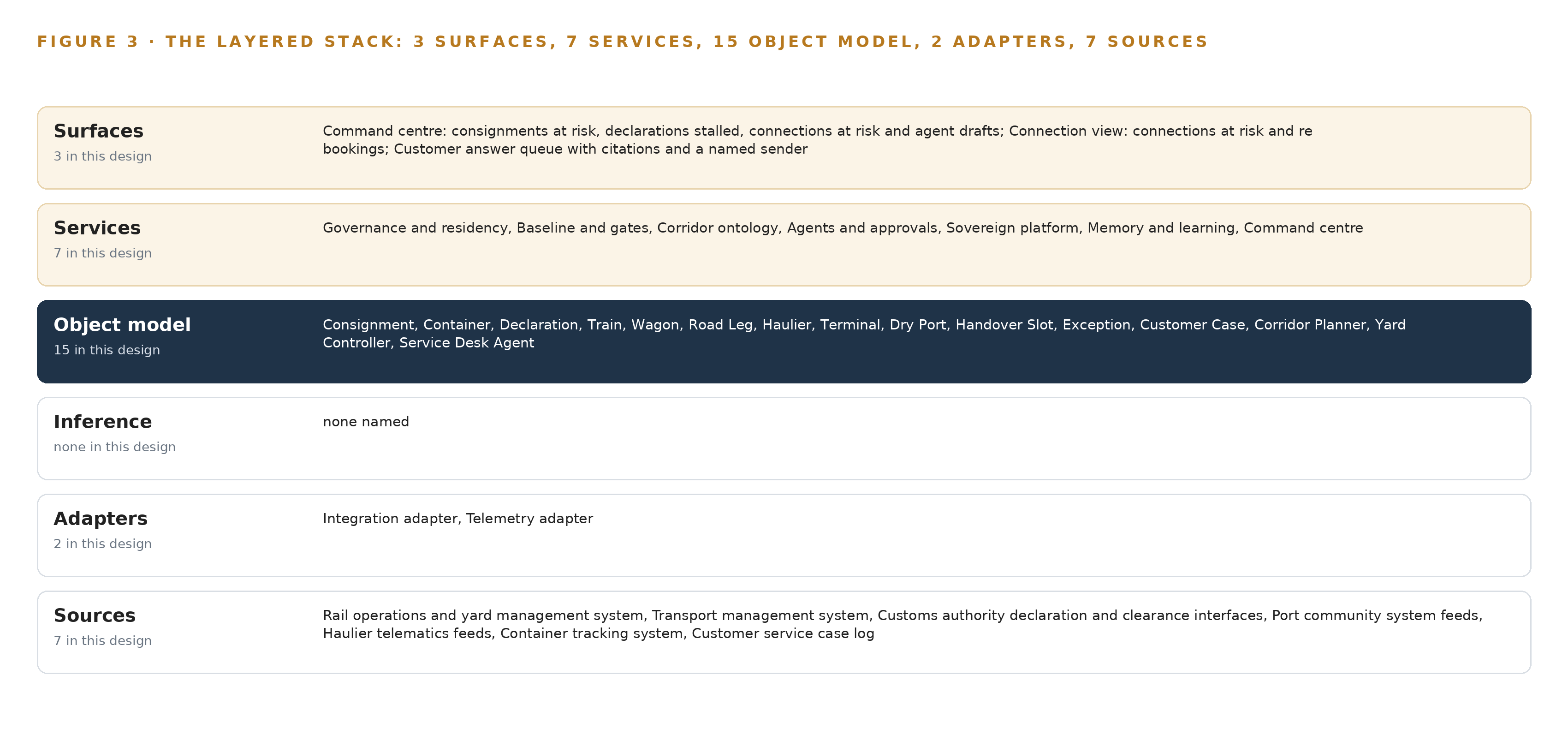
Three layers in a fixed order. Below sit the seven systems of record, read only, never replaced, never modified, never loaded. In the middle sits one governed object model of the corridor, a projection over those systems rather than a copy of them, so the model can be rebuilt from the sources at any time and never becomes a second book of truth. Above sit the applications and agents that draft answers, rebookings and exception chases, all of which become real only when a named person approves them. Figure 3 shows the layered stack with its counts: seven sources, two adapter families, fifteen objects, seven services and three surfaces.
The pattern fits because the owner's problem is a join failure, not a data shortage. Every fact the consignment story needs already exists inside the estate; what is missing is one place where the facts are already joined. International supply chains ordinarily depend on information moving across borders (Globaldataalliance n.d.), and this design inverts that habit for the operator's cargo, customer and declaration data, which stay in the country on the owner's own central node; there is no edge tier, and the one piece of equipment the design adds is that node, planned at about ten kilowatts of rack power and cooling in the owner's data center. An event backbone, Apache Kafka 4.3 in KRaft mode, holds the tiers together by carrying every change the adapters emit, in order. Table 7, printed by the platform from the plan, gives the layer by layer register of components and choices with the reason for each.
| Layer | Component | Choice | Why |
|---|---|---|---|
| Event streaming and messaging | by class, no product named | Product | Apache Kafka 4.3 KRaft |
| The ontology or graph store | by class, no product named | Product | Hyper Ontology v0.9 |
| Time series and telemetry storage | InfluxDB 3 Core, TimescaleDB, QuestDB | Class | The shelf holds InfluxDB 3 Core, TimescaleDB and QuestDB; the choice waits on the phase-one corridor's measured event volumes. |
| Video ingest, recording and management | by class, no product named | Not needed | No cameras; the design watches records and telematics, not video. |
| Edge model serving | by class, no product named | Not needed | No edge inference; all reasoning runs on the owner's central node, as the intake fixed. |
| On site language model serving | by class, no product named | Not needed | No model in the register survived this run's live checks, so nothing is served on this layer yet. The layer is model open work: it is chosen and sized when a verified model is. |
| Object tracking and trajectory forecasting | by class, no product named | Not needed | Road legs arrive as telematics positions and ETAs, not video tracks. |
| Edge orchestration of containers | by class, no product named | Not needed | No edge compute tier exists in this design. |
| An air gapped artifact and model registry | by class, no product named | Product | Harbor |
| Labelling and retraining | by class, no product named | Not needed | Under system of context nothing is trained; improvement runs through its memory loops. |
| Time synchronisation across sensors and systems | by class, no product named | Product | Chrony |
| Observability of the running system | by class, no product named | Product | Prometheus, Grafana and Loki |
4.2 The Stack Stage by Stage
Table 3 walks the same stack stage by stage, and each stage names its components. A supporting spine runs beside the stages: Chrony disciplines the clocks that event ordering depends on, Prometheus, Grafana and Loki observe the running system, Keycloak holds identity and access, and Harbor keeps artifacts and model images in an air-gapped registry. No model row survived this run's live checks, so language model serving is model open work: the hardware class is fixed at the 141 GB HBM class, and weights are committed only when a verified model stands in the register.
| Stage | What it is responsible for | How |
|---|---|---|
| Sources | Holding every fact the corridor story is made of: trains, wagons, yard slots, road legs, declarations, gate events, container identity and service cases | Seven named systems of record, all read inbound over agreed channels and never replaced |
| Sensing | Watching the corridor through records and telematics already flowing | Haulier telematics provide road leg position and ETA; no cameras and no new positioning hardware |
| Adapters | Putting every source behind one guarantee of lineage, ordering and staleness flags | Two families, the integration adapter and the telemetry adapter, built on Debezium with Apache Camel |
| Object model | One governed model of the consignment story, fifteen objects joined by typed links | Corridor ontology held in Hyper Ontology v0.9, a projection over the sources, never a copy |
| Inference | Reasoning over the model: stall detection, connection watch, drafted answers | Central node in the owner's data center on open weights; the model row is open work until a verified model stands in the register |
| Services | The seven workstreams: governance and residency, baseline and gates, corridor ontology, agents and approvals, sovereign platform, memory and learning, command center | Each service reads the object model and writes only through approvals; memory runs through a kept record of decisions and outcomes that the next decision reads, never into weights |
| Surfaces | The three places people work: the command center, the connection view, the customer answer queue | Rendered on the work surface, with citations on every answer and a named sender before it goes |
4.3 A Reusable Pattern
The reusable shape is the whole middle of this design: read-only systems of record below, a projection ontology joined by typed links, an event backbone carrying changes in order, adapters that guarantee lineage and staleness flags, and above it all agents that draft while people approve. A team carrying a similar brief keeps that shape and swaps the contents: their own source systems, their own object list grown from the nouns and relationships of their operation, their own thresholds, baselines and approval authorities, and their own hardware class once a model stands in their register. What they should not swap is the discipline. Sources are never written to, the model is never a second book of truth, and no action is real until a named person makes it so.
Fifteen Objects Turn Corridor Data Into One Story
The object model makes the consignment the focal object and joins container, declaration, train, wagon, road leg, haulier, terminal, dry port, handover slot, exception, case and the three human roles through typed links a document store cannot traverse.
Chapter 4 laid the stack from records to surfaces. This chapter opens the middle layer, the corridor ontology, where fifteen objects and their typed links turn seven fragmented records into one story a planner can read.
5.1 Fifteen Objects, One Story
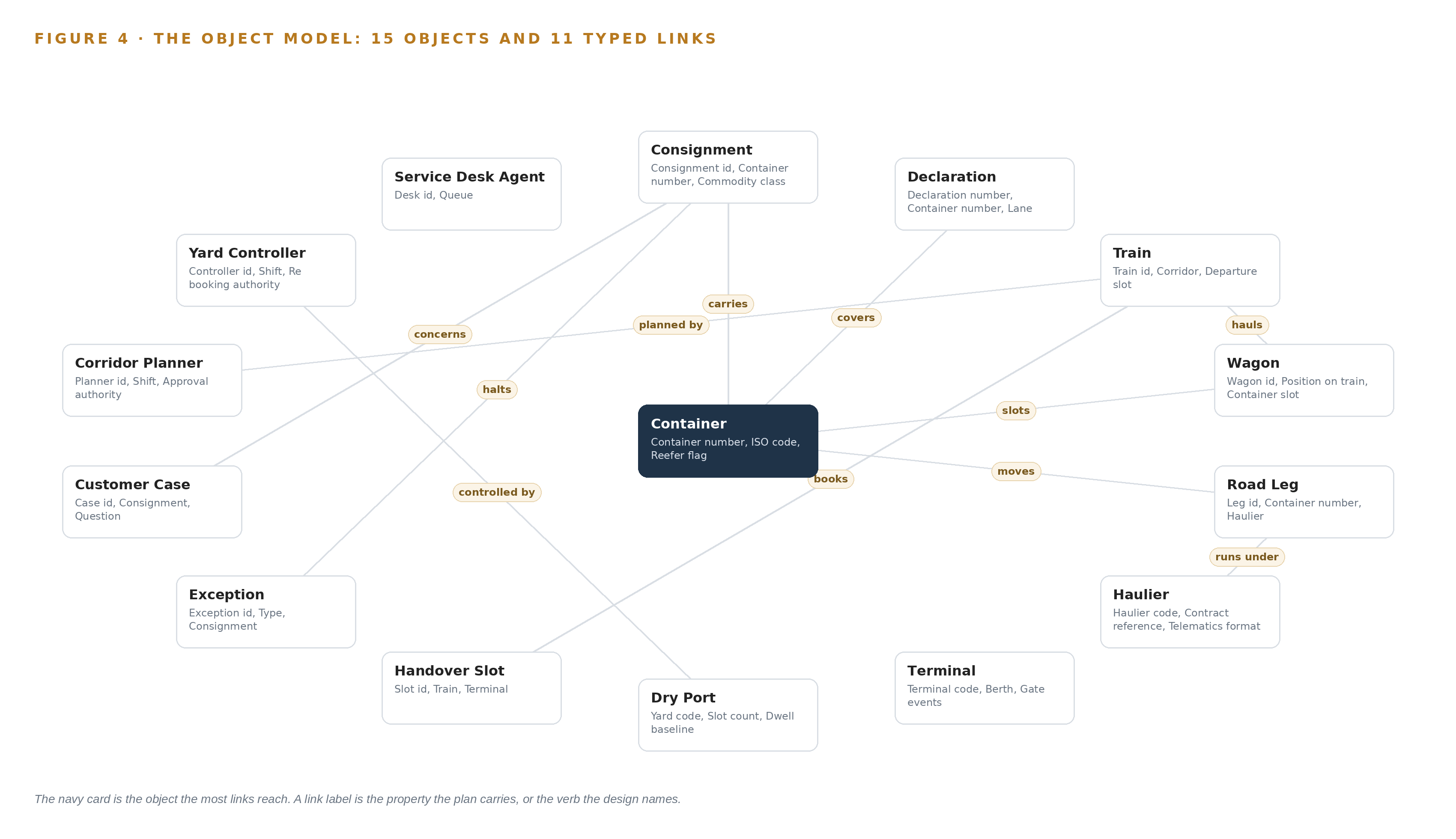
The model holds fifteen objects: Consignment, Container, Declaration, Train, Wagon, Road Leg, Haulier, Terminal, Dry Port, Handover Slot, Exception, Customer Case, and the three human roles, Corridor Planner, Yard Controller and Service Desk Agent. The consignment is the focal object, anchored in the container tracking system, with a status vocabulary that runs from Booked through At port, Cleared, In transit rail and At dry port to Handed over, with Exception as the turning point. Every other object attaches through typed links: the declaration joins the container by container number, the train carries its wagon list and each wagon carries the container in its slot, the road leg names its container and its haulier, the handover slot books its train, and the exception and the customer case name the consignment they concern. Figure 4 shows every object and every link.
What the links buy is traversal. Ask for consignments whose declaration has sat Queried past the lane's normal time, and the model returns a path, not a list: declaration to container to consignment, to the train and the handover slot it will miss, to the road leg and haulier downstream of that miss, to the open customer case asking about the same box, and to the corridor planner who holds approval authority over that train. A document store keyed on consignment cannot make that traverse, because the joins are not in the documents; they are in the typed links, so the traversal is a query rather than a project. Many industrial ontology examples stop at naming entities, and this model earns its keep one level up, in the links between them. Table 8, printed by the platform from the plan, gives each object with the system it is anchored in and its typed links.
| Object | Anchored in | Typed links |
|---|---|---|
| Consignment | Container tracking system | carries: Container |
| Container | Container tracking system | no typed link recorded |
| Declaration | The customs authority's declaration and clearance interfaces | covers: Container |
| Train | Rail operations and yard management system | hauls: Wagon; planned by: Corridor Planner |
| Wagon | Rail operations and yard management system | slots: Container |
| Road Leg | Transport management system | moves: Container; runs under: Haulier |
| Haulier | Transport management system | no typed link recorded |
| Terminal | Port community system feeds | no typed link recorded |
| Dry Port | Rail operations and yard management system | controlled by: Yard Controller |
| Handover Slot | Rail operations and yard management system | books: Train |
| Exception | Raised by the design's stall detection and connection watch | halts: Consignment |
| Customer Case | Customer service case log | concerns: Consignment |
5.2 The Human Loop and the Hosting Posture
The human loop lives in three places: the corridor planner holds approval authority, the yard controller holds rebooking authority over handover slots, and the service desk agent works the answer queue. The single write path is a named approval; no agent files, amends or cancels a declaration on its own, and agents draft while people decide. The hosting posture keeps everything on the owner's own hardware in the country. Identity and access run on Keycloak with permissions scoped to the three human roles, which matters because logistics data leaks from inside as well as from outside: at one parcel operator a former employee moved more than 26,000 customer records to outside firms, one of which used them for sales (Nikkei 2025). The estate makes no external model calls; there is no third party model service, and the boundary holds cargo, customer and declaration data in the country. Memory runs through a kept record of decisions and outcomes that the next decision reads, so each decision reads the record of earlier ones before it acts, and nothing is trained into weights.
5.3 One Object in Its Recorded Form
The Consignment, in its recorded form as the platform prints it below, carries its identifier, the container number it carries, its commodity class, its origin seaport and destination dry port, its current hand, its status vocabulary from Booked to Exception, and the link that places the container inside its story; the declaration, with its lane, broker, filing time, clearance state and last movement time and a status vocabulary from Filed to Held, is recorded the same way.
{ "id": "consignment", "label": "Consignment", "kind": "record", "anchored_in": "Container tracking system", "properties": [ "Consignment id", "Container number", "Commodity class", "Origin seaport", "Destination dry port", "Current hand", "Story link" ], "status_vocabulary": [ "Booked", "At port", "Cleared", "In transit rail", "At dry port", "Delivered", "Exception" ], "links": [ { "to": "container", "label": "carries" } ] }Every Source Enters Through an Adapter, Never Directly
Two adapter families, integration and telemetry, put seven named source systems behind one guarantee of lineage, ordering and staleness flags, so a stall is detected when the data says so rather than when the consignee calls.
Chapter 5 showed what the object model holds. This chapter shows how data gets into it: through two adapter families, never directly, so that lineage, ordering and staleness are guaranteed before any agent reasons over a single fact.
6.1 Seven Sources, All Read
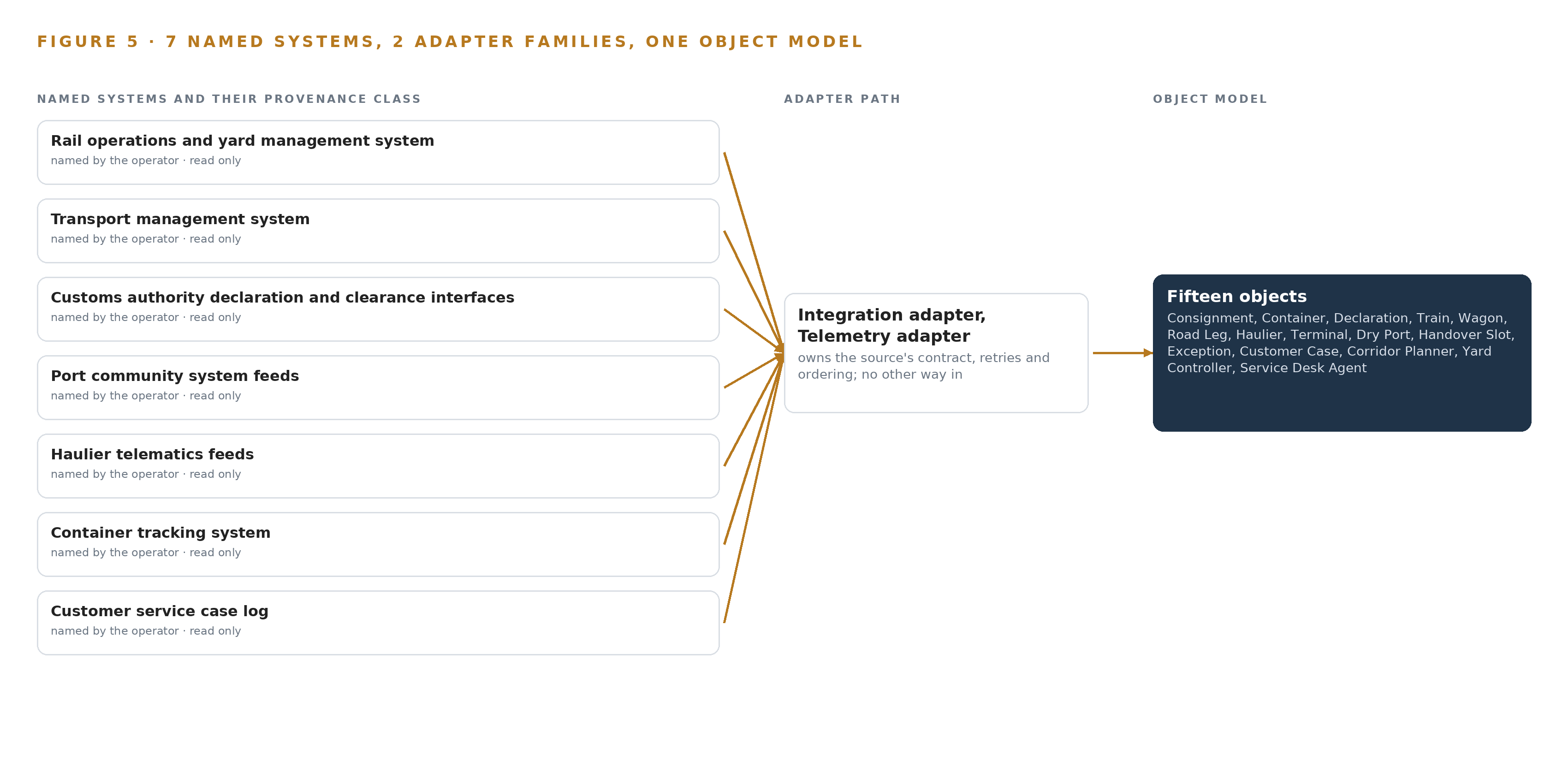
Figure 5 maps the seven named source systems and their adapter paths. The rail operations and yard management system owns trains, wagons, yard slots and the handover the whole corridor story turns on. The transport management system owns the road legs and haulier assignments the connection watch reasons over. The customs authority's declaration and clearance interfaces own declaration state and clearance events, the stall signal and the single declaration transit lanes. The port community system feeds own the vessel, gate and terminal events that start the consignment's story. The haulier telematics feeds provide the road leg position and ETA the connection watch depends on. The container tracking system owns the container number that joins every system to one consignment. The customer service case log holds the questions the answer queue drafts against and the record of answers sent. Every source carries the operator's own provenance class: each fact enters already owned by the operation, read inbound over agreed channels, with nothing scraped or purchased, and all seven are read only.
6.2 What the Adapter Tier Guarantees
Two families stand between the sources and the backbone. The integration adapter, built on Debezium with Apache Camel, brings the systems of record in as change events; the telemetry adapter brings the haulier feeds in as positions and ETAs. Together they guarantee three things. Lineage: every property on every object traces to a source record and a timestamp, so an answer can cite where each fact came from. Ordering: clocks across the estate are disciplined by Chrony, so a gate event and a clearance event on the same consignment can be sequenced. Staleness flags: each interface's cadence is published in the command center, so a declaration that has not moved reads as no news rather than as cleared, and a stall is detected when the data says so. One audited seam also has a security value, because logistics estates are breached through shared infrastructure and third parties: personal data left one provider through a shared network station (Warehousetotaal 2026), and third-party breaches doubled as a share of incidents in the most recent year (Cybelangel 2026).
6.3 The Event Backbone
Apache Kafka 4.3 in KRaft mode carries every change the adapters emit. Ordering is per partition keyed on the container number, so each consignment's story is sequenced within its own lane even when the whole estate streams concurrently. Delivery is at least once with idempotent handlers keyed on source record ids, so a replayed event cannot double-write a state change. Buffering is the retained log: when an interface drops or a scheduled file delivery slips, events wait, and the object model marks the gap rather than guessing. Replication stays in country, across the owner's own data center racks, and nothing replicates outside the boundary. Replay is also the recovery path, because a ransomware event stopped a logistics operator's services outright and encrypted the data it held (Askullogist 2025); the backbone's retained logs let the object model be rebuilt from the sources without ever writing back to them.
All Reasoning Runs on the Operator's Own Node
There is no edge tier in this design: the central node in the owner's in-country data center serves every agent and surface, the latency budget is set by the corridor's decision cadence, and the boundary admits only inbound reads.
Chapter 6 described how seven source systems enter through two adapter families and never directly. This chapter fixes where the reasoning over that joined data runs, and the answer is short by design: industrial AI on this corridor does not need an edge tier, because the decisions the system supports run on a cadence of minutes and hours rather than milliseconds, and the sovereignty the owner demands is easiest to hold in one place.
7.1 One Tier: the Central Node in Country
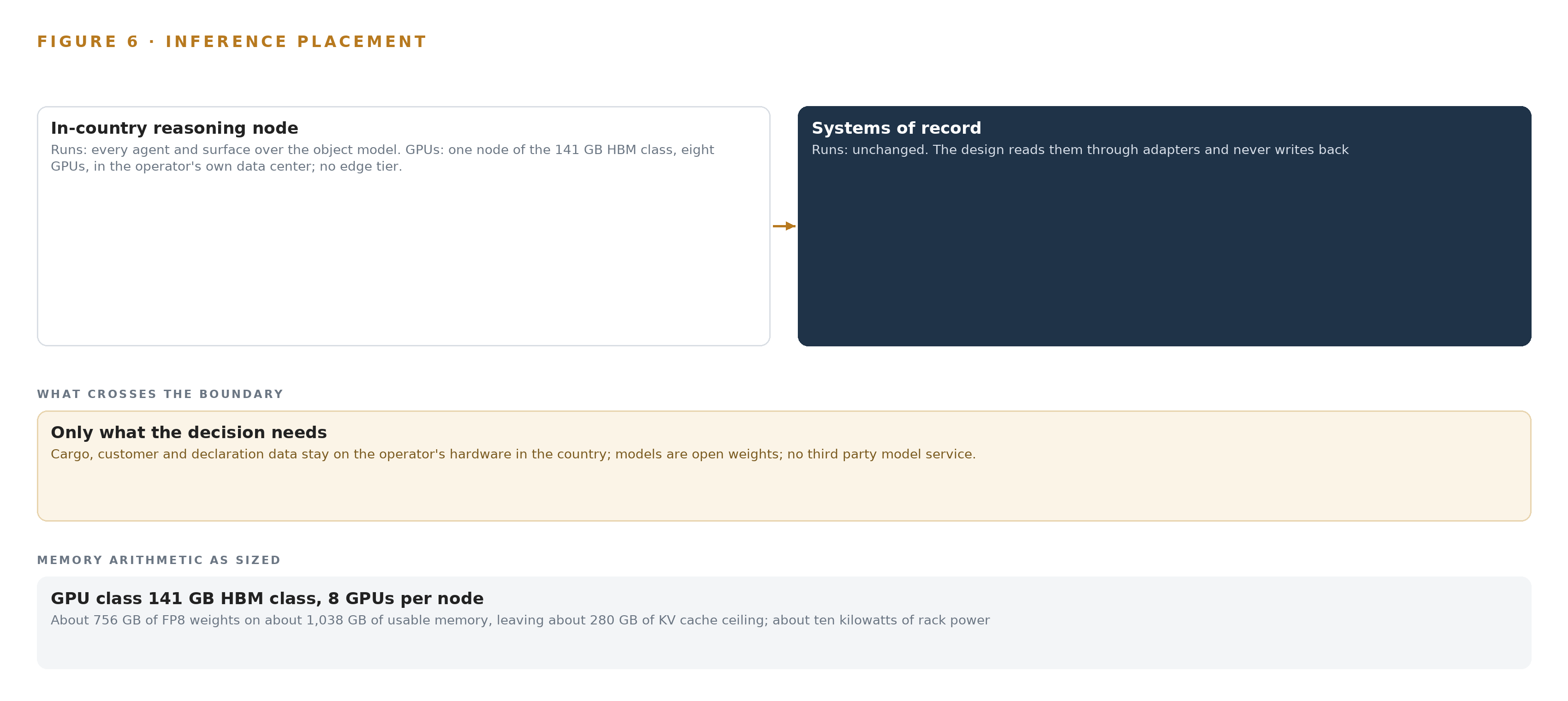
There is one inference tier, the owner's central node in the in-country data center, and it serves every agent and every surface. The design commits no cameras, no roadside compute, no edge orchestration of containers and no edge model serving, because the corridor is watched through records and telematics rather than through instruments, and haulier telematics already provide position and ETA. The plan sizes the estate for the phase-one corridor with this single node, with any scaling decided at the extension gates rather than assumed at the start.
The memory arithmetic comes from the sizing rule the register records, and it is stated here as that rule rather than as a committed model row, a distinction Chapter 8 carries in full. GLM 5.3, the model the requirement names, occupies about 756 GB of weights at FP8 precision, taken as 753B parameters. One node of the inference cluster class (GPU nodes for 300B to 1T parameter open weight models), with eight GPUs and about 1,038 GB of usable memory, holds those weights and leaves about 280 GB of KV cache ceiling, the working memory that determines how much concurrent context the node can serve. The node is planned at about ten kilowatts of rack power, which is ordinary data-center power and cooling rather than a field engineering problem. Figure 6 sets the placement out: one node, seven read-only source systems below it, three surfaces above it, and no second tier anywhere in the picture.
7.2 The Latency Budget Is the Decision Cadence
Each decision the system supports has its own clock, and the budget is set by that clock rather than by a target written in milliseconds. Stall detection watches declarations against lane normal-time baselines, and it must fire while the stall still costs hours of a nominal 96 hour dry port dwell rather than after the consignee calls, so its budget is the interval between a declaration's last movement time and the moment a planner could still act. The connection watch joins a road leg's telematics ETA to the handover slot window, and its budget is the gap between the ETA update and the window start, because an answer that arrives after the train has departed is a record rather than a decision. The answer queue drafts replies with citations and a named service desk agent sends them, so its budget is a working shift and completeness of citation matters more than a second saved. Scheduled file drops make some interfaces staler than others, so the command center publishes a per-interface cadence and flags staleness rather than pretending to a real time it does not have.
7.3 The Boundary Admits Only Inbound Reads
What crosses the network boundary is inbound reads, nothing else: seven interfaces over agreed channels, each read-only, with the systems of record never replaced, modified or loaded, and the single write path in the design running from the adapter tier into the object model. Cargo, consignee and declaration data stay on the owner's hardware in the country, and no third party model service is ever called. The boundary is drawn against the grain of the industry, since cross-border data transfers are integral to how supply chains ordinarily run (Globaldataalliance n.d.), and the owner's requirement inverts that default deliberately. It is also drawn against rising third-party exposure: third-party breaches doubled as a share of all security incidents in the most recent year (Cybelangel 2026), which is why egress monitoring sits at the boundary and why the telematics question is asked at phase zero, because haulier feeds may transit a foreign cloud before they reach the estate.
Each failure path has a stated behavior. When the link fails, staleness flags rise on the affected interfaces, the object model holds last known state, and exceptions recorded on the feed's return carry their true detected-at time rather than a smoothed one. When power fails, the node rides the data center's existing protections, and its about ten kilowatts sit within ordinary rack capacity. When the update path is exercised, weights and artifacts enter only through the air-gapped artifact registry, verified before anything is served, so an update can never become an unexamined ingress.
The Register Holds No Weights Until Verification Stands
The license decides what the owner can own, and no open weight model survived this run's live checks, so the register records the sizing rule, the inference cluster class (GPU nodes for 300B to 1T parameter open weight models) and the GLM 5.3 license question as open work rather than committing weights it cannot stand behind.
Chapter 7 placed every agent and surface on the owner's central node and drew the boundary as inbound reads only. This chapter states what that node is licensed and sized to run, and why the register commits no weights it cannot stand behind. Figure 7 opens the chapter with the model stack: one planned slot, the work surface model class open weights, self hosted, with the model row itself marked as open work rather than a filled commitment.
8.1 What the Requirement Names, and What the License Allows
GLM 5.3 is the model the requirement itself names: class open weights, self hosted for sovereignty, of the frontier class the plan records. Its role is the conversational command center the requirement asks for, the interface that answers questions about a consignment with citations back into the object model, and it runs on the single central node of Chapter 7. The sizing arithmetic already stated, 753B parameters at FP8, about 756 GB of weights on one 141 GB class node with about 280 GB of KV ceiling, is the rule that fixes its footprint. Its license carries a trigger: it bites a corporate group running a Model as a Service business above 10 billion USD, so the owner's corporate group is checked at phase zero, and GLM 5.2 under MIT stands as the fallback if the trigger is met. Open weights are what make the ownership real, because the owner holds the weights on its own hardware and no third party model service ever sees cargo, consignee or declaration data.
What the register does not do is commit that row. No open weight model survived this run's live checks: each catalog entry the design cites was verified by a person on the date it carries and was not rechecked live for this build. That verification is outstanding work before any weights are committed, and the register records it as open work rather than naming weights it cannot stand behind. The honest position is that the design runs on weights the owner holds, so which weights is part of what is being bought, and a design file that invented certainty here would spend the owner's money on it.
8.2 Equipment, Rules and the Register
Table 4 gathers the register in one place. On hardware, the choice is one node of the inference cluster class (GPU nodes for 300B to 1T parameter open weight models) with eight GPUs, because it holds the FP8 weights with the KV ceiling stated above, while two 80 GB class nodes and BF16 on a 256 GB class node were set aside. Sizing runs through the Model GPU Footprint Sizing Rule (vLLM, SGLang) and the GLM 5.3 Node Count By GPU Class, which fix the node count from weights, usable memory and KV ceiling before any purchase is made. On sensing, the register holds none: the design reads declarations, slots, gate events and telematics ETAs, not video. The pattern the design stands on is system of context, with the ontology as a projection over the seven systems of record and improvement running through a kept record of decisions and outcomes that the next decision reads instead of fine tuning, because the requirement asks for improvement without training a model on the fly. The ground is the owner's own hardware in an in-country data center, with weights and artifacts entering only through the air-gapped registry.
That ground carries one rule the design never contradicts. Saudi Arabia sits in US Country Groups D:3 and D:4, so the 141 GB class ships there only under a US export license granted case by case, a determination against ECCN 3A090 and 4A090 is required before any GPU class is quoted, and the license checkpoint sits in phase zero before purchase, with delivery riding timelines outside the vendor's control. Cross-border flows are how supply chains normally work (Globaldataalliance n.d.); this design keeps the cargo's data inside the country while the containers themselves cross borders, and the register says so in rows rather than in promises.
| The choice | What was picked | Why here |
|---|---|---|
| Work surface model | GLM 5.3, class open weights, self hosted, frontier class | Named in the requirement; open weights on the owner's own hardware keep every answer in country |
| License fallback | GLM 5.2 under MIT | Escapes the GLM 5.3 trigger for a corporate group running a Model as a Service business above 10 billion USD |
| GPU class | One node of the 141 GB HBM class, eight GPUs | About 756 GB of FP8 weights fit with about 280 GB of KV ceiling; phase one is sized on one node, gates scale it |
| Sizing rules | Model GPU Footprint Sizing Rule (vLLM, SGLang); GLM 5.3 Node Count By GPU Class | Fix the node count from weights, usable memory and KV ceiling before any purchase |
| Sensing | None; records and telematics only | The corridor is watched through declarations, slots and ETAs, not instruments |
| Pattern | System of context | The ontology is a projection over seven systems of record; a kept record of decisions and outcomes that the next decision reads improves the plan without training weights |
| Verification | No model row stands until live checks pass | Each catalog entry was verified by a person on its date and not rechecked live for this build |
| Ground | The owner's own hardware, in-country data center, air-gapped artifact registry | Cargo, consignee and declaration data never leave the country; no third party model service |
| Export license | Determination against ECCN 3A090 and 4A090 before quoting any GPU class | Saudi Arabia sits in Country Groups D:3 and D:4; the 141 GB class ships only under license, checked at phase zero |
A Measured Quarter Gates Every Corridor Extension
Three phases with seventeen items carry the build from baseline and approvals through the phase-one corridor and its quarter of measured dwell, stalled declarations, missed connections and answered questions, and the numbers, not opinion, open the further corridors.
Chapter 8 closed the model register and the license terms that decide whether the owner can hold its own weights. This chapter turns to the build itself: how seventeen items in three phases move from approvals to a measured quarter on the first corridor, and why the numbers, not opinion, open the corridors beyond it.
9.1 The Phases and Their Gates
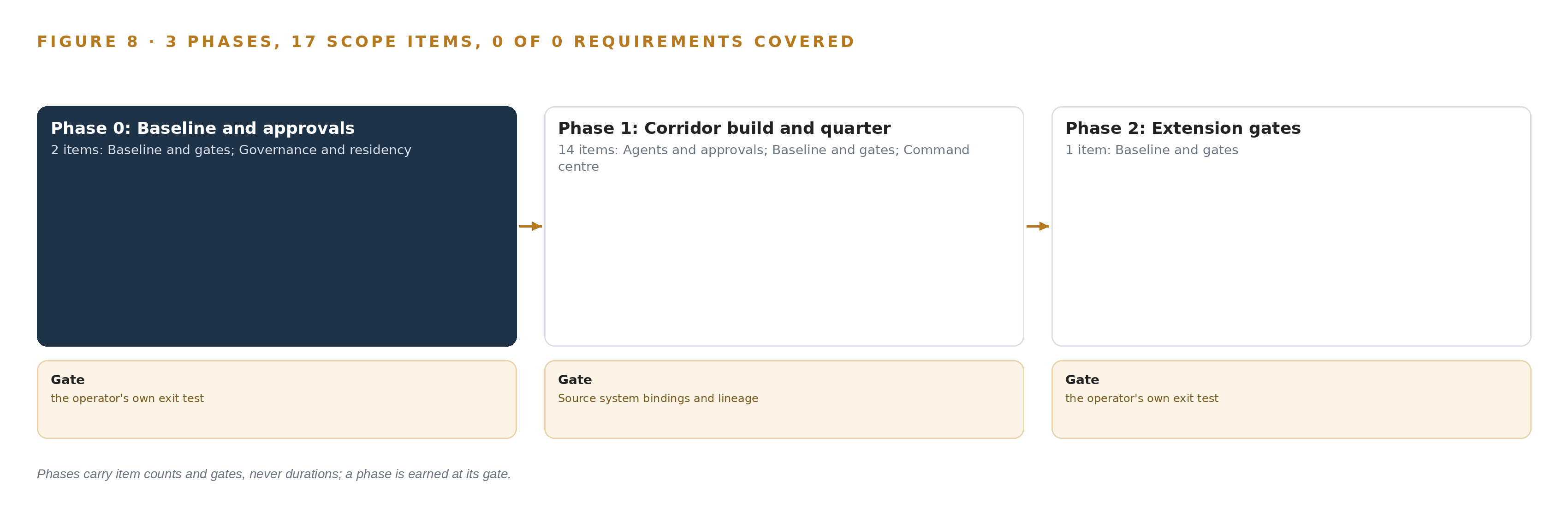
The rollout carries three phases and seventeen items, shown with their workstreams and gates in Figure 8. Phase 0 holds two items in two workstreams, governance and residency together with baseline and gates: residency and data protection compliance, and the phase-one baseline measurement. Nothing moves until the residency approvals close and the baseline is recorded, because a savings claim without a recorded starting point is an opinion. Phase 1 holds fourteen items in six workstreams: agents and approvals, baseline and gates, command center, corridor ontology, governance and residency, and memory and learning. Its exit gate is source system bindings and lineage: every property on every object must trace to the system of record that anchors it, and the joins must hold on one real week of production data before any agent is allowed to trigger. Phase 2 holds a single item, the extension gates to further corridors, and it spends nothing but the quarter's measured evidence. The requirement register holds fifteen requirements, each traced to a phase item, and coverage is reviewed at every gate so a gap surfaces as a gate failure rather than as a surprise.
9.2 What the Rollout Measures
The primary measure is dwell at the dry port, in hours, against a nominal of 96, with a breach when dwell runs above it; the fault the design watches for is a declaration stall at the seaport, because a stalled declaration is what turns a scheduled handover into yard congestion the design learns about from the consignee. Around that headline the quarter counts three more things: stalled declarations by lane, broker and hour of the day; missed connections, where a road leg running late in telematics is joined to the train it will miss; and answered questions, the cases the service desk closes with citations from the system rather than by a planner assembling six identifiers by hand. Two guard measures sit underneath. A weekly join-success gate at 95 per cent, with failures triaged by source system, protects the container number join the whole argument rests on. An action rate, the share of drafted answers and re-bookings the planners actually act on, is itself a gate, because a command center nobody acts on is a screensaver.
9.3 Failure Modes
Table 5 lists what fails and what the design does about it. The telematics row deserves its place on evidence: supply chains depend on information moving across borders (Globaldataalliance n.d.), and third-party breaches doubled as a share of security incidents in the most recent year, with regulators holding leadership accountable for vendor risk (Cybelangel 2026), so a feed that transits a foreign cloud before reaching the estate is a boundary failure, not a technicality.
| What fails | What the design does |
|---|---|
| The container number join silently fails across the six identifiers | Weekly join-success gate at 95 per cent, with failures triaged by source system |
| The GLM 5.3 license triggers for a corporate group running a Model as a Service business above 10 billion USD | Check the owner's corporate group at phase zero; GLM 5.2 under MIT is the fallback |
| Scheduled file drops make stall detection stale | Staleness flags and per-interface cadence published in the command center |
| Planners ignore drafts and the command center becomes a screensaver | Per-shift alert budget agreed before thresholds are set; action rate is a phase gate |
| Telematics transit a foreign cloud before reaching the estate | Covenant and contract question at phase zero; egress monitoring at the boundary |
| Export license delay on the 141 GB class GPU import | License checkpoint in phase zero, before purchase |
9.4 Lessons
Bind the join before the agents. The ontology is a projection over seven systems of record, and the container number is the one key that crosses all of them; an agent reasoning over a broken join produces confident nonsense, which is why the source system bindings and lineage gate stands before any agent triggers and why the join-success gate runs weekly forever after. Publish the cadence of every interface. A declaration event that arrives on a scheduled file drop is stale by construction, and a stall detector built on stale events reports yesterday's problem this morning; the command center therefore carries staleness flags and a per-interface cadence so a planner can see how old every signal is before acting on it. Agree the alert budget before the thresholds. Thresholds chosen in a vacuum either flood the shift or whisper; the per-shift alert budget is negotiated with the planners who will receive the alerts, and the action rate gate holds the design to the bargain. Check licenses and covenants at phase zero, not at purchase. The GLM 5.3 license trigger, the telematics cloud path and the GPU export license are all contract and regulatory questions, and each is cheap to ask before anything is bought and expensive to discover after.
9.5 What Is Still Open
Four questions remain open, and each one changes the plan when it settles. The export license determination for the 141 GB HBM class, against the control categories that govern advanced computing items, is a phase-zero checkpoint before purchase; settling it sets the order date and the phase-one hardware timeline, and an unfavourable answer moves the footprint to a different GPU class and a different node count. The register holds no open-weight model verified live on this run: each catalog entry was verified by a person on the date it carries and was not rechecked for this build, which is outstanding work before any weights are committed; settling it fills the serving layer and turns the unsized work surface footprint into a node count. The telematics covenant question, whether any haulier feed transits a foreign cloud before reaching the estate, decides whether egress monitoring closes a real gap or guards an empty one; a logistics peer in the region absorbed a ransomware attack that encrypted data and stopped services at scale (Askullogist 2025), and an insider leak of more than twenty-six thousand records at another carrier shows the boundary faces people as well as networks (Nikkei 2025). Finally, whether chrony's time synchronisation proves sufficient for event ordering decides whether a GNSS grandmaster class is added at the central site; settling it either confirms the software-only answer or adds one hardware class to the register.
The Intelligence Stays with the Corridor That Produced It
The object model, the weights and their fine tunes if ever made, the decision record and the boundary all belong to the owner, because the memory of which lane stalls at which hour was earned on its corridors and should compound inside its estate.
Chapter 9 showed a quarter of measured dwell, stalled declarations, missed connections and answered questions gating every extension. This chapter settles the question those numbers raise: who owns the intelligence the corridors produced, and where it compounds.
10.1 What the Operator Owns
The owner owns the object model. Fifteen objects, their status vocabularies and their typed links form a projection over the seven systems of record, never a copy of them, and the crossing mappings that answer questions no single system can are the owner's asset; the model survives any change of tooling beneath it because it is the argument, not the storage. The owner owns the weights and any fine-tunes, if ever made: the design commits open weights running on the owner's own hardware in the country, so whatever model the register settles on, the weights sit inside the estate, and under system of context nothing is trained into them, which means the improvement path never creates a derivative the owner does not hold outright. The owner owns the decision record: every exception with its confirmed cause, every approval by a named planner, every re-booking by a named yard controller, and every case answered with citations, held so the next decision reads what the last one learned about which lane, which broker and which hour stalls most often. That memory was earned on the owner's corridors and should compound inside its estate, not inside a vendor's. The owner owns the boundary: cargo, consignee and declaration data stay on its hardware in the country, no third-party model service is called, and the egress monitoring at the boundary exists to keep that covenant true rather than to assert it.
10.2 The Offer Behind the Design
CodeNinja designed this system on Praxis, its platform for designing physical AI systems, and the design maps directly onto what CodeNinja builds: the object model that projects seven systems of record into one corridor argument is Hyper Ontology; the command center and the work surface where the owner's own people build and adjust agents is Hyper Pragma; the kept record of decisions and outcomes that each next decision reads, which improves the operation without touching model weights, is Hyper Engram; the posture of open-weight models on the owner's own hardware, inside the country, with the export-license and residency questions carried as phase-zero checkpoints, is Sovereign Infrastructure. The design is the argument that these pieces belong together, and the ownership chapter is where the argument lands: everything the quarter measures, and everything the memory learns from it, stays with the corridor that produced it.
One Projection, One Memory, One Answer, Held Sovereignly
The design is one projection over six systems of record that never replaces or modifies them: an object model of fifteen objects joined by typed links anchored on the container number, adapters that guarantee lineage for every event, all reasoning on the owner's own in-country node under open weights, a memory of decisions and outcomes that improves the corridor without training any model, and a command center where a named planner, yard controller or service desk agent approves every action and every answer carries citations. The first measured quarter gates every extension beyond the phase-one corridor, so the system grows only on evidence the operation itself produced.
Running the same shape elsewhere takes three things the operation must already hold: systems of record whose identifiers can be resolved to one anchoring key, an in-country place for the node and its power, and named people willing to own each decision the agents draft. Swap the object vocabulary for the local corridor's nouns, rebind the adapters to the local source systems, re-run the export license and residency checks for the destination country, and the same fixed order of layers, the same rule of projection rather than migration and the same gated phases carry a different corridor to the same sovereign answer.
How Praxis Contextualized and Reasoned This Design
Every design in the series is produced on Praxis, and this chapter traces each choice in the paper back to the records read, the eight lenses applied and the patterns adopted, so a reader can audit the reasoning rather than take it on trust.
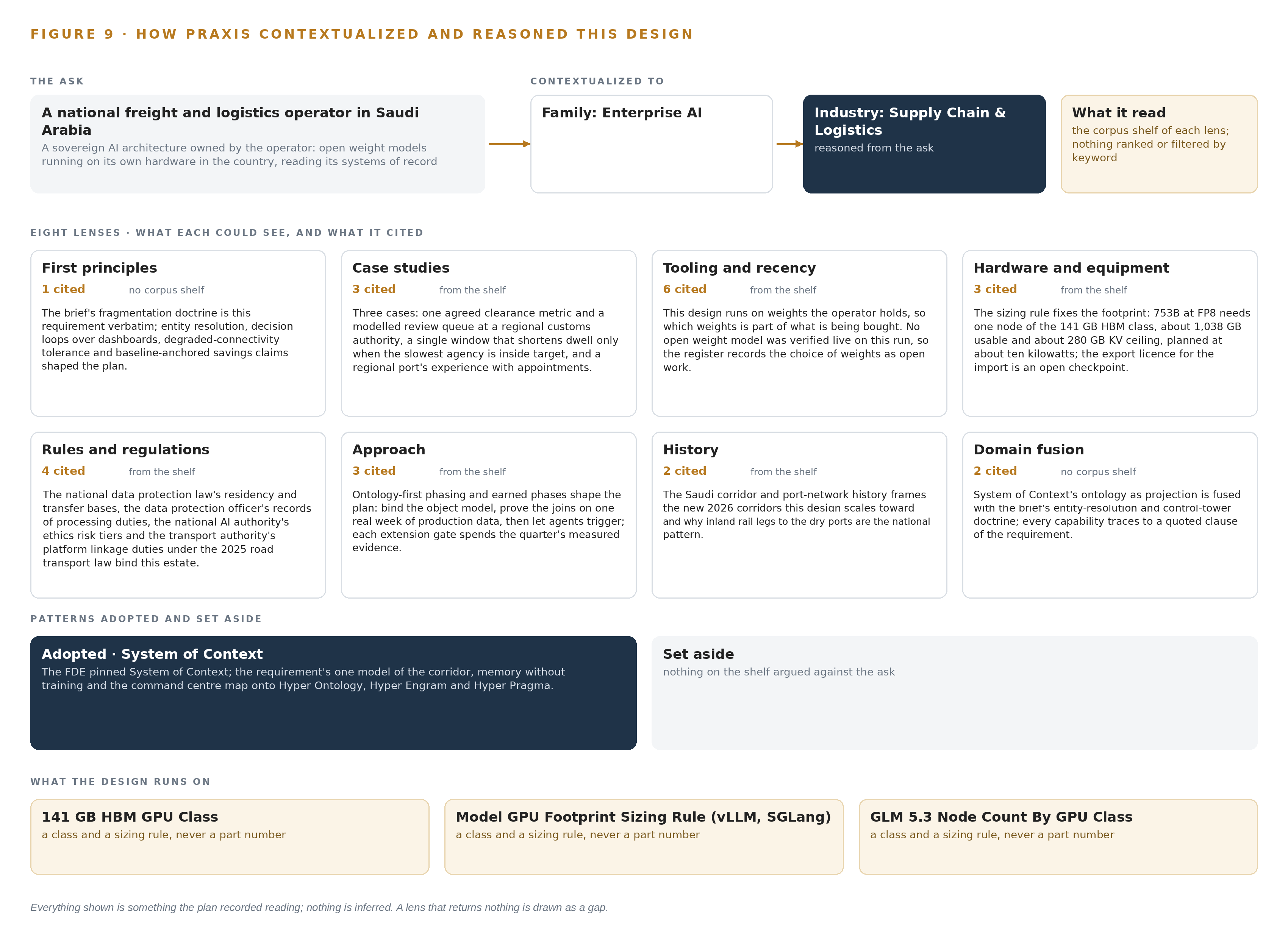
Chapter 10 closed the ownership argument: the model, the weights, the decision record and the boundary all stay with the owner. This chapter opens the reasoning itself, so a reader can audit how the design was reached rather than take it on trust. Every design in the series is produced on Praxis, and this chapter lets a reader trace any choice in the paper back to what justified it (Figure 9).
11.1 Contextualizing the Ask
The ask arrived written in the owner's voice: a sovereign architecture for corridor and customs operations, with open-weight models running on the owner's own hardware in the country, reading the systems of record, and nothing about consignees' cargo leaving the country or reaching a foreign model service. Praxis assigned the design to the Enterprise AI family and the Supply Chain and Logistics industry, a pin made by the forward deployed engineer on the project rather than a reasoned match, with the brief still read whole as reasoning input. Praxis read the corpus shelf of each lens, with nothing ranked or filtered by keyword, and every record the lenses cite is available on request.
11.2 The Lenses
Table 6 shows all eight lenses, what each could see, how many records each cited, and what each contributed to the design. No lens returned nothing; the tooling lens returned the one gap that matters, the absence of a live-verified open-weight model, and the design carries that gap openly rather than naming weights it cannot stand behind.
| Lens | Could see | Cited | What it contributed |
|---|---|---|---|
| First principles | no corpus shelf | 1 | The brief's fragmentation doctrine is this requirement verbatim: entity resolution, decision loops over dashboards, degraded connectivity tolerance and baseline anchored savings claims shaped the plan. |
| Case studies | the case study shelf | 3 | Three cases: one agreed clearance metric and a modelled review queue at a regional customs authority, a single window that shortens dwell only when the slowest agency is inside target, and a regional port's experience with appointments. |
| Tooling and recency | the tooling and recency shelf | 6 | This design runs on weights the owner holds, so which weights is part of what is being bought. No open weight model was verified live on this run, so the register records the choice of weights as open work. |
| Hardware and equipment | the hardware and equipment shelf | 3 | The sizing rule fixes the footprint: 753B at FP8 needs one node of the 141 GB HBM class, about 1,038 GB usable and about 280 GB KV ceiling, planned at about ten kilowatts; the export licence for the import is an open checkpoint. |
| Rules and regulations | the rules and regulations shelf | 4 | The national data protection law's residency and cross border transfer bases, the data protection officer's records of processing duties, the national AI authority's ethics risk tiers and the transport authority's electronic platform linkage duties under the 2025 road transport law bind this estate and are carried as phase zero approvals. |
| Approach | the approach shelf | 3 | Ontology first phasing and earned phases shape the plan: bind the object model, prove the joins on one real week of production data, then let agents trigger; each extension gate spends the quarter's measured evidence. |
| History | the history shelf | 2 | The Saudi corridor and port network history frames the new 2026 corridors this design scales toward and why inland rail legs to the dry ports are the national pattern. |
| Domain fusion | no corpus shelf | 2 | System of context's ontology as projection is fused with the brief's entity resolution and control tower doctrine; every capability traces to a quoted clause of the requirement. |
11.3 Patterns Adopted and Set Aside
One pattern was adopted, as primary: System of context. Its three layers sit in a fixed order, with the systems of record below, never replaced, never modified, never loaded; the ontology in the middle as a projection over them rather than a shadow copy, its crossing mappings answering the questions no single system can; and the applications and agents above. Its grammar is small and it is the reason the object model reads as it does: nouns become objects, facts become properties, relationships become typed links, and actions change status along a controlled vocabulary. Its kinetic loop closes on the model, sense, decide, act, learn, with the return edge making the model living rather than a diagram. Nothing was set aside, and no precedent on the shelf was rejected: the proven-solutions shelf was not searched before the record closes, and that absence is carried as honest open work rather than dressed up as a choice.
11.4 Where the Reasoning Lands
The reasoning lands on three equipment classes: the inference cluster class (GPU nodes for 300B to 1T parameter open weight models), the model GPU footprint sizing rule for the vLLM and SGLang serving runtimes, and the GLM 5.3 node count by GPU class. Together they fix the footprint at one central node in the owner's own data center, about ten kilowatts of rack power and cooling, with no edge tier, no cameras and no new field sensing anywhere in the design, because the corridor is read through records and telematics rather than instruments. Every figure in this chapter, from the records read to the citations per lens to the memory arithmetic, was recorded reading, and nothing is inferred: what the reasoning did not reach is stated as open work, and what it settled is traceable to the record that settled it.
What the Operator's Own Inference Node Costs Over Three Years
The paper is written for a national freight and logistics operator in Saudi Arabia, with every agent and surface running on one central node in the operator's own in-country data center (chapter 3, section 3.1; chapter 7, section 7.1). This appendix therefore prices for Saudi Arabia, with the national commercial electricity tariff for power and the AWS Middle East (UAE) region, me-central-1, as the rental reference. The design's frontier tier is "one node of the 141 GB HBM class, eight GPUs" (Table 4, "GPU class"; chapter 7, section 7.1; chapter 8, section 8.2), planned "at about ten kilowatts of rack power" (chapter 7, section 7.1). The paper names no second model and sizes no other server: the time series store, the event backbone, the registry, identity and observability are chosen by class and not sized (chapter 4, Table 7; chapter 4, section 4.2), so nothing is added for them rather than a server guessed. The paper's own scope boundary keeps "the hardware and its support contracts" outside the design's price (Table 2, "Scope boundary"), so this appendix is the reference the paper itself does not print. The node is priced two ways: owned, from a reseller's published configured price with support and power added, and rented, from the AWS price files for the nearest region that offers the same card, on demand and on the two three year all upfront plans. Every input is dated and cited, and the arithmetic is shown.
A.1 The Answer
Owning the node for three years costs about 569,000 US dollars, inside a range of 541,000 to 594,000. Renting the same eight H200 cards around the clock costs about 751,000 dollars on the deepest three year commitment (an AWS EC2 Instance Savings Plan, all upfront, for p5en.48xlarge in Middle East (UAE)), about 1.33 million dollars on the three year Compute Savings Plan, all upfront, and about 2.00 million dollars on demand. Against the deepest commitment, ownership costs about three quarters (569,203 / 750,535 = 0.76, and 0.72 to 0.79 across the range); against on demand, a little over a quarter (569,203 / 1,996,103 = 0.29). No rented option can sit inside the Kingdom today: AWS's Saudi region is scheduled to open by December 2026 (W.Media 2026) and its price files listed no Saudi region on the day read (AWS 2026a), and every rented option would carry cargo, customer and declaration data across the border, which the design's own first constraint rules out (chapter 3, section 3.1; chapter 7, section 7.3). Renting is therefore a price reference only. GLM 5.3 is the model the requirement names, with a licence trigger for a corporate group running a Model as a Service business above 10 billion US dollars that is checked at phase zero, and GLM 5.2 under MIT as the fallback (chapter 8, section 8.1; Table 4); the register commits no model row until live verification stands (chapter 8, section 8.1), and no price is asserted for weights here.
A.2 What the Hardware Would Cost
| Option | Basis | Three year cost (USD) |
|---|---|---|
| Owned, in the operator's own data center | One 8x H200 node with support and power, broken out below | 541,000 to 594,000, typical 569,000 |
| AWS, Middle East (UAE), on demand | p5en.48xlarge, eight H200 cards, 1,128 GB of HBM3e (AWS 2026c), at 75.9552 dollars an hour (AWS 2026b), 26,280 hours; outside the Kingdom | 1,996,103 |
| AWS, Middle East (UAE), three year Compute Savings Plan, all upfront | p5en.48xlarge at 50.66046 dollars an hour (AWS 2026a), 26,280 hours; outside the Kingdom | 1,331,357 |
| AWS, Middle East (UAE), three year EC2 Instance Savings Plan, all upfront | p5en.48xlarge at 28.55916 dollars an hour, the deepest three year plan for this instance in the region (AWS 2026a), 26,280 hours; outside the Kingdom | 750,535 |
The purchase option priced as the rental reference is the three year EC2 Instance Savings Plan, all upfront, the lowest three year rate the me-central-1 file lists for p5en.48xlarge (the partial upfront and no upfront three year Instance plans list 30.38208 and 32.81265 dollars an hour). Egress, storage of the mirrored record and the network link to the region are excluded, and the all upfront plans are paid in full on day one, so every rented figure is a floor. The AWS and reseller prices are the ones read for the ep34 appendices on 2 November 2026 and cited with that date; they were not re-read for this appendix.
The owned line, item by item:
| Line | Basis | Three year cost (USD) |
|---|---|---|
| Node | Thinkmate GPX GXS5-2508-8HGX-H2, 5U, NVIDIA HGX H200 with eight H200 SXM5 cards (1.1 TB of HBM3), two Intel Xeon Platinum 8558 processors of 48 cores and 330 W each, 32 x 32 GB of DDR5 memory, 3000 W 4+2 redundant power and a three year depot warranty, the configurator's default build: barebone 309,855, processors 2 x 5,584, memory 32 x 2,688, assembly and testing 330, warranty 45, a configured price of 407,660 dollars (Thinkmate 2026) | 407,660 |
| Support | 8 to 12 percent of hardware value a year (Introl 2026), 10 percent typical, over three years | 97,838 to 146,758, typical 122,298 |
| Power | The paper plans the node "at about ten kilowatts of rack power" (chapter 7, section 7.1), so this line takes 10 kW around the clock: 10 kW x 26,280 hours = 262,800 kWh, times a power usage effectiveness of 1.6 (above the 1.54 industry average, Uptime Institute 2025) = 420,480 kWh, about 11,680 kWh a month, which sits in the commercial tier above 6,000 kWh a month: 32 halalas per kWh today and 35 halalas from 1 January 2027, both excluding VAT (Tariff 2026a; Tariff 2026b), at 3.75 riyals to the dollar (SAMA 2026) | 35,881 to 39,245, typical 39,245 |
| Total | Low: 8 percent support, today's tariff. High: 12 percent, the 2027 tariff. Typical: 10 percent, the 2027 tariff, because the node is ordered only after the export licence determination and its three years run under the 2027 schedule | 541,379 to 593,663, typical 569,203 |
The power line is a ceiling: it takes the paper's planned ten kilowatts around the clock, against an H200 card's "up to 700W" (NVIDIA 2026a) and NVIDIA's own 10.2 kW maximum for an eight card system (NVIDIA 2026b), and a corridor work surface that reasons on a cadence of minutes and hours (chapter 7, section 7.2) will rarely hold eight cards at full draw. It also prices every kilowatt hour at the upper commercial tier, which is right if the room shares a meter with other loads; a dedicated meter would bill the first 6,000 kWh a month at 22 halalas today and 25 from 2027, and would add the 2027 fixed charge of 350 to 900 riyals a month by breaker size, at most 8,640 dollars over three years (Tariff 2026b). The reseller price is a United States dollar price from a United States reseller, before Saudi customs duty and 15 percent VAT, and a written quote delivered to the Kingdom will differ.
Why this hardware: the paper's sizing line is explicit, "GLM 5.3, the model the requirement names, occupies about 756 GB of weights at FP8 precision, taken as 753B parameters. One node of the inference cluster class (GPU nodes for 300B to 1T parameter open weight models), with eight GPUs and about 1,038 GB of usable memory, holds those weights and leaves about 280 GB of KV cache ceiling" (chapter 7, section 7.1), and Table 4 fixes the class as "One node of the 141 GB HBM class, eight GPUs" (Table 4, "GPU class"), with two 80 GB class nodes and BF16 on a 256 GB class node set aside (Table 2). Eight H200 cards at 141 GB are 1,128 GB of physical memory, of which the paper counts about 1,038 GB usable, and that is the node priced, as Thinkmate's HGX H200 configuration and as p5en.48xlarge, whose eight H200 cards carry the same 1,128 GB (AWS 2026c; NVIDIA 2026b).
One thing the paper leaves open, which does not change the node count or the price: the register commits no model row until a live verification passes (chapter 8, section 8.1; Table 4, "Verification"), so the node is sized for the model the requirement names rather than for a committed one; an unfavourable export licence answer "moves the footprint to a different GPU class and a different node count" (chapter 9, section 9.5), and this appendix would then be re-run.
A.3 What the Price Does Not Include
- An export licence determination, which is a checkpoint, not a price. The paper makes a determination against ECCN 3A090 and 4A090 a phase zero checkpoint before any GPU class is quoted (Table 4, "Export license"; Table 5; chapter 9, section 9.5). Saudi Arabia sits in Country Groups D:3 and D:4 (eCFR 2026a), and 15 CFR 742.6(a)(6)(iii), as it reads on the day, carries a worldwide licence requirement for 4A090.a items (eCFR 2026b). The paper's own statement that "the 141 GB class ships there only under a US export license granted case by case" (chapter 8, section 8.2) is consistent with that reading. The order date for the node is therefore set by that determination.
- Everything the paper's scope boundary keeps out: model training, cameras and roadside sensing, replacement of the systems of record, corridors beyond phase one, autonomous declaration filing, third party licence fees, historic data migration, estate wide end user training and round the clock support (Table 2, "Scope boundary"). The seven systems of record and the customs authority's interfaces are the operator's own and the authority's and carry no line here.
- The servers for the rest of the stack: the event backbone, the ontology store, the time series store, the air gapped registry, identity and observability are chosen by class and not sized in the paper (chapter 4, Table 7).
- A GNSS grandmaster class for time synchronisation, which is added only if Chrony proves insufficient for event ordering (chapter 9, section 9.5), and for which the paper gives no part or size.
- Facilities work for the node's load and cooling in the operator's data center, which the paper calls "ordinary data-center power and cooling rather than a field engineering problem" (chapter 7, section 7.1) and does not price.
- People: the engineers who build and run the platform, and the corridor planners, yard controllers and service desk agents who approve every draft, whom every option carries.
- Customs duty, 15 percent VAT, freight and installation on the hardware, which a written quote delivered to the Kingdom settles, and residual value at the end of three years.
- Double counted cover. The configured price already carries a three year depot warranty, so the support line may count some cover twice.
- A closed model token comparison, which is not printed because the paper states no token volume for the work surface.
A.4 Sources for This Appendix
- AWS. 2026a. EC2 Instance and Compute Savings Plans price files, region index and me-central-1, version 20261029175641, as read 2 November 2026 for the ep34 appendices and not re-read. https://pricing.us-east-1.amazonaws.com/savingsPlan/v1.0/aws/AWSComputeSavingsPlan/current/region_index.json and https://pricing.us-east-1.amazonaws.com/savingsPlan/v1.0/aws/AWSComputeSavingsPlan/20261029175641/me-central-1/index.json
- AWS. 2026b. EC2 on demand price data for the AWS pricing page, Linux, shared tenancy, Middle East (UAE), published 29 October 2026, as read 2 November 2026 for the ep34 appendices and not re-read. https://b0.p.awsstatic.com/pricing/2.0/meteredUnitMaps/ec2/USD/current/ec2-ondemand-without-sec-sel/Middle%20East%20(UAE)/Linux/index.json
- AWS. 2026c. Amazon EC2 P5 instances, p5en.48xlarge, eight NVIDIA H200 GPUs, 1,128 GB HBM3e, as read 27 October 2026 for the ep28 appendix and not re-read. https://aws.amazon.com/ec2/instance-types/p5/
- eCFR. 2026a. 15 CFR Part 740, Supplement No. 1, Country Groups, Saudi Arabia in D:3 and D:4, version of 29 October 2026, as read 2 November 2026. https://www.ecfr.gov/current/title-15/part-740/appendix-Supplement%20No.%201%20to%20Part%20740 (read through https://www.ecfr.gov/api/versioner/v1/full/2026-10-29/title-15.xml?part=740)
- eCFR. 2026b. 15 CFR 742.6(a)(6)(iii)(A), worldwide license requirement for 3A090.a and 4A090.a items, version of 29 October 2026, as read 2 November 2026. https://www.ecfr.gov/current/title-15/section-742.6 (read through https://www.ecfr.gov/api/versioner/v1/full/2026-10-29/title-15.xml?part=742§ion=742.6)
- Introl. 2026. GPU infrastructure TCO model, "Vendor support agreements typically cost 8-12% of hardware value annually", as read 2 November 2026. https://introl.com/blog/gpu-infrastructure-tco-model-5-year-enterprise-ai-deployment
- NVIDIA. 2026a. H200 specifications, H200 SXM, up to 700W (configurable), 141GB, as read 2 November 2026. https://www.nvidia.com/en-us/data-center/h200/
- NVIDIA. 2026b. DGX H100/H200 User Guide, Introduction, Table 3 Power Specifications, "10.2 kW max", and 8 x H200 GPUs with 1,128 GB total GPU memory, as read 2 November 2026. https://docs.nvidia.com/dgx/dgxh100-user-guide/introduction-to-dgxh100.html
- SAMA. 2026. Saudi Central Bank affirms its commitment to the riyal's peg to the US dollar at the official rate of 3.75, listed in search on 2 November 2026; the page did not load for direct reading that day. https://sama.gov.sa/en-US/MediaCenter/News/Pages/news-557.aspx
- Tariff. 2026a. National electricity consumption tariffs, published by the Kingdom's electricity service provider, commercial 22 halalas per kWh for 1 to 6,000 kWh a month and 32 above, as read 2 November 2026. https://www.se.com.sa/en/Ourservices/ColumnC/Bills-and-Consumption/ConsumptionTariffs/CT1/
- Tariff. 2026b. National electricity consumption tariffs after amendment, published by the same provider, applied from 1 January 2027, commercial 25 halalas per kWh for 1 to 6,000 kWh a month and 35 above, fixed charge 350 to 900 riyals a month by breaker capacity, excluding VAT, as read 2 November 2026. https://www.se.com.sa/ar-SA/ourservices/columnc/bills-and-consumption/consumptiontariffs/ct2/ct2
- Thinkmate. 2026. GPX GXS5-2508-8HGX-H2 5U H200 Xeon server, online configurator, default configuration as stated, configured price 407,660 dollars (sum of the page's default selections), as read 2 November 2026. https://www.thinkmate.com/system/gpx-gxs5-2508-8hgx-h2
- Uptime Institute. 2025. Global Data Center Survey 2025, average annual PUE of 1.54, as read 2 November 2026 through https://mgrid.org/2025/10/01/uptime-institute-data-center-pue-stagnation-2025-liquid-cooling/ (survey page https://intelligence.uptimeinstitute.com/resource/uptime-institute-global-data-center-survey-2025)
- W.Media. 2026. AWS Saudi Arabia cloud region set for December 2026 launch, 1 September 2026, as read 2 November 2026. https://w.media/aws-saudi-arabia-cloud-region-set-for-december-2026-launch/
Source Register
Askullogist. 2025. ランサムウェア攻撃の影響調査結果および. https://www.askullogist.co.jp/pdf/20251212.pdf
Nikkei. 2025. ヤマト運輸で情報2万件超流出 元社員から、別企業が不正利用 , 日本経済新聞. https://www.nikkei.com/article/DGXZQOUC150UY0V11C25A0000000/
Warehousetotaal. 2026. Persoonlijke gegevens Ceva-medewerkers buitgemaakt via gedeeld netwerkstation CLS • Warehouse Totaal. https://www.warehousetotaal.nl/veiligheid-en-personeel/cyber-security/persoonlijke-gegevens-ceva-medewerkers-buitgemaakt-via-gedeeld-netwerkstation-cls/144988/
Globaldataalliance. n.d.. Cross-Border Data Transfers & Supply Chain Management. https://globaldataalliance.org/wp-content/uploads/2021/07/03182021gdaprimersupplychain.pdf
Cybelangel. 2026. Supply Chain Breach Timeline: 2013 to 2025 CybelAngel. https://cybelangel.com/blog/resource/the-2026-supply-chain-cyber-risk-report/
About CodeNinja
CodeNinja is a Middle Eastern American artificial intelligence lab and system of context company. It builds sovereign self-improving systems that organizations own, run inside their own boundary and improve with every decision they make.